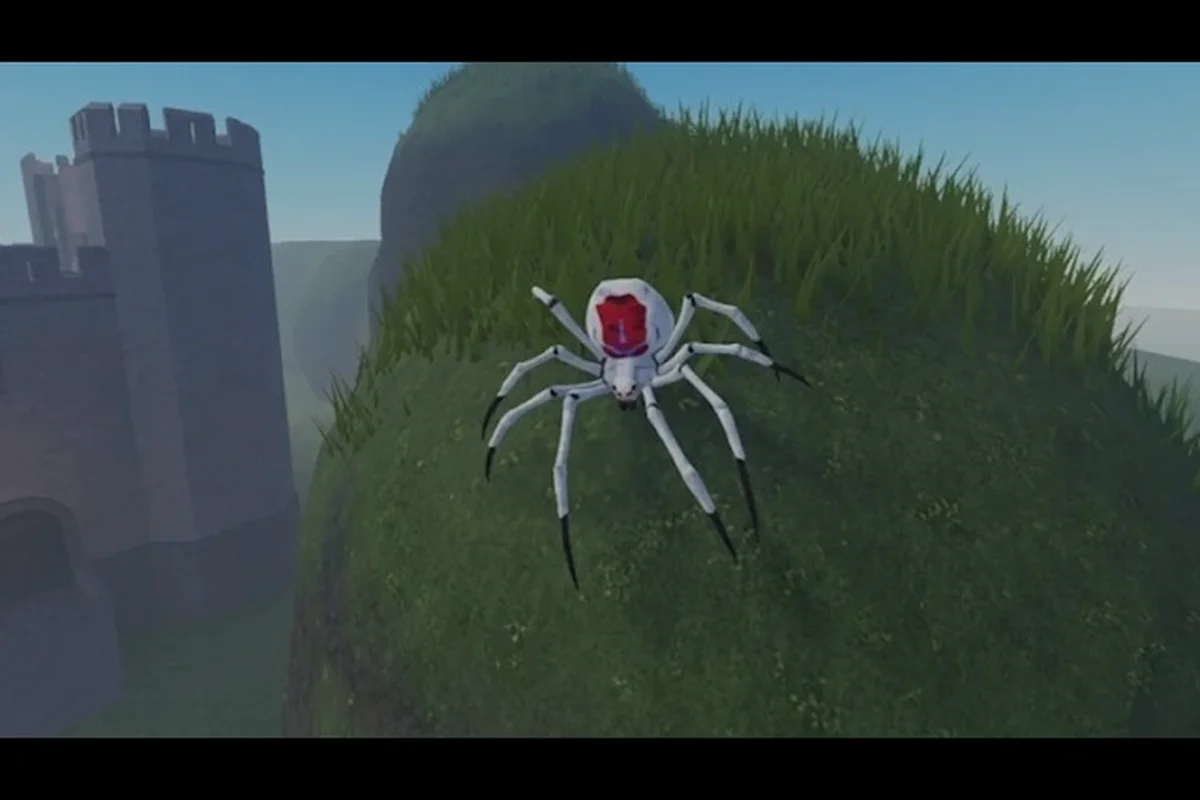
Bug Evolution’s map is compact enough for quick travel but varied enough to reward scouting, with starter fields, hills, the castle, and desert each serving a distinct purpose. Fields provide practical experience, the hills create a tougher combat route, the castle concentrates tougher encounters, and the desert is better suited to coin farming; choosing a spawn point near the resource you need can reduce unnecessary travel and make early progression more efficient.
Bug Evolution Map Size and World Layout
Bug Evolution uses a single open world rather than a series of disconnected levels. Its current world centers on grassy starter fields, a broader open-field area, hills, a stone castle, and a desert region. The official material does not publish a precise square-mile measurement, so the most accurate answer is qualitative: a base spider can cross major areas in roughly a minute or two, while food density and danger still vary enough to make route choice meaningful.
That distinction matters when comparing the experience with larger survival games. A tiny map would make travel meaningless, whereas an enormous map could turn every food run into a chore. Bug Evolution sits between those extremes, combining fast repositioning with distinct regional resources. It was still a new 2026 release at the time of this overview, and its player figures and development details continue to change.
Confirmed Regions and Their Roles
The map’s scale becomes easier to understand when each confirmed region has a clear purpose. The starter grass is not merely a safe arrival zone; it anchors the player’s early food loop and provides the shortest route back after a death.
| Region | Main purpose | Food and risk profile | Best user |
|---|---|---|---|
| Starter grass fields | Spawning, learning, early growth | Dense small food; lowest early pressure | New players |
| Open field area | Exploration and movement | Mixed availability; more exposure | Active scouts |
| Hills | Transitional hunting ground | Prey gathers near field boundaries | Mid-game hunters |
| Stone castle | Orientation and grouped fights | Mid-tier food; useful cover | Teams and veterans |
| Desert region | Exploration and future boss content | Less dependable for routine farming | Risk-tolerant players |
| Underground cave | Upcoming expansion area | Not present in the current build | Players planning ahead |
Community reports also indicate that the castle is especially valuable as a landmark because the game does not provide a full map overlay. Its silhouette can help a team orient itself when moving between the hills and open fields. The desert, meanwhile, should not be treated as the default farming zone simply because it looks distinct; player reports indicate that the grass fields remain more dependable for food.
How Big Is the Map in Practical Terms?
There is no verified official width, length, or area figure for bug evolution how big is the map in game units. Instead of inventing a number, judge the world by travel time and resource transitions. Major regions can be crossed quickly by a small spider, yet food is not distributed uniformly, and the boundaries between biomes create natural hunting corridors.
This produces a useful rule for new players: if you have been gone from the starter fields for less than a minute, you have probably not gained much distance. If you have crossed the castle, hills, and another biome, you have likely explored a substantial part of the visible world. The upcoming underground cave could eventually alter that relationship, but it should not be counted in the present map layout.
| Question | Practical answer |
|---|---|
| Is the world split into levels? | No; the current build uses one continuous open environment. |
| Is travel extremely long? | No; major regions are reachable within a minute or two for a base spider. |
| Is every area equally useful? | No; the grass fields favor growth, while the castle and desert offer different tactical value. |
| Is the cave currently available? | No; it was announced as a future map addition. |
| Is a full map overlay available? | No complete overlay has been verified, so landmarks matter. |
For food distribution, spawn density, and hunting routes, the broader Bug Evolution map guide adds useful regional detail beyond the raw size question. Its biome-by-biome breakdown explains why the grass fields support growth and farming, while the castle and desert create different tactical routes for hunting and respawn positioning. For example, choosing a nearby spawn point near a reliable food source can shorten travel time and reduce the gap between a fresh spider and a spider that has already reached another region, making regional resource availability more useful than any unverified map-diameter figure.
Bug Evolution Spawn Points and Respawn Route
The starter grass fields are the primary spawn area for newly hatched players, and they also serve as the place where players return after dying. In other words, the same location works for a fresh start and a respawn. This makes the opening field both a tutorial zone and a dependable recovery point.
For bug evolution spawn points, the practical pattern is straightforward. Your insect hatches in the grass-field starter area, where small food is densest. Eat nearby food until you reach the spider stage at level 10, then buy Bite Damage level 1 if you can afford it. This order gets a new player combat-ready without forcing an immediate fight against a larger insect.
Respawn Location and Early-Game Route
When you die, return to the grass-field starter area rather than assuming you will appear beside a boss, distant food source, or random point. Because the field links directly to the open field and nearby hill approaches, you can rebuild your size relatively quickly. The key is to eat small nearby items first instead of making a risky cross-map trip before reaching spider stage.
| Situation | Where to go | Why it works |
|---|---|---|
| First spawn | Grass-field starter area | Small food is dense and early pressure is lower |
| Death after early growth | Same grass-field starter area | Rebuilds progress without abandoning the safe biome |
| Ready to explore | Open field and hill edge | Connects to more varied hunting opportunities |
| Looking for a landmark | Stone castle | Easier orientation in a world without a full overlay |
| Checking a high-risk biome | Desert | Useful for exploration, but less reliable for routine food |
For bug evolution where do you respawn questions, the answer remains consistent with the starting area rather than a separate graveyard. That arrangement reduces downtime because players already understand where the densest starter food appears. It also creates a predictable route into the map: eat in the grass, scout toward the open field, and use the hills or castle as progressively more dangerous expansion targets.
What to Do Before Leaving the Grass
The starter area is valuable because its first two minutes simplify several competing decisions. Eat immediately, avoid attacking anything that looks capable of overpowering you, and buy Bite Damage level 1 once coins allow. You can then decide whether to push toward the Bug Tree or save more coins for the next evolution node.
A practical opening sequence is: keep the Bug Evolution map’s limited starter area as a staging zone, use the abundant small insects to reach level 10 quickly, and spend coins on Bite Damage level 1 before moving toward either the Bug Tree or the next evolution node. If the Bug Tree is too risky, farm nearby spawn points instead; delaying evolution leaves you vulnerable, while investing early gives you a stronger chance to cross the map’s open field and hill edges.
-
Eat the closest small food until you reach level 10 and the spider form.
-
Buy Bite Damage level 1 to improve your odds in an early encounter.
-
Grow in the grass until your health and damage are stable enough for travel.
-
Move toward the open field or the edge where the hills begin.
-
Return to familiar food whenever a hunt goes poorly.
Because the Bug Evolution map expands through the Bug Tree and evolution nodes, the starter grass represents only a small, safe portion of the playable area. For more detailed food-location planning, use the where Bug Evolution insects spawn guide to compare spawn density before traveling beyond the starter zone. This matters when choosing between a nearby Bug Tree route and a longer trip toward stronger insects, since map size affects travel time, food availability, and how quickly you can rebuild health after an unsuccessful hunt.
Bug Evolution Map Explained by Biome
The best way to understand bug evolution map explained is as a chain of resource zones. The grass fields support reliable early growth, the open field offers room to maneuver, the hills form a productive boundary for hunting, the castle provides a recognizable destination, and the desert introduces risk without serving as the main food source.
This chain is based on the current game build as of October 30, 2026. The underground cave was announced for a later update, so it should not be treated as an available biome when planning a route. Likewise, a Desert Sand Worm boss was tied to a scheduled November update, which means desert-related content may change, but it is not part of the verified current layout used in this guide.
Growth, Hunting, and Coin-Farming Value
Each region serves a different progression need. Grass favors fast food collection, the hills and castle approaches favor prey concentration, and the desert is better treated as an exploratory detour unless community reports confirm a change. The map is therefore not organized around a single best location; it is organized around the resource you need next.
| Location | Growth value | Coin value | Risk | Best time to visit |
|---|---|---|---|---|
| Grass fields | Excellent | Good | Low | First minutes and respawn recovery |
| Open field | Good | Moderate | Moderate | General travel and scouting |
| Hill edge | Good for hunting | Good | Moderate to high | Once spider form and basic damage are secure |
| Castle surroundings | Good | Good | High | Group hunting or prepared excursions |
| Desert | Moderate | Uncertain | High | Exploration and future-content testing |
| Cave | Unknown | Unknown | Unknown | After its announced release |
The hill edge is especially valuable because it acts as a crossing point. Prey and players move between the grass and elevated terrain, so food encounters can occur close together. Players who want to identify rare or unusually strong insects can use the regional information in where the strongest insects appear when scouting these routes.
The Role of the Stone Castle
The stone castle is more than scenery. In a map without a complete overlay, it serves as an orientation point, a meeting location, and a place where players can use the surrounding cover. Its nearby mid-tier food also makes it a reasonable destination after the earliest growth phase, although it should not replace the grass fields as a safe farming base.
Teams approaching the castle can use the structure to regroup without losing their bearing. Solo players can use it as a navigation target: identify it from the open field, then decide whether to continue toward the hills or turn back. This is one reason the current world feels larger in practice than its quick travel time suggests; landmarks make each trip more readable.
Desert Cave and Upcoming Changes
The desert is a confirmed current region, but the cave is not. It was scheduled as a future map addition for November 19, and the Desert Sand Worm boss was connected to the November 9 update. Those dates matter because they identify the cave as a planned destination rather than something available now.
Until the cave is released and players can verify its contents, treat it as an unknown space. The safe planning method is to identify the existing grass, field, hill, castle, and desert routes, then revisit the map once the addition is live. New terrain may change travel distances, food distribution, or the quickest route to bosses.
Best Place to Grow in Bug Evolution
The grass fields are generally the best place to grow during the opening stage because starter food is concentrated there and the player begins nearby. That concentration reduces travel time, makes accidental encounters less likely, and supports a quick recovery after death. The result is more food eaten per minute, which matters more early than access to a distant hunting zone.
However, “best” changes as the insect grows. A field that is ideal for a level 1 hatchling may become inefficient for a larger predator. The better location shifts from dense, safe food toward concentrated prey and survivable encounters once basic damage and health are established.
Choosing a Route by Growth Stage
| Growth stage | Recommended route | Reason |
|---|---|---|
| Hatchling | Immediate grass-field food | Fastest access to small starter food |
| Level 10 spider | Grass, then open-field edge | Secure Bite Damage level 1 before moving |
| Early mid-game | Grass and hill boundary | Combines safety with denser hunting |
| Mid-game | Hill edge and castle approaches | More prey and meaningful combat |
| Late or experimental | Desert | Exploration with higher risk |
| After cave release | Compare cave with established routes | Current cave information is not verified |
The underlying growth system includes speed, stamina, health, and food interactions, so the best farming route depends on whether you need quick small-food gains or can afford safer, slower hunting. The Bug Evolution food system breakdown explains why eating continuously may not always be optimal: each meal affects digestion, movement, and recovery, meaning a route with frequent spawn points can still be inferior to a less dense area that provides more sustainable food and combat opportunities.
Why Grass Fields Beat a Constant Hunt
Hunting consumes time and health, and both create an opportunity cost. A player can spend several minutes pursuing a target while nearby food remains uncollected. Eating in the grass fields uses fewer decisions, which makes them ideal for reaching the spider stage, purchasing basic damage, and building a stable foundation.
The grass also supports an efficient return loop. If a hill or castle encounter fails, the player can retreat toward the field instead of starting over in an unknown region. That safety makes the starter biome valuable even after a first successful hunt; it serves as the home base within a continuous open world.
| Growth goal | Best area | Avoidable mistake |
|---|---|---|
| Reach spider stage quickly | Grass fields | Chasing insects before reaching level 10 |
| Acquire basic combat power | Grass or nearby open field | Spending coins before buying Bite Damage |
| Find mid-game prey | Hill boundary | Entering the hills with weak damage |
| Minimize risk | Grass fields | Treating every visible insect as a target |
| Explore for future content | Desert | Expecting it to match the grass food density |
More advanced food choices and growth priorities are covered in the Bug Evolution food-farming guide, which is useful once the player understands where food appears. For example, spider-stage progression can be supported by collecting insects in the grass fields, while later farming decisions depend on moving toward hill boundaries or the desert for different prey and coin sources. This matters for the map-size question because the world is not a uniform resource zone: spawn points, food density, and safe return routes determine where growth is most efficient.
Best Place to Farm Coins in Bug Evolution
Coins come from gameplay rather than a fixed chest location, so the best place to farm coins depends on whether you value speed, safety, or larger prey. Grass fields are the most consistent early source because small food is plentiful, while hill edges and castle approaches become stronger mid-game coin locations because hunting opportunities increase.
Do not assume that the desert automatically offers the richest rewards. A visually distinct biome can contain less dependable food, and the current verified information does not establish the desert as the top coin route. Likewise, the cave cannot be evaluated until it actually enters the game.
Coin-Farming Routes by Player Stage
| Player stage | Preferred farming route | Coin efficiency | Main advantage |
|---|---|---|---|
| New hatchling | Grass fields | High for effort | Food is close and safe |
| New spider | Grass and open-field edge | High | Maintains speed while preparing for travel |
| Established spider | Hill boundary | Moderate to high | Concentrated prey opportunities |
| Strong player | Castle approaches | Potentially high | Mid-tier food and grouped encounters |
| Risk seeker | Desert | Variable | Exploration and possible rare opportunities |
| Late player | Compare all confirmed biomes | Depends on respawns | Efficiently targets the richest current route |
Because the Bug Evolution map contains multiple biomes, the best place to grow is rarely fixed: grass fields suit early hatchlings, hill boundaries offer concentrated prey for established spiders, and castle approaches can support stronger players. For a broader breakdown of earning methods and grinding priorities, the Bug Evolution money guide can help connect location choice with actual coin income, including how respawn points and spawn density affect the time needed to farm each route.
Safe Farming Rotation
A simple rotation reduces the risk of spending a long trip for one small payout. Start in the grass fields, collect several nearby food sources, and only move toward the hill edge after your insect can survive a likely encounter. If you return empty-handed or lose health, go back to the starter area and rebuild rather than pressing deeper into unfamiliar terrain.
The castle works best when players are prepared to accept more danger in exchange for better prey. Its cover and recognizable position also reduce navigation time, but groups of stronger insects may gather there. Approach with sufficient damage, secure the first target, and leave if the encounter becomes unfavorable. Consistent routes usually produce more coins than repeated attempts at a distant high-risk target.
Desert and Cave Coin Potential
The desert is worth testing if you enjoy exploration, but community data does not confirm it as the strongest farming location. The same caution applies to the Desert Sand Worm: its scheduled November 9 introduction may create better rewards after the update, yet treating it as a current coin source would be premature.
The announced cave has even less useful data because it is not in the open build. Do not plan a farm around expected drops, enemy density, or travel times. Once released, compare three measurable factors: food respawns per minute, average coin value, and risk of death. Those figures will produce a more reliable location ranking than the cave’s appearance alone.
Practical Route Planning and Map Strategy
A compact world rewards planning around food density, combat readiness, and retreat distance. The grass fields minimize travel, the hill edge improves prey access, the castle supplies a fixed landmark, and the desert creates controlled exploration risk. Treat the map as a set of linked choices rather than a single farming destination.
Because no verified full map overlay exists, record landmarks and route times as you play. Note how long it takes to travel from the grass to the castle and from the castle to the hills. Then identify one reliable food patch in each region. Those anchors make returning after a death faster than relying on memory alone.
Quick Decision Checklist
-
Hatching now: Eat in the grass and reach spider stage at level 10.
-
Need coins safely: Stay in the starter fields and collect nearby food.
-
Ready to hunt: Move to the boundary where the open field meets the hills.
-
Need a landmark: Head toward the stone castle.
-
Testing future boss content: Visit the desert without depending on it for routine income.
-
Planning the cave: Wait for release, verify spawns, and compare routes afterward.
-
After dying: Respawn in the grass and rebuild from nearby food.
| Route | Travel style | Main benefit | Main drawback |
|---|---|---|---|
| Grass only | Very short | Fastest growth and lowest risk | Limited mid-game hunting |
| Grass to open field | Short | Easy early expansion | Moderate exposure |
| Grass to hill edge | Medium | Strong prey concentration | More dangerous combat |
| Grass to castle | Medium | Landmark, cover, and mid-tier food | Potential group fights |
| Grass to desert | Longest confirmed option | Exploration and future content | Variable food and rewards |
| Route into cave | Not currently measurable | Potential new content | No current spawn or reward data |
This route-planning approach also explains why bug evolution map size affects play more through location quality than raw distance. You can cross the world quickly, but you still need to decide whether the next meal, fight, or retreat is worth leaving a safe patch.
Frequently Asked Questions
How big is the Bug Evolution map?
Bug Evolution does not have a verified official width, length, or area measurement. It is best described as a compact open world where a base spider can cross major regions in roughly a minute or two. Despite that short travel time, separate biomes provide different food densities, risks, and landmarks, so exploring the map still affects progression.
Where do players respawn in Bug Evolution?
Players respawn in the grass-field starter area, which is also where newly hatched insects begin. Small food is densest near this location, allowing a dead player to rebuild quickly. The best recovery routine is to eat nearby food, reach spider stage at level 10, and buy Bite Damage level 1 before attempting another distant hunt.
What is the best place to grow in Bug Evolution?
The grass fields are the best starting location because starter food is close, abundant, and relatively safe. As the insect becomes stronger, move toward the open-field edge, hill boundary, or castle approaches for better hunting. The ideal place changes as combat power and available prey change, so efficiency matters more than staying in one biome.
Where should players farm coins?
Early players should farm coins in the grass fields because nearby food reduces travel and lowers the risk of losing a payout. Mid-game players can test the hill edge and castle surroundings for denser prey, while the desert remains a higher-risk, less predictable option. The announced cave should be evaluated only after release because its food and reward data remain unverified.
Is there a cave in the current Bug Evolution map?
No cave is available in the current build as of October 30, 2026. It was announced as a future map addition for November 19. The existing world includes grass fields, an open-field area, hills, a stone castle, and a desert, so route planning should not include cave travel until the update makes it accessible.