Understanding how to progress in Bug Evolution means controlling a simple loop: eat safely, grow through levels, improve your combat stats, and evolve before pushing into dangerous areas. The right timing makes the difference between a steady climb and a run that stalls because you spent every coin too soon.
Bug Evolution How to Progress: The Opening Loop
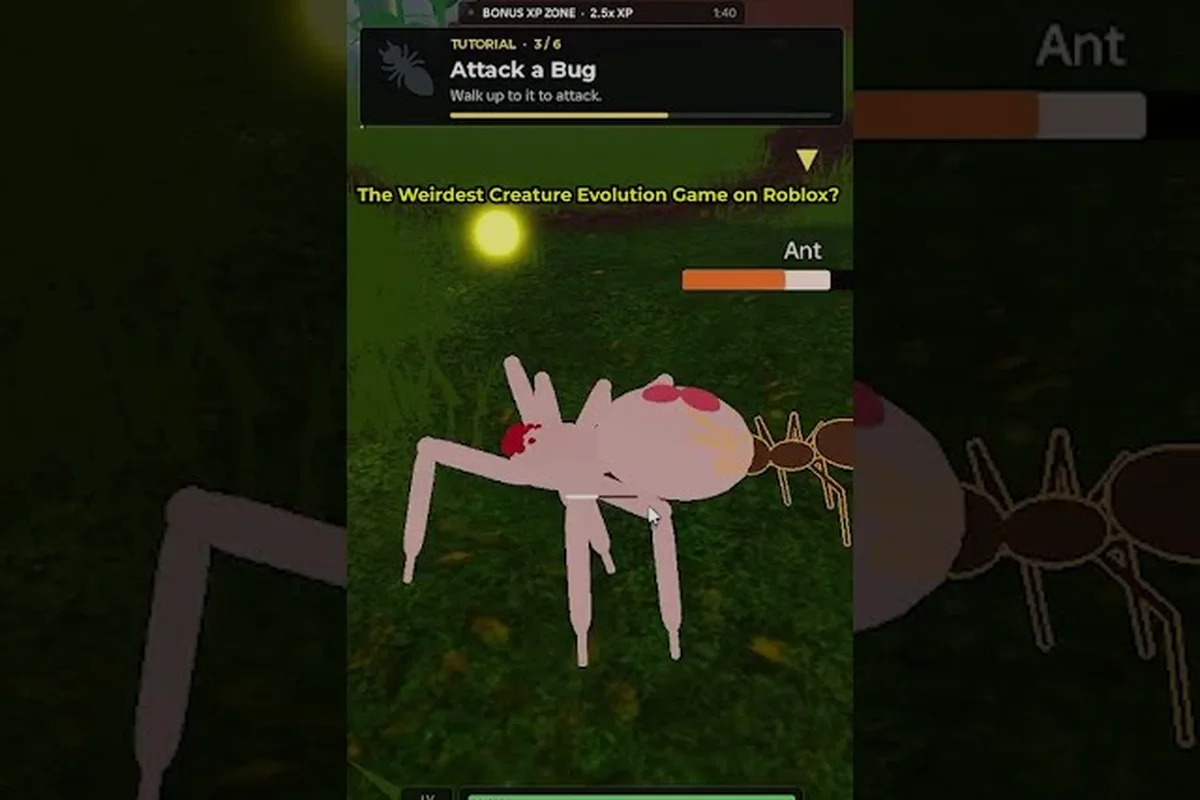
The first hour of Bug Evolution follows a repeatable structure. You hatch as a tiny spider, eat small food scattered through the grass near spawn, pass through the LV 1 fly stage, and continue toward the LV 10 spider evolution. Once you have enough coins, you can invest in Bite Damage and Bite Speed before opening the route into the wider map.
Progress depends on sequencing rather than speed alone. Chasing distant food too early can expose you to larger insects, while evolving without a coin reserve may leave you unable to improve your strongest stats. A clean opening gives you enough size and combat power to make each next area safer.
Opening progression checklist
Complete the opening route in a deliberate order, because each objective unlocks the requirements for the next: use nearby small food to gain early levels, reach the LV 1 fly stage, then continue toward LV 10 and the spider stage. Once your first real fights begin, buy Bite Damage level 1 to improve damage output. This structure also highlights the critical level thresholds for bug evolution, helping you avoid arriving at the Bug Tree with coins spent but insufficient combat upgrades.
| Order | Action | Reason |
|---|---|---|
| 1 | Hatch and eat nearby small food | Build your first levels without combat |
| 2 | Reach the LV 1 fly stage | Unlock the first insect form |
| 3 | Continue toward LV 10 | Prepare for the spider stage |
| 4 | Buy Bite Damage level 1 | Improve your first real fights |
| 5 | Choose another upgrade or evolve | Continue with a balanced build |
This sequence prevents a common problem: reaching an evolution with no combat investment. You should still collect coins during the trip to the Bug Tree, but avoid spending every coin on minor purchases before understanding how the next stage feels.
Read the HUD before moving
The HUD gives you all five core stats at once: Speed, Health, Bite Damage, Bite Speed, and Stamina. A gold bar tracks coins, while the current insect name and level appear nearby. The Bugs tab records your collected forms, and the Bug Tree button opens the evolution menu.
You do not need to memorize every number before fighting. Instead, watch which bar changes most during an encounter. If damage is too low, food will be slow to disappear. If bites are slow, enemies can retaliate while you attack. If stamina empties, you may be spending too long in a fight that could have been avoided.
| HUD signal | What it usually indicates | Best adjustment |
|---|---|---|
| Food takes several bites | Low Bite Damage | Buy damage before pursuing stronger insects |
| Attacks land too slowly | Low Bite Speed | Upgrade bite speed when fights feel prolonged |
| Stamina drains during combat | Attacks are lasting too long | Retreat or improve efficiency |
| Health falls during normal fights | Limited survivability | Prioritize safer food routes |
| Coins accumulate quickly | Good farming efficiency | Bank coins for a planned upgrade |
For a broader explanation of the controls and interface, the Roblox beginner guide can help you understand basic movement and the insect roster before optimizing your route. Practice the HUD under low-risk conditions first: note how Bite Damage affects how quickly food disappears, how Bite Speed changes the time needed to defeat an insect, and how Stamina drains during longer encounters. This makes the interface a useful tool for deciding whether to farm more coins, upgrade a weaker stat, or retreat before Health and Stamina become limiting.
Bug Evolution Early Stage Upgrade Priorities
Your first meaningful decisions come from coin spending, not from choosing a distant evolution. The most common early mistake is evolving immediately because the Bug Tree is available. Evolution increases your size and opens new possibilities, but it does not automatically solve a weak combat build.
Community guides consistently place Bite Damage and Bite Speed among the first purchases. Damage helps you defeat an opponent before it drains your resources, while bite speed shortens the number of attacks needed to finish food or another player. These upgrades are especially valuable when a server contains insects that are already close to your current level.
Compare the early upgrade options
| Upgrade | Immediate benefit | Best time to buy |
|---|---|---|
| Bite Damage | Fewer hits to defeat food and enemies | Before taking on stronger insects |
| Bite Speed | Faster attacks and less time exposed | When fights drag on or stamina drops |
| Health | More tolerance for mistakes | After establishing a reliable food route |
| Speed | Easier movement and escaping | When your current stage is mobile but fragile |
| Stamina | More sustained activity | Before long hunts or repeated fights |
The best early build depends on your server, but most players should establish a basic damage advantage before specializing. Buying one or two damage upgrades can make nearby prey manageable. Bite speed then becomes valuable when your opponents begin trading hits with you.
When to evolve
Evolve when you meet three conditions: you have reached the required level, you can handle nearby enemies, and you have enough coins left for immediate upgrades. If you satisfy only the first condition, evolving may leave you stronger in size but weaker in actual fights.
The safest plan is to bank coins while eating, inspect the next node in the Bug Tree, and determine which stat the following area demands. If the next stage contains fast insects, Bite Speed may matter more. If it contains armored or dangerous opponents, Bite Damage is the stronger foundation.
Bank before branching: Evolution unlocks the next form, but coins determine how effectively you can use it. Saving enough for immediate Bite Damage or Bite Speed upgrades prevents a common progression mistake: evolving with an empty wallet and entering a tougher area before your new form has practical combat value. For example, if the next Bug Tree node faces armored insects, keep farming until you can afford a damage upgrade that makes those fights sustainable; otherwise, a larger bug may simply lose more stamina without improving your results.
| Current situation | Better choice |
|---|---|
| Just reached LV 10 with few coins | Farm nearby before evolving |
| Have spare coins and a safe server | Evolve, then buy damage immediately |
| Repeatedly lose stamina in fights | Delay evolution and upgrade Bite Speed |
| Cannot defeat nearby competitors | Delay evolution and improve damage first |
| Teammates are covering dangerous food | Evolve sooner and support their route |
Bug Evolution Food Farming Route
Food is the foundation of progression because it supplies levels, coins, and the practical strength needed to claim more territory. A good route does not require perfect aim; it requires short travel times, low exposure to larger insects, and enough nearby food to keep the entire team eating.
Start with the grass fields around the spawn area. These locations provide smaller targets and let you learn the movement camera without being forced into immediate combat. Once you have reached the spider stage and strengthened your bite, expand toward the open field. If you want additional route context, the map-size and spawn-location overview explains how the play space fits together.
Route progression by maturity
| Stage | Preferred route | Main goal |
|---|---|---|
| Newly hatched | Spawn-area grass | Reach LV 1 and LV 10 safely |
| Fly stage | Nearby grass and low-risk food | Grow consistently toward spider form |
| Spider stage | Mixed open-field route | Earn coins while building combat stats |
| Early evolution | Wider but controlled route | Push into stronger insects |
| Late evolution | Dangerous high-value areas | Secure the strongest available food |
Keep the route circular
A straight line creates repeated danger because every meal may place you near the same predator. Moving in a loose circle allows you to check several feeding points and leave quickly when a stronger insect appears. This is especially effective in team play, when one teammate attracts attention while another circles to the next patch.
Community reports describe teams as more efficient because teammates can cover one another, share kills, and divide food routes. The key is not to travel as a tight cluster. Spread out enough to consume several areas, but remain close enough to respond when another player is pressured.
Food farming habits that compound
-
Eat smaller food while moving between larger patches, because every item contributes to growth and experience.
-
Save the riskiest food for after buying Bite Damage, since a level advantage does little if your attacks are too slow.
-
Collect coins continuously rather than attempting to engage every opponent you see.
-
Retreat when your health drops and your stamina is low, because losing a fight also removes the food and coins you collected.
-
Rotate back to safer grass when teammates create an opening elsewhere.
A farm route should produce resources without requiring perfect execution, so keep the opening spawn fields in your rotation even after your first evolution. These starting food patches act as a recovery supply when the open map becomes crowded and teammates cannot safely contest richer zones. For example, circling back to a spawn field after a failed fight can restore your food and experience while preserving the coins you already secured, instead of forcing a risky run through enemy-controlled grass.
Bug Evolution Evolution Tree Strategy
The Bug Tree is the central progression system, allowing a session to move through more than 30 insect forms according to community and store information. The tree contains familiar early forms such as houseflies and moths, followed by spiders and tarantulas, then black widows and giant prehistoric creatures. The available branches determine the pace of your run, so planning matters more than selecting a destination at random.
Choose a node that matches the route you can actually farm. A dramatic-looking evolution is less valuable when it requires crossing several dangerous areas. Your current Bug Tree branch, required level, and next stat increase should determine the next target.
Tree decisions by play style
| Play style | Preferred branch decision | Why it works |
|---|---|---|
| Solo survivor | Pick the nearest reachable node | Reduces travel risk |
| Team fighter | Select a form that supports group control | Supports nearby teammates |
| Fast farmer | Choose a branch with strong food efficiency | Preserves gathering momentum |
| Heavy brawler | Favor damage and durability gains | Improves fight reliability |
| Opportunist | Watch neighboring players before evolving | Copies a route that is working |
Sequence nodes by three checkpoints
Checkpoint one: Can I survive one level above my target? If enemies one stage above you reliably defeat you, the next node is still too far away. Improve damage, bite speed, or health until the matchup becomes fair. For example, if the stronger enemy can interrupt your attack before you land two bites, increasing bite speed may be more valuable than adding health. Test the upgraded form against that specific threat, because surviving one level above your target confirms that the next evolution is realistically reachable rather than merely visible on the Bugs tab.
Checkpoint two: Can I reach the node with food? A theoretically strong form has no value if the route requires crossing unsafe territory every time you need coins. Test the route with one cautious trip before committing: note how much food the new form collects, whether enemies can intercept it, and how long the return to your nest takes. If the extra food income comes with a longer exposure to danger, compare that risk with the upgrade’s expected benefit and choose the safer node.
Checkpoint three: Does the new form improve the run? Evaluate the upgrade against the goal you are actually pursuing, not by its raw stats. If the route still requires several missing evolution nodes, a marginal damage increase or small food bonus may not pay back its cost yet. For example, a form that survives stronger enemies but collects coins too slowly may delay progression more than a slightly weaker form with better food income. Reaching a node early has value only when the next required level is realistically close and the new form improves your ability to reach it.
The Bugs tab also shows which forms you have collected. That gives you a clearer picture of available branches, although owning a form does not mean it is the correct choice for the current server. Server competition changes constantly, and the strongest player is whoever maintains the best combination of food income, upgrades, and location.
Bug Evolution Survival and Team Tactics
The end-of-round goal is to become King of the Server, the strongest insect in a 15-player lobby. Progress is therefore not limited to personal level; it also involves deciding when to fight, when to cooperate, and when to preserve your resources. The survival theme creates mild violence, but the practical challenge is consistent resource management.
Solo play is suitable for learning because you control your own pace and can avoid large insects. Team play can multiply income, but only if teammates divide responsibilities rather than converging on the same food point. A useful formation includes one player checking ahead, one farming nearby, and one collecting coins from the edges of the area.
Solo versus team priorities
| Approach | Best advantage | Main risk |
|---|---|---|
| Solo | Complete control over food pace | No backup against strong enemies |
| Team | Faster area control and shared pressure | Competing upgrade priorities |
| Hybrid | Team support with a personal coin reserve | Communication and positioning |
| Combat situation | Recommended action |
|---|---|
| Enemy is clearly stronger | Retreat and farm elsewhere |
| Enemy has similar strength | Fight only if stamina is healthy |
| Enemy is weaker | Finish quickly and collect the reward |
| Several enemies surround you | Use a teammate to create space |
| Stamina is nearly empty | Stop attacking and disengage |
Stamina deserves special attention because Bite Speed directly affects how long a fight can last. If your attacks are slow, each engagement consumes more stamina even when the enemy is weak. This is why community reports repeatedly identify ignored bite speed as an early mistake. Faster attacks improve both damage output and survival efficiency.
Adapt when the server changes
Do not stick to one route simply because it worked during the first two minutes. If another team camps a food patch, shift to a secondary route. If players begin following your teammate, rotate the group rather than feeding into a trap. If everyone focuses on the same high-level insect, that area may become temporarily safe for a smaller player to collect coins.
The objective is not to win every encounter. A player who loses one fight but keeps collecting food may finish ahead of a stronger insect that spent its resources chasing every target. This makes Bug Evolution everything you need to know about progression less about finding an unbeatable strategy and more about controlling costs.
For broader decision-making after the early game, the survival and victory guide explains how food income, coin spending, and fight selection interact across the mid-game. For example, a player can trade an unfavorable insect matchup for uninterrupted food collection, then reinvest those resources into a stronger evolution path instead of weakening the team with repeated pursuits of a dominant opponent.
Bug Evolution Walkthrough for Each Stage
This Bug Evolution walkthrough condenses the session into a stage-by-stage routine. It focuses on repeatable goals rather than fixed locations, because player density and insect sizes can change between rounds. The reliable sequence is to grow near safety, strengthen your combat, test a wider route, and evolve when the next stage can be handled consistently.
Stage 1: Hatching to LV 1 fly
Eat the closest small food and avoid spending coins immediately. At this size, your priorities are movement, basic control, and learning where food appears. Reach the LV 1 fly stage as quickly as you can without chasing food across the map. A fly is still vulnerable, so the area near spawn remains preferable when larger insects begin moving through it.
Stage 2: Fly to LV 10 spider
Continue consuming small food, then begin mixing in moderately safer targets as your level rises. Keep collecting coins along the route. Once you reach LV 10, inspect the Bug Tree but compare its next node with your current coin balance. If you lack enough to improve damage after evolving, spend a little longer in the safe fields.
Stage 3: Spider with combat upgrades
Buy Bite Damage level 1, continue eating, and establish a circular farming route. Add Bite Speed when fights become repetitive or your stamina drops. This stage should produce both growth and a functioning combat build, not merely a higher insect name. If nearby players are stronger, focus on efficiency until your bite stats catch up.
Stage 4: First major evolution
Travel cautiously to the wider field, farm mixed food, and upgrade one or two stats before opening the next Bug Tree node. Compare the next branch with the insects other players are using. If many nearby creatures have already evolved beyond your build, delay your own evolution and gather more coins.
Stage 5: Late-game competition
At this stage, alternate between high-value food runs and controlled fights. Preserve enough stamina to escape, and avoid spending every coin immediately after a victory. Team players can create openings for one another, while solo players should leave dangerous areas before health becomes critical. Remember that the King of the Server goal rewards efficiency as much as strength.
| Stage | Primary target | Upgrade priority | Main mistake to avoid |
|---|---|---|---|
| Hatch to fly | Small food and early levels | No premature spending | Wandering beyond spawn |
| Fly to spider | Safe growth and coins | Prepare for first damage upgrade | Chasing rare food early |
| Spider stage | Circular farm route | Bite Damage, then Bite Speed | Evolving with no reserve |
| First major evolution | Wider-field income | Balance offense and survival | Following everyone blindly |
| Late game | High-value food and controlled fights | Keep flexible reserves | Burning stamina on long battles |
Bug Evolution Common Questions and Mistakes
New players usually lose progress through predictable errors: evolving before banking coins, entering dangerous regions while underpowered, and ignoring Bite Speed. For example, spending coins to evolve immediately can leave you unable to buy food after an unlucky fight, while pushing into a higher-level area without enough damage makes every recovery more expensive. Bite Speed matters because faster feeding reduces downtime and creates more opportunities to collect coins or food. Avoiding these mistakes shortens the learning curve because your resources go toward growth instead of repeated recoveries.
The collection of lessons learned from experienced players expands on subtle habits that are easy to overlook, such as spending too quickly and treating every visible insect as a required target. The key mindset is to evaluate each action by its return: food produces growth, coins produce power, and fights produce rewards only when their cost is acceptable.
Quick mistake checklist
-
Evolving too early: A new form without upgrade money can be weaker than your previous build.
-
Chasing rare food: The largest visible meal may sit beside an insect that outclasses you.
-
Ignoring bite speed: Longer fights consume more stamina and create more opportunities to be hit.
-
Standing still while eating: Move between food points so your route does not become predictable.
-
Fighting after collecting: Decide whether the reward justifies the damage before starting a battle.
| Mistake | Cost | Correction |
|---|---|---|
| Immediate evolution | No coin reserve | Bank first, evolve second |
| Rare-food chase | Health and resources lost | Use safer food until stronger |
| Low bite speed | Stamina drain | Upgrade when fights feel slow |
| Linear farming route | Predictable positioning | Rotate around several patches |
| Unnecessary combat | Missing food time | Farm unless a safe reward is available |
A reliable final checklist
Before evaluating a new evolution or entering a dangerous region, confirm that your health and stamina are reasonably full, that your next Bug Tree node is reachable, and that you can afford at least one combat upgrade afterward. Then check whether teammates are covering the same area or a different one.
If these conditions are not met, return to a safe food route and rebuild the resource balance. One short farming circuit is usually more productive than entering a contested zone with weak stats. This approach also keeps the session flexible, since you can respond to stronger players without having spent your entire coin bank.
Frequently Asked Questions
How do I progress quickly in Bug Evolution?
Progress quickly by eating nearby small food, reaching LV 10, and buying Bite Damage before chasing stronger targets. Bank enough coins to improve your build after evolving, then expand your route gradually. Fast progression comes from continuous income without wasting resources on premature fights or unnecessary upgrades.
Should I evolve as soon as a new Bug Tree node is available?
Not always. Evolve when you meet the level requirement, can survive nearby enemies, and can afford an immediate upgrade afterward. If your coins are already spent, remain on your current form and farm safely. The next form is useful only when you can make it work in combat.
Is Bite Speed important for early progression?
Yes, especially once you fight stronger insects. Faster bites reduce the number of attacks needed, which can lower stamina use and shorten every encounter. Buy damage when enemies take too many hits, then add bite speed when fights repeatedly drag on or your stamina bar empties.
Should I play solo or join a team in Bug Evolution?
Solo play gives you complete control over food routes and avoids coordinating with other players. Team play can increase income because members cover different areas, share kills, and create openings. For your first session, learn the solo loop; afterward, team up if you want broader map control and faster resource gathering.
What are the most common progression mistakes in Bug Evolution?
The most common mistakes are evolving without a coin reserve, ignoring Bite Speed, and chasing rare food in dangerous areas. Players also lose momentum by fighting every opponent or farming one predictable route. Stay near safer food early, upgrade Bite Damage, rotate your route, and reserve resources for the next evolution.