In Bug Evolution, coordinated teams outperform reckless solo players because food routes, damage support, and target selection determine who survives the server. This Bug Evolution team guide shows how to share food lanes, protect weaker teammates, and convert early insects into a coordinated force; for multiplayer sessions, players can test these tactics through Bug Evolution how to play with friends and Bug Evolution multiplayer guide resources while competing for the King of the Server title.
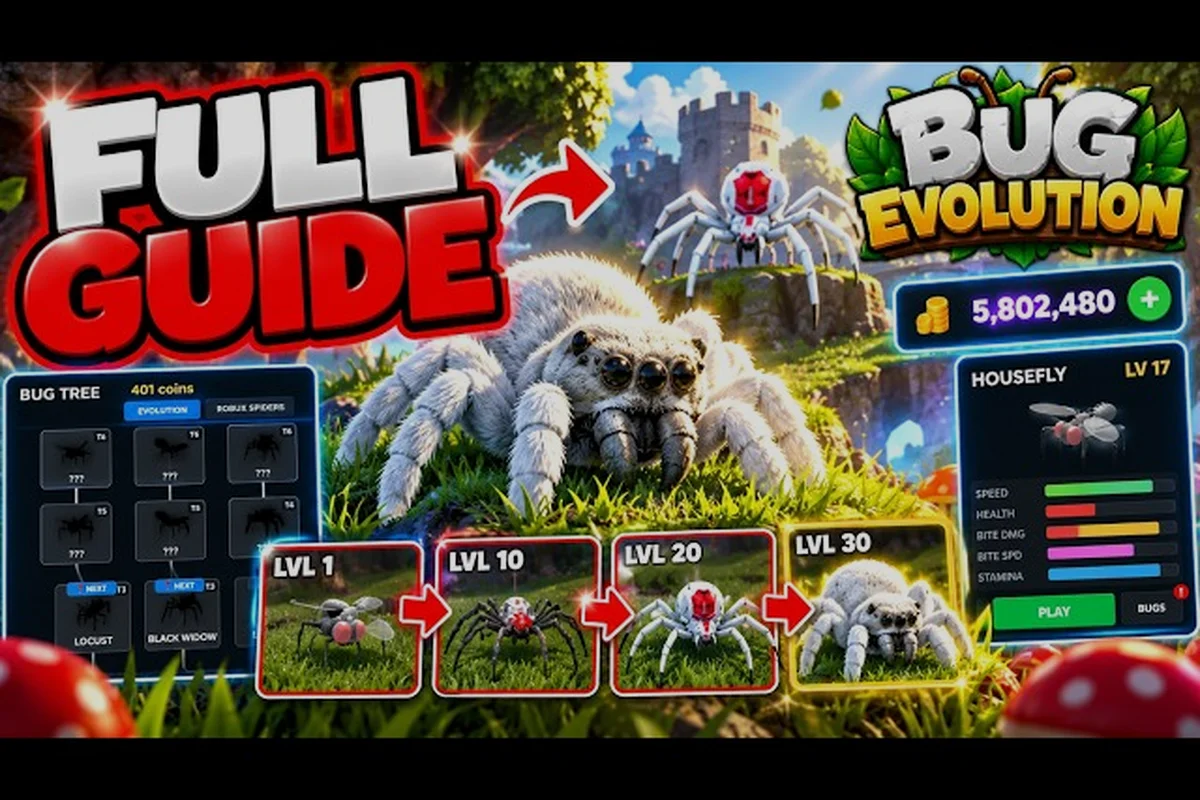
For visual confirmation of the guide’s data, mechanics, and sources, consult the bug evolution team guide video.
Bug Evolution Team Guide: Build a Reliable Four-Person Core
Bug Evolution is a 15-player survival server where insects hatch, eat, grow, evolve, and compete. A good team does more than share a server; it assigns jobs, protects weak players, and controls the best food routes at the right time. This bug evolution team guide focuses on those team habits instead of repeating the basic hatch-and-eat loop.
The strongest multiplayer strategy is to create a compact core of four teammates, even if other players are nearby. Four players can cover the dangerous directions without splitting into a group that gets picked off one member at a time. Keep early groups together, establish a meeting point, and only expand the formation once the team has reached the spider stage and purchased useful upgrades.
Assign Practical Team Roles
Roles should remain flexible because insects have different sizes and combat strengths. At the beginning, assign a scout, a collector, a escort, and a fighter. The scout checks dangerous zones, the collector gathers food, the escort protects the collector, and the fighter handles enemies that approach the group.
| Team role | Main responsibility | Best action during early growth | Common mistake |
|---|---|---|---|
| Scout | Finds safe food and threats | Moves slightly ahead and checks open fields | Leaving the group alone |
| Collector | Gathers nearby food | Stays within one screen of an ally | Running toward distant food |
| Escort | Protects vulnerable teammates | Stays between allies and danger | Chasing every attacker |
| Fighter | Handles close threats | Covers the rear during feeding | Overextending alone |
Communication should remain short and practical, but each callout must trigger a clear action. Use “Food north” to redirect the scout and collector, “danger” to pull the escort and fighter toward the threat, and “evolve now” when the group has enough food and a safe window to change form. For example, if the scout spots an enemy beside the feeding route, the collector should pause while the fighter blocks the approach instead of continuing toward the food. This keeps the team focused on survival and feeding rather than chasing every insect encountered during a busy round.
Build Around the Shared Growth Loop
The opening loop is straightforward: hatch, eat food around the grassy spawn fields, reach the spider stage at LV 10, and continue leveling through the Bug Tree. Food grants growth, while coins fund combat upgrades such as Bite Damage and Bite Speed. A team should collect both without becoming separated.
The best arrangement is a two-lane formation. Two players cover the nearer food patch while the other two rotate between the next area and the group’s rear. Everyone can eat at a different pace, so the formation should expand when food is plentiful and tighten whenever a larger insect appears.
| Growth phase | Team objective | Upgrade priority | Formation |
|---|---|---|---|
| Newly hatched | Reach LV 10 spider stage | Food first; coins second | Tight cluster |
| Early spider | Survive and build coin reserve | Bite Damage level 1 | Two-lane formation |
| Mid-game evolution | Open a wider food route | Bite Damage and Bite Speed | Small staggered group |
| Late-game contest | Challenge stronger insects | Balanced stats and stamina | Role-based coverage |
This hierarchy matters because LV 10 is the first major milestone. Players who evolve too early without coins arrive at the next tier underpowered, while players who chase coins instead of food reach that milestone too slowly. Balance both resources, but food remains the primary driver of early growth.
Bug Evolution Multiplayer Guide: Coordinate Food, Combat, and Evolutions
A multiplayer group becomes inefficient when everyone performs the same action. If all four players attack the same target, the target may escape or another player may steal the kill. If everyone eats identical food, the team can run out of growth while enemies remain nearby. Division of labor fixes both issues.
Use a Food Relay Instead of Four Solo Routes
Begin with the closest grass fields. One player marks a patch, another collects it, and the rest maintain a protective perimeter. After the first patch is depleted, rotate the collector while everyone else advances. This relay reduces wasted travel and makes it easier to respond when an enemy enters the area.
The Roblox beginner guide for Bug Evolution explains the controls and HUD, which are especially useful for new teams. On PC, movement normally uses WASD or the arrow keys, the mouse controls the camera, and clicking triggers the bite or eat action. Mobile players use a virtual joystick and camera drag, so spoken landmarks can reduce confusion between PC and mobile teammates.
Prioritize nearby food that teammates can reach and defend without breaking the protective formation; this keeps the relay moving instead of forcing the collector into a risky solo route. For example, choose a patch only when the route between the current position and that patch is clear, then signal the collector’s position and expected travel time. If the patch is farther away or likely to attract a larger insect, leave it for a later rotation, because a safe retreat is more valuable than an early feeding opportunity.
-
Eat the nearest safe food when a teammate is exposed.
-
Save rare or distant food until the formation has room to cover it.
-
Rotate collectors so no single player carries every risk.
-
Stop feeding briefly when a larger insect enters the group.
-
Resume growth immediately after the danger has been cleared.
Assign Attack Styles by Bug Type
Different insects create different combat conditions. Large forms can absorb damage and occupy space, while fast forms are better for distractions and chases. The team should agree on whether an engagement is a quick kill, a clean escape, or a full-group attack.
| Situation | Attack plan | Reason |
|---|---|---|
| Weak target | One player attacks while others collect | Prevents unnecessary group damage |
| Dangerous target | Fighter engages; others hold food | Preserves growth and escape options |
| Enemy chasing teammate | Escort turns to intercept | Stops isolated players from being eliminated |
| Server leader appears | Avoid an unplanned full fight | Better teams fight from a prepared position |
| Stamina is low | Retreat and regroup | Chasing with depleted stamina leaves the team exposed |
Community guidance generally favors stable growth over constant combat. That does not mean the team should avoid every enemy; it means the group should select fights where its stronger insects have a clear advantage. If a teammate is caught far from the group, direct support toward that player rather than allowing everyone to chase a new target.
Synchronize Bug Tree Evolution
The Bug Tree organizes evolution into tiers from T1 through T6. Higher nodes have level and growth requirements, and selecting an available node changes the current insect into its new form. Coins are spent on combat upgrades, so evolving at the right moment requires a team-wide check rather than an individual decision.
A practical rule is to evolve only after all three readiness checks pass: the target node’s level and growth requirements must be met, the team must be able to cover the evolution area for the full transition window, and nearby teammates need sufficient coins and stamina for the next fight. For example, if one player is ready for a higher-tier Bug Tree node but no teammate can hold nearby enemies, postponing evolution prevents the newly evolved insect from becoming the team’s main target and gives the rest of the squad time to prepare combat upgrades.
-
The player has enough level and growth for the desired node.
-
The team can cover the evolution area for several seconds.
-
Nearby teammates have enough coins and stamina for the next fight.
This prevents one member from evolving into a stronger form and immediately drawing every enemy toward them. When two or more teammates reach compatible nodes, evolution them in sequence rather than simultaneously. The first player becomes the shield while the second completes the transition.
Bug Evolution How to Play With Friends: Communication and Recovery
Playing with friends is easier when everyone understands the same objectives and recovery rules. The bug evolution multiplayer guide provides additional information on multiplayer systems and hunting, but coordination still depends on consistent team habits. Decide on goals before the match begins and use those goals to settle every disagreement.
Agree on Three Team Goals
Set one objective for each phase. Early goals should focus on reaching the spider stage and buying Bite Damage level 1. The middle phase can center on reaching the next compatible evolution with a coin reserve. The final goal is to challenge players strong enough to threaten the team’s position in the 15-player server.
| Match phase | Primary goal | Secondary goal | Success signal |
|---|---|---|---|
| First minutes | Reach the spider stage together | Keep all players alive | Multiple teammates reach LV 10 |
| Early game | Save for Bite Damage | Expand the safe food route | First combat upgrade purchased |
| Mid-game | Unlock the next evolution | Preserve a shared coin reserve | Team moves into a new tier |
| Late game | Contest stronger insects | Maintain stamina for escape | Group secures a high-value target |
The final server goal is to become King of the Server, meaning the strongest player in the current 15-player lobby. A coordinated group may need to help one member earn that title, but a narrow focus can cause the rest of the team to be eliminated. Choose a champion without ignoring the shared survival objective.
Call Out Useful Information, Not Constant Noise
Useful calls should help a teammate make a decision without slowing down the fight. “Stop and fight” is too vague unless it identifies why the target is worth engaging; “hunter at the east tree” is more actionable because it gives a location and a nearby danger, but it still lacks urgency. Use a short structure: location, threat, then action—for example, “East tree, big bug, regroup.” This tells teammates where the threat is, what they face, and what to do next.
-
“East field, big bug, regroup.”
-
“Food south, move as a pair.”
-
“Low stamina, retreat.”
-
“Bug Tree ready, evolution area.”
-
“Coin target reached, buy damage.”
Players should avoid constant insect identification, because names matter less than direction, size, and movement when coordinating a Bug Evolution multiplayer push. The insect form and current level are visible on the HUD, so teammates can confirm whether a target is a Worker, Soldier, or Spitter, and whether it has evolved, without interrupting combat with unnecessary name calls. For example, instead of naming every creature, say “Big bug moving north, intercept,” giving the team a threat priority and an immediate response.
Build a Simple Recovery Plan
Every team needs a rule for when a player falls behind. If someone separates, the rest of the group should not instantly spread across the map. Mark the last known location, keep eating nearby, and send one fast teammate to confirm the situation.
If the missing player is safe, the group can continue collecting before returning. If they are being attacked, the others should approach from different directions and create a pincer movement. If the missing player has already been eliminated, regrouping quickly matters more than searching for revenge.
The same rule applies to fights against much larger enemies. A team may use the combat overview for Bug Evolution to evaluate damage, stamina, and player-versus-player situations. Even with better upgrades, a losing chase can drain the group’s resources faster than the target is worth.
Bug Evolution How to Beat the Game: A Stage-by-Stage Team Plan
Beating Bug Evolution means surviving the entire growth cycle and competing for the strongest position in the server. Because the game is built around evolution, preparation matters more than winning one fight. The best teams make progress at every tier instead of relying on a single early-game advantage.
Phase One: Establish a Safe Food Base
Start near the grassy fields around the spawn area, where food is safer to collect and teammates can react quickly to movement nearby. Hatch, eat the closest small food, and remain within mutual-protection range instead of splitting up. For example, two collectors can feed at the spawn edge while a third teammate watches the approach routes. The objective is reaching LV 10 without spending coins too early or chasing food across exposed ground, since unnecessary risk can leave the team short of evolution progress.
During this phase, communication should establish boundaries. Mark dangerous directions, identify safe patches, and keep one teammate between the collectors and any approach. The team should leave the spawn region only after enough members are ready to handle open-field encounters.
Phase Two: Reach the Spider Stage
Once the core reaches the spider stage, begin spending coins. Bite Damage level 1 is the community-recommended early purchase because it improves the team’s ability to interrupt dangerous insects. Save additional coins rather than buying every upgrade immediately, especially if the team plans to evolve soon.
| Resource | Team target | Reason |
|---|---|---|
| Food | Keep all core members leveling | Growth unlocks Bug Tree options |
| Coins | Bank after Bite Damage level 1 | Supports stronger combat and later evolution |
| Stamina | Preserve for emergency movement | Prevents failed escapes and overextended chases |
| Safe space | Maintain one clear retreat lane | Gives the team room to disengage |
The early-game progression guide is useful for refining the route beyond the first spider stage. The key team principle remains simple: growth creates options, coins make those options stronger, and stamina keeps the retreat viable.
Phase Three: Evolve as a Group
At the next compatible Bug Tree tier, evaluate which teammates should evolve first. A group with one advanced insect and several weak members is vulnerable to focused attacks. Give the advanced insect time to protect the others while a second teammate completes the evolution.
Focus on functional coverage rather than identical forms. A large teammate can hold attention, a faster teammate can collect or flank, and smaller teammates can use their mobility to gather food. The exact forms available depend on the Bug Tree branch and growth requirements, so check the current node before committing.
Phase Four: Hunt and Contest the Server
By the late game, the team should have enough growth, coins, and stamina to identify worthwhile targets. The King of the Server title belongs to the strongest player in the lobby, so attacking random insects may not create the best return. Coordinate against players whose insects threaten the intended champion or occupy valuable routes.
Use three criteria when choosing a target: threat, value, and risk. Treat the contest as a coordinated team decision rather than a race to damage the King of the Server. For example, if a rival beetle repeatedly cuts off the route to a profitable insect, target it only when the team can finish the fight before stamina drops; otherwise, preserve the escape route and let the current champion finish weaker opponents.
-
Threat: The target can harm a meaningful part of the team.
-
Value: Eliminating it supports a champion’s growth or evolution.
-
Risk: The team can disengage if stamina falls.
The boss guide for Bug Evolution covers stronger enemies such as the desert sand worm. Boss encounters can provide a major growth opportunity, but they also punish teams that spread out. Bring the full core, agree on the escape direction, and keep a collector outside the main clash when conditions allow.
Advanced Bug Evolution Team Tactics for Consistent Wins
Even a strong team can lose consistency by making avoidable mistakes. The advanced improvements below focus on information control, target selection, and long-session stamina rather than complicated rules. They also help new groups learn which habits produce reliable results.
Control Information, Not Just the Battlefield
A team that spots an enemy first can choose whether to fight, while a team reacting to the same information often loses positioning before the player can redirect. Assign the scout explicit permission to call distant threats even when they are not chasing them, and make the call through a consistent signal such as direction, distance, and estimated danger. For example, if the scout marks a nearby beetle crossing toward the team’s food route, teammates can reposition, guard the route, or disengage instead of automatically starting a chase. This keeps information control connected to team objectives rather than turning every sighting into an unnecessary fight.
Useful team priorities include deciding whether to pursue, protect, or avoid an enemy based on the current team objective. If a teammate has spotted a beetle approaching a food route, the scout should communicate its direction and danger level while the rest of the team chooses between guarding the route, taking the kill when the risk is low, or disengaging to preserve health and stamina. This turns early information into a coordinated decision instead of triggering an automatic chase that can disrupt evolution.
-
Avoid the first unnecessary fight: A kill may not repay the health, stamina, and exposure.
-
Protect the growth window: New players often need food more than they need another insect.
-
Preserve the retreat: Leave an open route before the enemy closes it.
-
Track the champion’s needs: Food, coins, and evolution readiness should guide the target choice.
-
Stop after the objective is complete: Once the team earns a strong position, farming more food may be better than chasing another title.
Rotate Leaders When the Team Is Uneven
One player may understand the mechanics better, but the team should not depend on a single leader for every decision. Assign a short-term coordinator for each phase, such as the opening scout or the teammate closest to the Bug Tree. That person announces the objective while everyone else still evaluates danger.
If one teammate becomes much stronger, the group can deliberately protect that player’s growth. However, avoid turning every encounter into a personal escort mission. The surrounding teammates still need food and must survive long enough to benefit from the team’s success.
Build a Replayable Midgame Routine
A repeatable routine reduces confusion between sessions, especially once the team reaches its first Spider stage and the group’s priorities shift from simply surviving to coordinating around evolution nodes. The useful checkpoint is role clarity: one player can track the next bug tier, another can watch the safe route, and the remaining players can watch for threats before the team commits. This division keeps the multiplayer group from scattering during a crowded map, while a quick regroup after each objective prevents players from entering unsafe fights without support.
-
Collect a safe patch of food and confirm everyone is alive.
-
Rotate toward the next evolution node through a known safe route.
-
Watch for the group’s next bug tier and avoid unnecessary fights.
-
Purchase Bite Damage or Bite Speed as the available coins allow.
-
Regroup before entering a contested area.
-
Repeat until the team can challenge a high-value target.
Routine does not mean every run follows an identical route. The team should treat food, evolution checks, upgrades, and regrouping as fixed decision points rather than rigid destinations, allowing the safe path to shift when spider pressure closes off an approach. For example, if a contested lane blocks the next evolution node, the group can collect food, hold position outside direct fire, and wait for the threat to move before rotating. That keeps Bite Damage or Bite Speed priorities visible without forcing an unsafe engagement, while preserving the progression cycle that makes multiplayer sessions easier to coordinate.
Frequently Asked Questions
What is the best way to play Bug Evolution with friends?
Choose a compact group of roughly four players and divide the work. One player scouts, one collects food, one protects the collectors, and one handles threats. Stay near the spawn grass early, reach the spider stage at LV 10 together, and expand only after everyone can cover a wider food route.
Should teammates evolve at the same time in Bug Evolution?
Not necessarily. Evolve sequentially when possible, because a newly advanced insect can protect teammates who are still transitioning. Before opening the Bug Tree, confirm that the evolving player meets the node’s level and growth requirements and that the team has a clear retreat route.
How does a Bug Evolution team collect more food?
Use a relay instead of sending every player to a separate area. Two players collect while the others cover them, then rotate the collector position before moving to another patch. Keep one teammate watching the direction that contains the largest known threat, and stop feeding if a dangerous insect enters the group.
Should a Bug Evolution team fight the King of the Server?
Only when the group has a sound advantage and can protect its strongest member. A server leader may pull the team into a long chase, drain stamina, and expose the collectors. Check health, available stamina, nearby enemies, and the champion’s next evolution before committing to the fight.
What is the best upgrade priority for a Bug Evolution team?
Early groups should prioritize growth and buy Bite Damage level 1 once they reach the spider stage. Save further coins instead of spreading them across several upgrades. Later, balance Bite Damage with Bite Speed so fights resolve faster and consume less stamina during repeated team encounters.