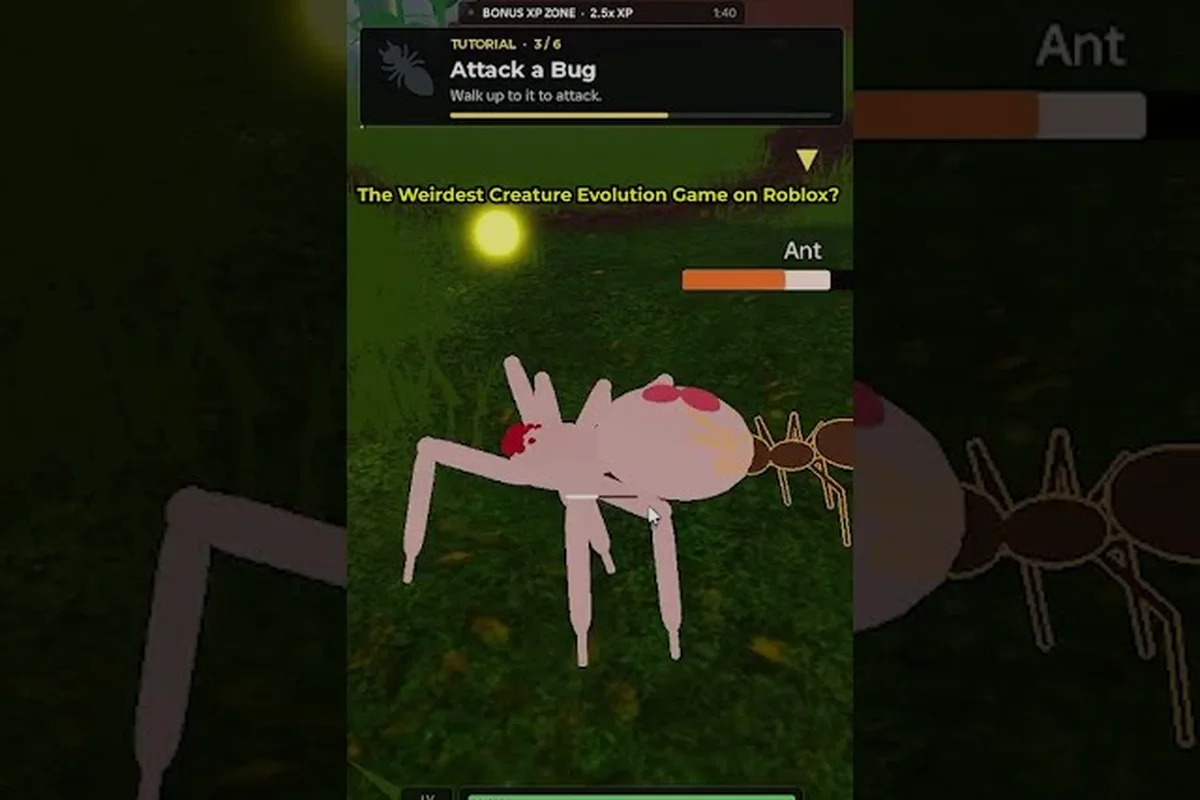
Bug Evolution’s opening choices matter because the spider form’s damage and farming speed determine whether you can survive stronger insect encounters. Start by eating near spawn, where food is safest, then use early coins to unlock Spider Form and prioritize Bite Damage before pursuing larger bugs; for example, reinvesting initial earnings into Bite Damage improves your ability to handle targets that arrive near your spawn, while saving for stronger insects can leave you underpowered.
Bug Evolution Opening Checklist
The first minutes of Bug Evolution reward a simple routine rather than an immediate rush across the map. You hatch as a tiny insect, eat food scattered through grassy areas, raise your level, climb the Bug Tree, and improve the five visible stats: Speed, Health, Bite Damage, Bite Speed, and Stamina. That foundation makes early decisions easier because every choice supports a later evolution.
Community gameplay reports describe the opening insect as the Housefly, followed by the small spider form around level 10. The Housefly is intentionally weak, so treat it as a learning stage rather than a form worth defending. Your real objective is to build enough size, coins, and combat power to survive the next tier.
Your First 60 Seconds
| Priority | Action | Why It Matters |
|---|---|---|
| 1 | Eat nearby small food | Quickly gains levels without entering a fight |
| 2 | Stay around the spawn grass | Creates a safe learning area |
| 3 | Reach level 10 | Unlocks the early spider form |
| 4 | Bank coins from food | Prepares you for upgrades and evolution |
| 5 | Buy Bite Damage level 1 | Improves your first serious fights |
| 6 | Open the Bug Tree | Compares your progress with the next forms |
The spawn-area food route is more valuable than a dramatic hunt for one large insect. A large meal may grant impressive experience, but it can also attract competitors or put you near an enemy with enough size and damage to interrupt your progress. Frequent small meals create a steadier income of levels and coins.
On PC, movement uses WASD or the arrow keys, the mouse controls the camera, and clicking or pressing a key handles eating or biting. Mobile players use a virtual joystick and drag to move the camera. The controls differ slightly, yet the priority remains unchanged: eat first, fight selectively, and upgrade before moving deeper into the map.
What the HUD Tells You
The interface gives you enough information to avoid wasting an evolution. Check your current insect name, level, coins, and five stat bars before moving. A large insect with low health is less valuable than a smaller one with balanced stats, because fights can end before a risky player recovers.
| HUD Element | Early Decision It Supports |
|---|---|
| Current level | Shows whether you are ready for the next form |
| Gold coin count | Determines whether an upgrade is affordable |
| Health | Shows how safely you can contest food |
| Bite Damage | Determines how quickly you win exchanges |
| Bite Speed | Controls how often you can attack |
| Stamina | Shows how long you can keep moving or fighting |
| Bug Tree | Displays the next evolution tier |
The most important early distinction is between food income and combat readiness. You may have enough food to level up, yet still be too weak to protect it. Before taking a central patch, compare your health and damage with nearby insects rather than assuming your level alone makes you safe.
Bug Evolution Early Game Guide
The opening stage is about converting nearby food into three resources: levels, coins, and useful insect forms. You begin as a Housefly, pass through the level 1 fly or base stage, and continue toward the level 10 spider. According to community testing, the grass fields near spawn are the cleanest place to learn this loop because small food is easier to collect and dangerous players are less likely to patrol the area.
Food, Levels, and Coins
Food serves two purposes in Bug Evolution: it raises your level and supplies the coins used for stat upgrades and progression. Because every extra bite creates income, the best early approach is to eat continuously while avoiding extended combat. This is especially valuable if another player reaches the same patch first, because one lost meal can delay an evolution by several seconds.
Try this route: treat every meal as a compounding resource rather than a momentary heal, since eating raises your Bug level and generates coins that can fund Bite Damage, Bite Speed, or Bug Tree progression. For example, if two food clusters are close together, clearing the nearer one before risking combat can secure both experience and upgrade currency, whereas an early defeat may cost several seconds of food income and leave you behind a rival’s evolution.
-
Eat the closest small food instead of crossing the field immediately.
-
Collect a second group before approaching any highlighted area.
-
Compare nearby player sizes and choose an empty direction.
-
Return toward spawn if an opponent moves into your route.
-
Spend coins as soon as they become useful rather than saving blindly.
The coin-first trap is common among new players. Saving every coin feels productive, but the Bug Tree can unlock stronger forms while leaving you vulnerable. If an affordable upgrade improves Bite Damage or Bite Speed, it usually creates more long-term food income than an extra few coins stored without a plan.
Upgrade Order for a Weak Start
Bite Damage should be the first combat purchase for most players because it shortens fights and reduces the time your opponent can retaliate. Bite Speed is the natural follow-up, especially if your attacks feel slow. Stamina matters during escapes, while Health becomes increasingly valuable once larger insects begin appearing.
| Situation | First Purchase | Why |
|---|---|---|
| Nearly always food is available | Bite Damage | Prevents long, risky exchanges |
| Your attacks feel slow | Bite Speed | Creates more chances before stamina runs out |
| Enemies chase you frequently | Stamina | Improves your ability to leave a bad route |
| You take repeated damage | Health | Survives stronger mid-tier insects |
| You already have solid combat stats | Save toward evolution | Speeds up the next Bug Tree tier |
Do not spend coins solely because a button is available. Bite Speed without enough damage can leave you repeatedly hitting an enemy that still wins the exchange, while excessive Health cannot compensate for being unable to escape. The best early build usually spreads points across damage and movement while maintaining enough stamina for emergencies.
The upgrade priority overview explains how stat purchases and Bug Tree choices affect later progression. Use it after you understand the basic hatch-eat-upgrade loop so each coin has a clear purpose. For example, if Bite Damage and Bite Speed are already enough to defeat nearby insects without losing Health, save coins for the next Bug Tree tier rather than adding another combat point; a cheaper evolution can unlock stronger upgrades sooner and reduce the number of risky fights required before your next stat increase.
Early Mistakes to Avoid
Three mistakes repeatedly stand out in community reports: evolving too early without banked coins, chasing rare food in dangerous zones, and ignoring Bite Speed until fights drag on. Each mistake compounds because lost stamina reduces your ability to gather the food needed to fix your build.
| Mistake | Immediate Cost | Better Correction |
|---|---|---|
| Evolving with no reserve | Few options to recover from a bad fight | Keep coins for the next stat purchase |
| Crossing the map for one meal | Exposure to several larger insects | Fill local spawn fields first |
| Slow, long fights | More stamina spent and more damage taken | Add Bite Speed after basic damage |
| Ignoring visible enemies | Unplanned retreat or defeat | Read the route before entering a patch |
| Changing forms repeatedly | No time to benefit from a form | Evolve when your next tier is prepared |
The housefly stage is not a failure state. Use it to learn where food regenerates, how quickly coins accumulate, and how enemy health bars move during a fight. That knowledge makes the level 10 spider transition feel controlled instead of chaotic.
Bug Evolution Full Guide to the Bug Tree
The Bug Tree is the central progression system, offering access to more than 30 insect forms across a session. It is not a passive collection menu: each climb changes your available body, strength, and strategic role. The important question is therefore not simply which form looks strongest, but whether you can feed, survive, and use its advantages long enough to earn the next upgrade.
Reading Evolution Nodes
The interface displays connected insect paths, with new forms becoming available as you progress. Before committing to an evolution, compare each branch’s size, Bite Damage, Bite Speed, Speed, Stamina, and Coin value rather than choosing solely by appearance. For example, a larger insect may deal more Bite Damage but also attract more attention, while a faster form can escape predators but leave you short of Coins for post-evolution stat upgrades. Use the Bug Tree and the available evolution statistics to identify a branch that improves your current food-gathering and combat loop instead of unlocking a form that is stronger on paper but weaker in practice.
| Evolution consideration | What to check | Practical result |
|---|---|---|
| Current health | Can you survive while earning food? | Avoids an immediate defeat after evolving |
| Bite Damage | Will fights last longer? | Supports a faster food loop |
| Bite Speed | Can you attack often enough? | Reduces stamina loss per encounter |
| Speed | Can you chase or escape? | Expands control over the map |
| Stamina | Do you have room for a retreat? | Protects risky food runs |
| Coins | Can you buy a stat after evolving? | Prevents a weak unlocked form |
The Bug Tree can contain promising late insects, but selecting one prematurely does not create its benefits. If your current insect cannot safely hold a food patch, unlocking a stronger form may only give you a larger target. Community guides generally recommend treating evolution as the result of preparation rather than a spontaneous reward.
For a broader look at the roster, compare the strongest early and late insects after you understand how your current form performs. A tier list is more useful when it confirms which insects fit your available food and combat stats.
When to Climb Immediately
Climb when you have reached the required level, possess enough coins for the next meaningful stat purchase, and understand the route to the node. Those conditions matter more than the visual appeal of the next insect. If a stronger form unlocks, move away from the Bug Tree immediately afterward and collect a small group of food before attempting a fight.
A useful sequence looks like this: prioritize a Bug Tree path that addresses your current combat weakness instead of chasing the nearest evolution. For example, if enemies frequently escape your Bite Damage, compare the cost of a Bite Damage node with one that raises Bite Speed, then favor whichever stat closes that survival gap first. This ordering matters because a larger insect with weak attack efficiency may survive longer without actually improving how quickly you defeat targets; inspect each connected node’s stat effect, required level, and coin cost before committing your next upgrade.
-
Eat until the required level is displayed.
-
Buy Bite Damage or Bite Speed if the purchase is affordable.
-
Open the Bug Tree and inspect the connected nodes.
-
Choose a form that improves your weak point rather than merely adding size.
-
Evolve, collect nearby food, and test the new form in a safe area.
-
Return to the tree only after rebuilding coins and levels.
When to Save Instead
Saving makes sense when the next node is close but your current form is already performing well. It also helps when you are waiting for a teammate or when a strong player controls the nearby food. In that situation, staying with a productive route can produce more progress than repeatedly changing forms.
The strongest rule is simple: upgrade before the next evolution, not after the crisis. If you arrive at the Bug Tree with no coins and no safe food source, the new form may not immediately help. The complete unlock progression guide is helpful for planning which nodes and stat purchases fit the next stage.
Bug Evolution Mid Game Guide
The middle of a server shifts the problem from survival to positioning. You are now large enough to contest better food, but smaller insects can still outmaneuver you, and larger players can punish a direct approach. Your route should therefore be based on current server conditions rather than a fixed circle around spawn.
Choose a Food Route
Community reports identify the open field as a natural expansion after the early spider stage. Open routes offer more food, but they also expose you to players who have already established themselves. A productive mid-game route changes frequently; the safest patch on the map can become dangerous within a minute.
| Route | Main benefit | Main risk | Best response |
|---|---|---|---|
| Spawn grass | Low-level food and safer reset | Crowded when several players level together | Return between fights, then rotate outward |
| Open field | More food and faster leveling | Larger insects patrol the center | Stay near the edge and avoid long chases |
| Unclaimed side patch | Temporary uncontested income | Unknown insects beyond the safe area | Scout before committing |
| Teammate’s route | Shared coverage and faster income | Coordination mistakes | Assign different gathering roles |
| Bug Tree area | Convenient evolution access | Strong players may camp it | Evolve quickly and leave |
The key change is that food location now depends on player density. Two insects feeding the same patch create an avoidable confrontation, especially if both need the same next upgrade. Watch movement at the edges of a field before entering, and use open sightlines so a potential opponent sees you before you reach valuable food.
Build a Balanced Combat Profile
A single upgraded stat rarely remains the best choice as the game accelerates. More Bite Damage helps finish enemies, but Speed and Stamina determine whether you can secure the food they were guarding. A balanced profile can disengage, while a narrow damage build may require every engagement to end quickly.
| Current weakness | Upgrade response | Strategic change |
|---|---|---|
| Enemies survive too many bites | Add Bite Damage | Shorten the fight and reduce incoming damage |
| Attacks arrive too slowly | Add Bite Speed | Land more bites before stamina runs low |
| Chases exhaust you | Add Stamina | Create a reliable escape reserve |
| Players hit you before you react | Add Speed or Health | Improve positioning and durability |
| You win only by outlasting enemies | Add Damage | Reduce the length of risky contests |
Do not spread coins evenly at the expense of every stat. The better approach is to cover a clear weakness while keeping one reserve purchase available. When teammates are available, they can cover one side of the map while you collect a different route. The team strategy guide explains how coordinated coverage changes food income and fights.
Size Up the Battle Before Engaging
Three numbers should influence your decision: your health, the opponent’s health, and the distance between you. If the opponent is larger but weak, a clean attack may be worthwhile. If their health is full and your stamina is low, continuing the chase is usually a poor use of time.
Before committing to a fight, check whether the opponent is worth the stamina and health cost of the chase. Compare your health, stamina, and size with the target’s health and size, then inspect the surrounding route for safe food and escape space. For example, a smaller beetle with 40% health and low stamina should avoid a stronger beetle at full health unless it can retreat to food immediately; the resources saved by disengaging can prevent a costly death later.
-
Full health and full stamina: contest a moderate opponent.
-
Low health: collect safe food instead of forcing a kill.
-
Full health but low stamina: improve damage before seeking another fight.
-
Large opponent with low health: finish the fight only if the route remains safe.
-
Several opponents nearby: leave the patch and rotate.
This cautious approach pays off because food regrows on the map, whereas health and stamina cannot be replenished between battles. For example, disengaging from a stronger beetle at 40% health, eating safely, and returning later can preserve a usable health pool for a future contest. Saving stamina also avoids wasting damage output on a pursuit that fails: the next fight should begin only when the current target is weakened enough for your health, stamina, and size to produce a realistic chance of a clean kill.
Bug Evolution Late Game Guide
The late game is defined by the King of the Server objective and a crowded power structure. A handful of large insects can control the best food routes, while lower-level players fight for scraps around them. Winning the server title may require direct competition, but a smart approach is to preserve resources until the strongest opponents reveal their route.
Control the Best Food Instead of Chasing Every Fight
Late-game players should prioritize sustainable food over a long kill count. A smaller insect with steady access to food can grow into a late threat without repeatedly challenging the current leader. Patience is useful here because each evolution increases vulnerability, and a missed fight may cost more time than a careful route.
Instead of rushing every confrontation, treat food access as your economic engine and choose a route that lets your insect reach its evolution thresholds without needing repeated wins. For example, an ant or beetle can benefit from a dependable food source even when its damage is below that of a tarantula, because uninterrupted feeding preserves the growth path and reduces the risk of an early elimination. A practical comparison is to secure two productive patches before targeting a stronger opponent, then move only when the insect’s health, stamina, and evolution progress make the exchange worthwhile. This makes late-game growth less dependent on finding a fight and more dependent on controlling access to resources.
-
Identify which patches remain consistently productive.
-
Watch how often stronger insects return to those patches.
-
Build enough damage to challenge a distracted opponent.
-
Preserve stamina for the approach and retreat.
-
Enter only when the reward justifies the risk.
The late-game roster contains formidable prehistoric and venomous forms, but their strength depends on the build supporting them. Compare tarantulas, black widows, giant insects, and other late options in the insect tier list. Treat that ranking as a selection reference rather than a promise that one form wins every encounter.
Prepare for the King of the Server
Most servers contain around 15 players, and the round ends when one insect becomes the strongest player. That makes the final objective a social as well as mechanical challenge. Strong players may hunt smaller insects, defend rich routes, or move between patches to avoid a counterattack.
A reliable late-game preparation routine starts with reading the server’s power balance before committing to a path: if several insects are already dominant, avoid routes that funnel you into their hunting range, and use quieter patches to protect your growth. For example, a player with strong combat upgrades but limited food may need a different opening route than a player who has reached level 10 through abundant feeding. This preparation matters because one early mistake can turn a promising insect into a target for every stronger player.
-
Banking enough coins for several combat upgrades.
-
Keeping enough food to reach the next level without hunting.
-
Choosing an evolution that matches your available route.
-
Watching the strongest players rather than following them blindly.
-
Entering major fights with full stamina.
-
Avoiding an exhausted confrontation near the end.
The endgame guide expands on late objectives and first-hour decision making. Use it to compare your planned route with the current state of your server rather than copying a fixed insect path for every match.
Adapt to the Server State
There is no universal best insect or route because server populations change. If one player dominates the center, edge routes can generate safer income. If most players are small and scattered, you can establish control near a productive field before building stronger. If teammates cover the center, the group can focus on a different route and combine its food income.
| Server situation | Best adjustment |
|---|---|
| One dominant insect controls the center | Collect from outer patches |
| Many weak insects are clustered | Control a separate route |
| Teammates draw attention | Gather on the opposite side |
| Your form has low damage | Save coins and avoid direct challenges |
| Your health is below half | Reset through safe food |
| Final minutes are approaching | Preserve enough stamina for a decisive fight |
The Bug Evolution full guide can help new players revisit basic controls, food collection, and the opening growth loop. Late-game skill comes from applying that loop while reading changing server pressure: if the center becomes crowded, move to an outer food patch and conserve stamina; if a teammate controls the center, farm elsewhere instead of competing for the same insects. This lets you build size and damage before choosing a decisive fight.
Practical Bug Evolution Routine
A good routine should be easy to execute while moving through the map. Instead of making dozens of independent decisions, use a repeating sequence that connects food, stats, evolution, and combat. This reduces mistakes during busy rounds when several insects may be gathering near the same patch.
Repeatable Session Plan
| Time or milestone | Focus | Concrete goal |
|---|---|---|
| First minute | Learn controls and collect small food | Reach the first evolution level |
| First few minutes | Build a safe spawn route | Reach the spider form near level 10 |
| After the spider form | Improve damage and secure coins | Enter the open field with basic combat stats |
| Middle of the session | Rotate between productive routes | Keep levels and coins rising together |
| After major evolutions | Reboot your route | Eat safely before testing a fight |
| Final phase | Preserve stamina for contenders | Contest the King of the Server position |
The three-resource check is simple to remember: levels, coins, and combat readiness. If one is low, identify the action that restores it. Eat for levels, collect more food for coins, and purchase stats for combat readiness. This prevents the common tendency to keep fighting simply because an opponent is visible.
A Simple Decision Checklist
Before every new patch, ask whether evolving now improves your position rather than simply changing your appearance. A useful early evolution should secure more food, preserve safe routes, or fund the next upgrade without leaving you exposed; in the mid game, weigh the upgrade’s practical value against current stamina, while in the late game, check whether the transformation still creates room to scale or collect enough resources for the next stage.
-
Is there enough food here to justify the exposure?
-
Can I reach it without crossing another player’s route?
-
Do I have enough stamina to fight and retreat?
-
Is my next upgrade affordable?
-
Will evolving now leave me with useful options?
Answering these questions does not eliminate risk, but it turns evolution into a repeatable, two-step decision: first confirm that the current food, stamina, and route position support the transformation, then inspect what the next upgrade unlocks. Community guides commonly advise securing food before coins and prioritizing an upgrade that expands your next evolution instead of endlessly postponing purchases; for example, choosing a food-gathering upgrade immediately after evolving can make the following transformation easier to afford, whereas buying a temporary coin boost first may leave you short on the resource needed to survive the next route.
Final Preparation Check
Before the session’s closing phase, confirm that your health, stamina, and coins are not all dangerously low. Carry enough reserves to retreat, eat safely, and make one meaningful combat upgrade. If you are close to an evolution, prioritize the food needed to level rather than a distant target that offers no immediate advantage.
A strong start in Bug Evolution comes from a simple chain: hatch, eat nearby food, reach the spider form, purchase Bite Damage, bank more coins, and evolve when your next tier is prepared. Master that sequence before taking on stronger insects, because consistent early income creates the health, stamina, and stat advantages needed for the King of the Server objective.
Frequently Asked Questions
What should I do first in Bug Evolution?
Eat the closest small food near spawn and use the grassy area to gain levels. Reach the spider form around level 10, purchase Bite Damage with your early coins, and only then expand toward the open field. This sequence matters because it builds combat strength before larger insects begin contesting the same food.
Should I evolve immediately when a new insect is available?
No, do not evolve simply because a new node is visible. Make sure you have enough coins for the next useful stat upgrade, have a safe food route, and understand what the new insect improves. A larger form with poor combat stats or no nearby food can make you easier to target.
Which upgrade should a new player buy first?
Bite Damage is the safest first combat purchase because it shortens fights and lowers the number of attacks you need to survive. Add Bite Speed if your attacks feel too slow, then improve Stamina or Health according to your problems. Keep a small coin reserve instead of spending every coin immediately.
Is solo play or teaming up better in Bug Evolution?
Solo play is easier for learning because you control your own pace and can avoid unnecessary fights. Team play can produce faster food income because teammates cover different routes and assist with kills. Once you understand the hatch, eat, upgrade, and evolve loop, teaming up becomes more effective for contesting stronger insects.
How do I reach the King of the Server?
Grow efficiently, improve your stats, and collect the next evolution only after preparing your resources. Watch the strongest insects instead of constantly chasing them, preserve stamina for decisive encounters, and attack when an opponent is weakened or distracted. The title depends on being the strongest player when the round closes.