Bug Evolution Roblox beginners need a safe plan for their first minutes, because every early decision affects growth, coins, and survival. Learn the basic loop, reach your spider form safely, and spend your first coins without wasting the opening stage.
Bug Evolution Roblox Beginner Guide: What the Opening Minutes Require
This Bug Evolution Roblox beginner guide focuses on the game’s first practical loop: hatch, eat nearby food, grow stronger, and unlock insect forms through the Bug Tree. That foundation matters because speed alone can leave a new player underleveled, while careful progression creates a character that can survive the open field.
The official Bug Evolution game page on Roblox identifies the game as a survival and evolution simulation by | Corgi Crew |. A session uses a 15-player lobby and ends with a contest for the strongest player, known as King of the Server. As of October 30, 2026, the page listed roughly 20,800 concurrent players, so expect plenty of competition even while you are learning the controls.
| Opening objective | What to do | Why it matters |
|---|---|---|
| Hatch successfully | Start with the smallest insect form | Gives you access to the standard food-gathering loop |
| Reach level 10 | Eat steadily near the spawn-area grass | Reduces the chance of meeting a much stronger insect |
| Reach spider form | Continue feeding and inspect the Bug Tree | Improves your size and opens a more active playstyle |
| Buy Bite Damage level 1 | Spend your first earned coins | Creates a safer margin in an early contest |
| Choose a growth route | Push the Bug Tree or bank toward the next unlock | Prevents both stalled progress and wasted coins |
The Core New-Player Loop
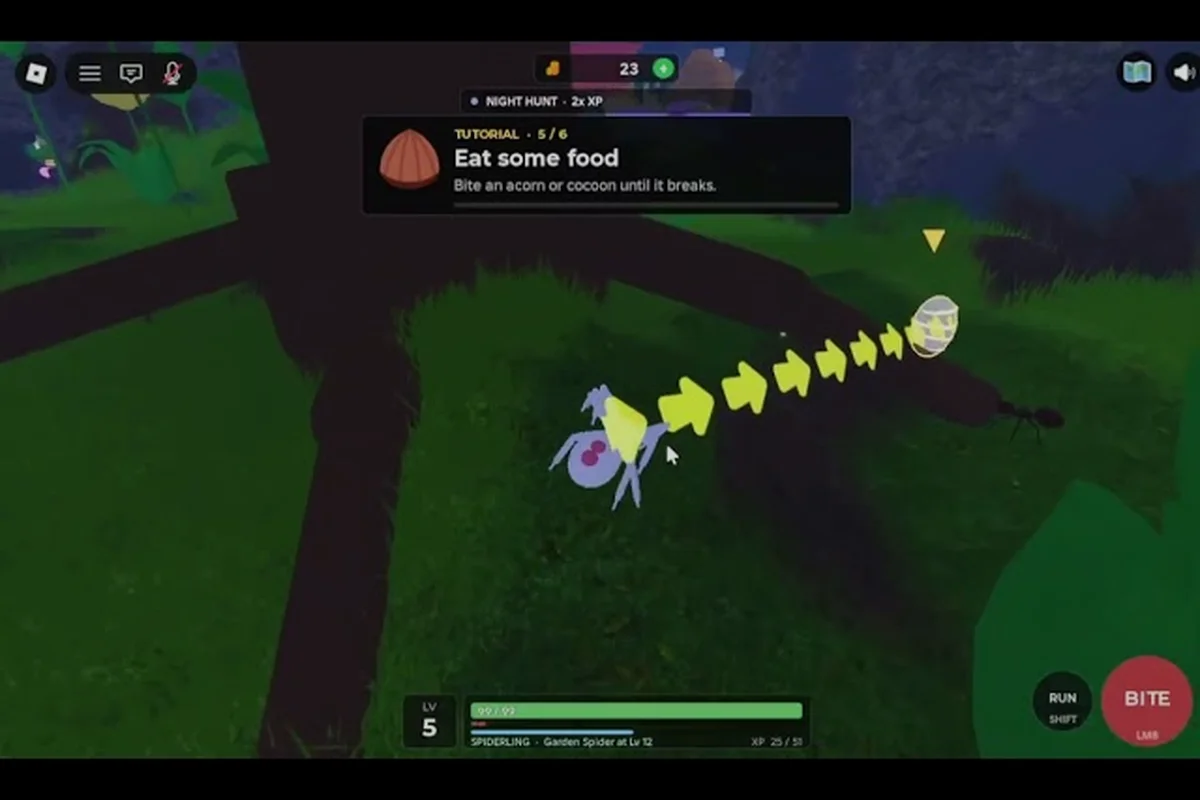
Every useful session begins with the same five-part rhythm: hatch, eat, grow, evolve, and defend. The Housefly is the opening form shown in the game’s example progression. It is intentionally weak, so your first goal is not to hunt players; it is to collect enough food to reach the level 10 spider stage without taking an unnecessary fight.
Eat food scattered through the grassy area near your starting point. Small food is safer because you can collect it quickly and move on before larger insects notice you. Once your level rises, check the current insect name, level, coins, and stat bars before moving toward a more valuable food source.
The HUD provides five core attributes to watch as you move from the Housefly toward the level 10 spider stage: Speed, Health, Bite Damage, Bite Speed, and Stamina. These values determine whether you can escape a larger insect, sustain pressure during a fight, or collect food without being interrupted. For example, a Housefly should prioritize food gathering and stamina management first, since its early-stage stats are unlikely to make it competitive in direct combat. Read the HUD before accepting a fight, then compare the insect’s level and current bars against the food value and risk of the area.
-
Speed determines how quickly you can reposition.
-
Health shows how much punishment you can absorb.
-
Bite Damage determines how much harm your attacks cause.
-
Bite Speed affects how quickly you can attack.
-
Stamina supports movement and combat actions.
A strong start is not built by buying every upgrade immediately. In Bug Evolution, each coin should address a clear weakness in your current insect rather than create an unbalanced build. For example, a Housefly that loses fights because it cannot escape may need Speed or Stamina, while a player who reliably reaches level 10 but struggles against stronger bugs can improve Health, Bite Damage, or Bite Speed. Keep a balanced food income first, because reaching the spider stage requires steady progress rather than one risky trip into a dangerous area. Before spending, compare your current HUD bars with your next intended fight: if one stat is already strong and another is nearly empty, buy only the upgrade that fixes the immediate problem.
Bug Evolution How to Play: Controls, Movement, and Food
Bug Evolution how to play basics are simple, but positioning matters more than button speed. On PC, move with WASD or the arrow keys, steer the camera with the mouse, and use a mouse click or key press for the primary bite-and-eat action. The game follows Roblox’s default controls and does not currently offer a separate keymap screen.
On mobile, use the virtual joystick to move and drag the camera to look around. These controls are workable, but mobile players should use smaller movements near dangerous food. A sudden camera turn or joystick input can make a spider overshoot a target and collide with a stronger insect.
| Action | PC control | Mobile control | Beginner use |
|---|---|---|---|
| Move | WASD or arrow keys | Virtual joystick | Collect nearby food in short routes |
| Look around | Mouse | Camera drag | Check behind bushes before eating |
| Bite or eat | Mouse click or key press | Game action button | Collect food and challenge weak insects |
| Use the Bug Tree | Select the on-screen Bug Tree control | Tap the matching control | Review available evolution paths |
| Review your insects | Open the Bugs tab | Open the Bugs tab | Check forms already discovered |
Safe Food Collection
Start with the grass near the spawn area and build a repeating route. Circle clusters rather than running directly toward the brightest food marker, because the largest pieces are likely to sit in more competitive locations. Eat smaller pieces first, then move deeper only after reaching the spider stage.
Community guides consistently emphasize the same opening pattern: feed near the grass fields, read the HUD, and use the Bug Tree once enough levels have been reached. This approach also makes it easier to learn how much food each level requires, because your level counter updates as you collect meals rather than through a separate quest interface.
Do not confuse food value with food safety. A rare or valuable meal can still be a poor choice when several larger players are circling it. Your priority order should be nearby food first, a clean escape route second, and only then an attempt at a better meal.
When to Leave the Spawn Area
Leave once you are strong enough to handle short encounters, not merely because the next food source looks brighter. At level 10, spider form is the first major milestone because it changes your movement and makes the open field less intimidating. Before departing, confirm that you understand your health, stamina, and bite damage.
A useful departure rule is to leave with at least half of your current stamina and a clear path back toward safer grass. If you encounter a larger insect, use terrain and distance rather than immediately trading bites. This is especially important in a busy lobby, where another player can interrupt a fight that seemed fair in isolation.
Bug Evolution Roblox Tutorial for Your First Evolution
The first Bug Tree decision is where many players either spend too soon or delay too long. A Bug Evolution Roblox tutorial should therefore teach the order of operations rather than promise one perfect path for every server. Your available insects, coins, and nearby competition can change the right moment to commit to an upgrade.
Begin by opening the Bugs tab to see which forms you have discovered. The Bug Tree button opens the evolution interface, where you can inspect insect paths and requirements. The game features more than 30 insect forms, ranging from houseflies and moths to tarantulas, black widows, and giant prehistoric creatures.
| Decision point | Recommended action | Reason |
|---|---|---|
| First evolution reached | Check the next node’s coin cost | Confirm that you can pay without becoming defenseless |
| Enough coins but weak combat | Buy Bite Damage level 1 first | Reduces punishment time during short fights |
| Strong food route available | Feed before evolving | Prevents a costly mistake while low on health |
| Bug Tree offers several branches | Choose by play style | One path may favor speed while another supports combat |
| Nearby player is larger | Delay a visible evolution | Animation and positioning can create an opening for rivals |
Choosing a Branch
Evolution branches should match the route you intend to use. If you prefer to roam, collect food, and avoid prolonged fights, prioritize mobility and efficient food income. If you plan to contest stronger insects, focus on damage and attack speed rather than buying only one expensive upgrade.
For deeper information about the available forms and progression paths, use the Bug Evolution evolution guide. It can help you compare insects beyond the Housefly and spider stages while keeping this opening guide focused on fundamentals.
Coins Before or After Evolution?
There is no universal answer because server conditions vary. A player with safe access to food can evolve immediately after meeting the level requirement, while a player under pressure may need to keep eating. The important rule is to avoid arriving at the Bug Tree with zero coins and no way to improve your combat.
A balanced first cycle should use the Bug Tree as a temporary checkpoint rather than a destination: arrive as a spider with enough coins for the next combat upgrade, but do not spend every coin immediately. For example, keeping a reserve for Bite Damage level 1 gives you a usable attack before the next evolution, while extra food collected during the route can restore health or stamina if a stronger insect intercepts you. The key is to judge safety from the Bug Tree route, nearby player pressure, and your current health, not from the level requirement alone.
-
Reach level 10 and become a spider.
-
Eat until your health and stamina recover.
-
Buy Bite Damage level 1 when you have enough coins.
-
Continue collecting food until the next evolution is affordable.
-
Evolve when the route is clear and you have a retreat available.
This order prevents the common early mistake of evolving with no banked resources. It also prevents the opposite mistake of hoarding every coin until a much stronger player has already targeted you. For example, if Bite Damage level 1 costs 1,000 coins and your next evolution requires 5,000, keep the upgrade affordable while retaining a coin buffer; otherwise, a player who hunts low-level insects near the Bug Tree can force you to lose food, recover health, and restart the route before you afford your next form.
Bug Evolution Roblox Guide to Stats, Coins, and Early Fights
Stats matter most when your food route crosses a contested zone. The Bug Evolution Roblox guide should therefore teach new players to interpret the HUD, not merely collect coins. A large coin total can be useless if a short bite drains your stamina and leaves you unable to retreat.
Read All Five Bars
Speed helps you avoid attacks and reach food first. Health determines how many mistakes you can survive. Bite Damage reduces the number of bites needed to defeat an opponent. Bite Speed controls attack frequency, while Stamina governs your ability to keep moving and fighting.
The most common early mistake reported by players is ignoring Bite Speed. A fight that should end quickly can stretch into a stamina drain, especially when both insects have similar health but one attacks faster. Before challenging another player, compare the visible form and watch how quickly their attacks land.
| Situation | Better stat to improve | Practical reason |
|---|---|---|
| Enemies reach you first | Speed | More distance creates time to eat or recover |
| Bites take too long | Bite Damage | Fewer attacks reduce incoming damage |
| Fights drag on | Bite Speed | Faster attacks consume less time and stamina |
| You lose every trade | Health | More health provides a larger safety margin |
| Stamina empties while escaping | Stamina management | Retreat remains possible when movement is efficient |
When to Fight and When to Flee
Fight when the target is smaller, your health is strong, and you have an exit behind you. Flee when the target has better reach, the area is crowded, or your stamina is low. A fight does not need to end with a kill to be successful; escaping with collected food and full progress can be the better decision.
Watch for other players while eating because the sound and visual cues of an attack may be easy to miss during a feeding sequence. Turn the camera frequently, especially around tall grass or uneven terrain. Solo players can learn the pace safely, but the Bug Evolution survival guide contains more detailed tactics for preserving health and pursuing the King of the Server objective.
Managing the Coin Economy
Coins come from your session activity and should be spent on improvements that support your current route. The first purchase is usually Bite Damage level 1 because it immediately helps in a contest, but you should not empty your coin bar before considering the next evolution node.
Think of coins in three groups rather than one lump sum, because Bug Evolution rewards players who balance immediate contest power with long-term progression. For example, if you earn 1,000 coins from eating and have already purchased Bite Damage level 1, setting aside enough for the next Bug Tree node prevents you from spending every coin on a minor stat increase. Treat the remaining balance as a working budget: use part of it to strengthen the ability that affects your current route, while keeping the next evolution within reach so you can upgrade immediately when the required coins are available.
-
Combat reserve: Enough to improve your most urgent stat.
-
Evolution fund: Money reserved for the next Bug Tree node.
-
Flex reserve: A small surplus for an unexpected need.
This simple budget prevents impulsive spending and keeps your next Bug Tree node within reach. For example, if a Bug Tree node costs 1,000 coins, wait until that amount is reserved before upgrading another minor stat; then use only the flex reserve on Bite Damage or another current-route improvement. The result is steady progress: you continue earning from eating and contests instead of pausing near the Bug Tree with nothing left to spend.
Bug Evolution New Player Guide for the First Five Minutes
A clean first five minutes can take you from a Housefly to a capable spider without fighting a single player. That is not a rule; it is a learning route. Use it when you want to understand movement, food values, leveling, and the Bug Tree before entering a competitive server mindset.
| Time | Target | Checkpoint |
|---|---|---|
| 0:00–0:30 | Hatch and identify nearby food | Learn movement and camera control |
| 0:30–1:30 | Reach level 10 | Keep food collection near spawn grass |
| 1:30–2:30 | Reach spider form | Confirm health and stamina are healthy |
| 2:30–3:30 | Earn and spend coins | Buy Bite Damage level 1 |
| 3:30–5:00 | Prepare the next evolution | Bank coins and locate a safe Bug Tree route |
A Low-Risk Practice Route
Begin by eating the nearest small food. Do not turn for every item, because constant direction changes waste movement and expose you to insects you would otherwise avoid. Create a short loop around the spawn grass and clear the useful food on each pass.
After reaching spider form, test your bite against one weak insect only if the target interrupts your route. The goal is to learn the bite timing, not to chase a kill. If the fight becomes awkward, move away; the small amount of food gained is not worth losing half your health.
Once you have bought Bite Damage level 1, open the Bug Tree and plan the next form. Check its level requirement, coin price, and likely combat style. Then return to food collection until both the evolution and your stat reserve are funded.
When to Start Taking Risks
Move into the open field after meeting three conditions: your health is mostly restored, your stamina has room for a mistake, and you know where the nearest safe food is. If you meet a stronger player, avoid an extended chase. If you spot food that nobody is contesting, take it quickly and return to your route.
Teaming up becomes attractive after you understand the solo loop because teammates can cover each other while eating and share the pressure of fights. The Bug Evolution team guide explains how coordinated play changes food routes and makes the King of the Server goal more approachable.
Common Beginner Mistakes to Avoid
Most lost progress comes from rushing a mechanic rather than ignoring the game entirely. Three mistakes appear repeatedly: evolving with no coins, traveling to rare food in dangerous zones, and neglecting Bite Speed during combat. Each mistake has a simple correction that protects your early session.
| Mistake | Why it hurts | Correction |
|---|---|---|
| Evolving with an empty coin bar | You cannot improve stats after changing forms | Keep an evolution fund |
| Chasing rare food immediately | Strong insects notice high-value targets | Build a food route first |
| Ignoring Bite Speed | Fights last longer and drain stamina | Improve attack speed before repeated fights |
| Standing still while eating | Nearby players can attack easily | Rotate the camera and keep moving |
| Spending every coin at once | One mistake can leave you defenseless | Divide coins into reserve groups |
| Playing only for kills | Victory may cost your food and health | Preserve progress before every fight |
Fixing a Bad Opening
If you evolve without coins, return to the nearest reliable food source instead of challenging a stronger player. Your form may be better, but missing combat upgrades can make the next encounter unnecessarily costly. If a fight drains your stamina, collect safer food and rebuild your reserve.
If you are lost, use the Bug Tree as a reference point. Its menu shows what you are working toward, while the Bugs tab records discovered forms. Moving toward a visible menu can also keep you oriented in the open field. As a last resort, retrace your route toward the spawn grass rather than wandering into an unknown zone.
The Fastest Route to a Strong Start
The best beginner progression is steady growth, one useful upgrade, and controlled risk. Eat close to spawn, reach level 10, become a spider, purchase Bite Damage level 1, and fund the next evolution before pushing farther. Once you understand that rhythm, you can focus on powerful insects and the server-wide crown objective.
Frequently Asked Questions
What should a new player do first in Bug Evolution Roblox?
Begin with nearby food in the spawn-area grass, learn the movement and bite controls, and avoid larger insects while leveling. The practical goal is level 10 and the spider form, followed by buying Bite Damage level 1 when your coins allow it.
Is it better to evolve or save coins as a beginner?
Do both in a balanced order: reach the evolution requirement, keep enough coins for Bite Damage, and reserve what remains for the next Bug Tree node. For example, if level 10 unlocks the spider form, evolve first when the requirement is met, then purchase Bite Damage level 1 if your coin balance supports it. Saving every coin for the next node may leave you underpowered, while evolving with no reserve can expose you after changing forms.
How do beginners collect food without getting attacked?
Use a short, repeatable route around the spawn grass and collect small food first. Rotate your camera between bites, avoid crowded patches, and leave a clear escape route. Move into the open field only after your health and stamina recover.
Should new players hunt other insects immediately?
No. Fighting is secondary to reaching a useful form and learning the map. Test a weak target when it interrupts your food route, but avoid stronger insects until you have enough combat stats and stamina to handle a longer exchange.
Is solo play suitable for learning Bug Evolution?
Yes. Solo play gives you full control over pacing and makes it easier to focus on food, leveling, and the HUD. Team play becomes more efficient later because teammates can protect each other and cover food routes, but learning the basic loop first is still valuable.