
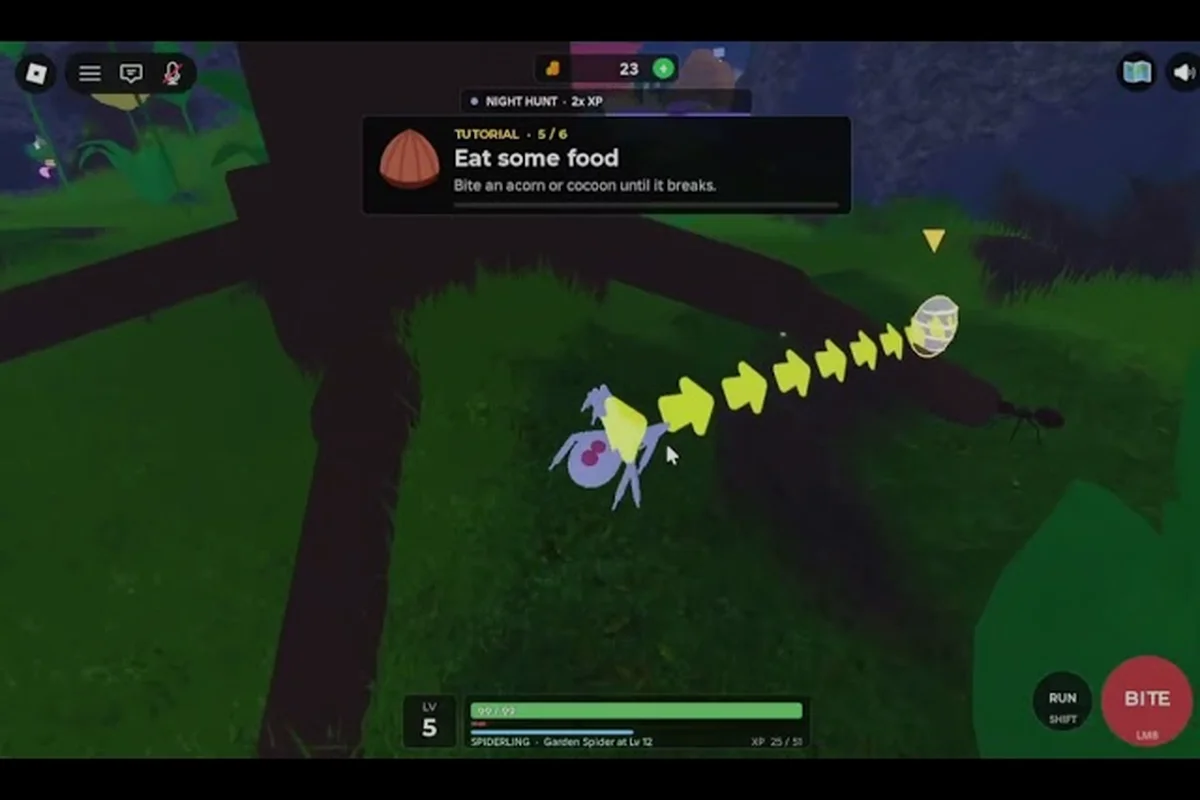
Bug Evolution money guide routines are important because coins are the main resource for combat upgrades, and every wasted fight or death reduces your active farming time. This guide explains how to build a steady coin income, choose safer routes, and turn repeated runs into faster progression.
Bug Evolution Coin Farming Fundamentals
Coins in Bug Evolution come from consuming food, while levels and growth also depend on eating and surviving. That makes money farming closely connected to the early-game progression loop: find food, eat efficiently, avoid unnecessary fights, and spend the resulting coins on upgrades that make the next run safer. Understanding this connection is the foundation of any reliable bug evolution coin farming plan.
The game’s HUD displays five combat and movement attributes: Speed, Health, Bite Damage, Bite Speed, and Stamina. It also shows a gold coin bar, the current insect and level, a Bugs collection tab, and the Bug Tree interface. Because coins are the only player-controlled currency shown there, they should be treated as the central upgrade resource rather than as optional spending.
How the Income Loop Works
Food is the main source of both growth and money. Every item you eat can move you toward a level threshold, unlock Bug Tree options, or contribute to the coins needed for shop purchases. The most efficient route therefore does more than collect currency: it collects food without losing a large amount of time to stamina management, combat, or recovery.
A simple formula for judging a route is to compare its coin income per minute with its hidden survival cost. If a food cluster yields 120 coins but forces frequent stamina recovery or two deaths, its practical value may be lower than a safer route yielding 90 coins. Track food gathered, coins secured, levels gained, and downtime across a timed run; this makes it easier to identify profitable Bug Tree farming routes and avoid farming methods that look strong only before accounting for recovery time. That calculation reduces to a single useful rule: useful run value equals food collected plus levels gained plus coins secured, minus time lost to danger.
That does not mean every risky area is bad. A compact food cluster may produce more coins per minute than a wide field, while a dangerous cluster may be inferior once deaths are counted. The best methods change as your insect becomes stronger, so a useful grinding guide must distinguish between the opening minutes, the middle game, and late-session targets.
Early, Middle, and Late Priorities
| Game Stage | Main Priority | Best Coin Approach | Main Risk |
|---|---|---|---|
| Opening minutes | Reach the spider stage and survive | Eat nearby food in short loops | Running into a stronger insect |
| Early levels | Build basic combat strength | Alternate food routes with upgrade purchases | Spending every coin at once |
| Middle game | Increase collection speed | Patrol several reliable food pockets | Returning to an empty spawn |
| Late game | Chase deeper Bug Tree goals | Farm while protecting upgrade progress | Fighting for small coin gains |
| Endgame | Out-class the lobby | Use high-stat builds and safe feeding | Overconfidence near valuable clusters |
At the start, your first goal should not be a large cash balance. It should be reliable early coins: eat the closest small food, reach the spider stage around level 10, and buy the first Bite Damage upgrade when possible. That prevents a common early-game mistake—trying to advance the Bug Tree without enough combat power to protect the run.
Safe Opening Checklist
-
Eat immediately rather than spending the opening minutes inspecting distant food.
-
Favor open grass and clear sightlines when your insect is still weak.
-
Break fights off before stamina falls to a dangerous level.
-
Save enough coins for Bite Damage and Bite Speed before purchasing a cosmetic preference.
-
Return to known food pockets only after checking that they have respawned.
This opening routine keeps income stable by minimizing the two largest losses: death and travel without reward. It also builds the character for stronger encounters, so each minute of farming becomes more productive. For example, after securing a safe food pocket, spending the first minutes eating and improving Bite Damage and Bite Speed can increase coin value from later kills, while a failed fight may cost both the insect and the walk back to the farming zone. The key is to strengthen the insect before risking a profitable route, then return only to pockets that have respawned and are still safe to harvest.
Bug Evolution Money Fast Routes
The fastest way to make money is not a single location or trick; it is a repeatable route that combines dense food, short travel, and controlled risk. Community testing points to constant eating near reliable food spawns, especially when players avoid stronger insects. This approach is safer than fighting first and eating later because food is what supports both the coin balance and your level.
Player reports also suggest that teamwork can increase efficiency: one player clears a food pocket while another protects the group. That does not make every group session profitable, because competition for the same food can erase the benefit. Treat co-op as a coordination tool rather than a guaranteed multiplier.
Route Options Compared
| Route | Coin Potential | Travel Time | Death Risk | Best Use |
|---|---|---|---|---|
| Dense open-field pocket | High | Low | Low to medium | Main early and mid-game loop |
| Wide grassy patrol | Medium | Medium | Low | Building a safe coin bank |
| Shared food cluster | High | Low | Medium | Coordinated groups |
| Strong-insect territory | Very high | Medium | High | Builds with reliable escape options |
| Empty-spawn return | Low | High | Medium | Only after a respawn check |
| Bug Tree progress trip | Indirect | Variable | Variable | When an unlock requires a level |
The open-field pocket is usually the strongest default because it combines quick collection with enough room to notice danger. The wide grassy patrol produces fewer coins per minute in ideal conditions, but it is useful when your health or stamina is still fragile. Strong-insect territory becomes attractive only after faster kills and better health reduce the cost of mistakes.
A Reliable Patrol Loop
A reliable patrol loop turns coin farming into a repeatable route rather than a series of random searches. For example, after banking coins for an insect speed or coin-gain upgrade, return to the same connected food pockets and repeat the circuit; each upgrade can shorten travel time and increase the value of the next trip. The key is to route between nearby food sources, collect coins before pockets become depleted, and reinvest the earnings instead of accumulating currency that provides no benefit. This approach supports efficient bug evolution money farming while reducing wasted movement and unnecessary long-distance resets.
-
Collect: Eat from the nearest pocket without crossing the map unnecessarily.
-
Reset: Step back toward open ground after several bites so stronger insects lose track.
-
Check: Look for a second pocket before spending time on a long journey.
-
Bank: Return to the shop and buy the most useful upgrade instead of letting coins sit unused.
This cycle prevents the common error of farming one spot until it empties and then wandering randomly. By connecting each food pocket to the next, you keep moving through productive areas while preserving a controlled retreat lane. The food farming guide expands on choosing food sources and increasing growth efficiency.
Which Route Should You Use?
Use the dense pocket when your insect has enough damage to discourage competitors. Use the broad patrol when the primary objective is saving coins without risking an early evolution reset. Use stronger territory only if your Bite Damage, Bite Speed, Health, and Stamina can support a fast escape or victory.
The route should also match your spending goal. Farming for the next evolution node requires a larger balance and benefits from concentrated pockets. Farming for a minor stat boost requires less income, so a safer patrol is appropriate. This distinction prevents excess risk when you only need one more upgrade.
Bug Evolution Best Coin Farming Methods
The best coin farming methods combine high food density with predictable travel and an upgrade plan. Since food creates coins, growth level, and progress toward deeper Bug Tree nodes, successful farming accelerates several objectives at once. The priority is to protect that combined progress rather than chase coins in locations that offer little food.
Upgrade Priority
Bite Damage and Bite Speed are generally the first recommended purchases. They shorten fights and reduce the number of bites required, which can preserve stamina and reduce exposure. Health comes next because it helps you survive ambushes. Speed and Stamina are more valuable later, when you can move between pockets or disengage from combat without losing too much time.
| Upgrade | Early Value | Farming Benefit | Suggested Timing |
|---|---|---|---|
| Bite Damage | Very high | Ends conflicts before stamina drops | Buy the first level as soon as possible |
| Bite Speed | High | Reduces time spent exposed | Add after basic damage |
| Health | High | Protects against ambushes | Add before visiting crowded zones |
| Speed | Medium | Improves travel between pockets | Add after core defenses improve |
| Stamina | Medium to high | Supports longer collection routes | Add when routes become more ambitious |
Do not spend the entire balance on one upgrade row at once. A balanced set often produces more coins over time because it reduces the chance that a fight ends your run. If one upgrade is clearly preventing progress, concentrate temporarily, but return to the core stats afterward.
Buy, Then Re-Test
After each purchase, return to the route that caused the problem. If Bite Damage was too low, test whether a dense pocket now feels safer. If stamina caused repeated retreats, test a shorter route or consider Stamina. This feedback loop makes the bug evolution grinding guide more useful because each purchase is tied to a measurable obstacle.
Coins that remain in the balance do not improve your earning rate. Spending on the right stat creates more earning time, while saving indefinitely usually postpones important progress. The best balance is enough reserve for the next essential upgrade, followed by a deliberate purchase as soon as it becomes affordable.
Avoid Income Leaks
Common income leaks include wandering after a pocket is depleted, fighting opponents when food is available, ignoring stamina, and spending coins on low-impact upgrades before core stats. Each action may look productive while reducing the number of coins actually banked.
Track three numbers during each food-circuit session: coins banked per minute, total coins earned, and the coin cost of every death or escape. Compare a cautious route that preserves health and stamina with a shorter route that forces more combat or retreat. For example, if one circuit earns 80 coins in 90 seconds but loses 25 to combat, while another earns 60 without losses, the second route has the higher net profit; in coin-farming terms, avoiding income leaks matters more than the raw kill value.
-
Coins gained during each food circuit.
-
Time spent moving without eating.
-
Losses caused by depleted pockets, combat, or retreat.
If two food circuits earn very different amounts, calculate net value by subtracting combat losses and retreat costs from gross coins, then compare that profit against the route’s time and risk exposure. For instance, a route producing 120 coins but losing 40 in damage may still outperform one producing 90 coins without losses, especially when the aggressive circuit also consumes more stamina and forces an escape. The safer route is preferable when its coins-per-minute result remains strong; a higher raw kill value is not worth it if depleted pockets or repeated retreats erase the earnings.
Bug Evolution How to Farm Coins Without Wasting Respawn Time
Respawn time is the hidden tax on every failed attempt. A risky player may earn plenty of coins, but if most of that income disappears during a death, the apparent farm becomes a net loss. Efficient farming recognizes that avoiding one failure may be worth several ordinary collection routes.
Read the Danger Signs
A strong insect nearby, a narrow escape route, or an already depleted food pocket should trigger a change of plan. Do not force a fight simply because the opponent is visible. If your stamina is already low, the safest profit is usually the food you can secure without starting an extended battle.
Keep your route near open areas and avoid cornering yourself behind trees, rocks, or other obstacles that limit visibility. When a fight begins, decide quickly whether the expected coin gain justifies the risk. Bite Damage and Bite Speed make this decision easier because they improve your control over fight duration.
Build a Two-Tier Plan
Create one primary farm and one recovery farm: use the dense food pocket for maximum routine income while your combat stats are healthy, then rotate to a broad grassy route after taking damage or winning a costly fight. This two-tier setup prevents a single mistake from ending the coin session and gives you a safer fallback when nearby players contest the primary farm.
| Plan | Location Type | Goal | When to Use |
|---|---|---|---|
| Primary | Dense, open food pocket | Maximum routine income | When combat stats are healthy |
| Recovery | Broad grassy route | Secure coins with low exposure | After damage or a costly fight |
| Emergency | Any nearby food | Restart earning after defeat | When waiting would waste the session |
The recovery route matters because it lets you keep earning without making a bad situation worse. It also helps when a team occupies the nearest pocket. Switching to a secondary route is often more productive than waiting for a respawn or entering a fight you cannot finish.
Session Targets
Set targets by the next required purchase rather than by an arbitrary number of coins. If Bite Damage level 2 costs a specific amount, farm until that amount is reached, make the purchase, and test the result. This keeps each circuit connected to a decision and makes weak spending less likely.
The leveling guide is useful for seeing how food consumption also pushes you toward level milestones. Since the same action can support both systems, separating coins and levels into competing routes can waste time. Use one food-rich route when both goals point in the same direction, then switch only when the next level unlocks a new food area or evolution requirement.
Bug Evolution Grinding Guide for Sustainable Income
A sustainable grind has a clear stopping point, a repeatable route, and an upgrade threshold. Without those controls, players tend to wander, make random purchases, and spend more time organizing the HUD than collecting food. The following routine treats money farming as a cycle with measured decisions.
First Five Minutes
Eat the closest food, establish movement, and identify two open-field pockets. Avoid chasing a distant target before you know whether you can return safely. Reach the spider stage around level 10 if possible, then purchase Bite Damage level 1 with the accumulated coins.
The first upgrade matters more than a large early balance because Bite Damage compounds across every collection route: each stronger hit improves your ability to secure food and reach the next coin milestone without spending the margin on recovery. For example, if you are saving toward the next basic purchase, a small surplus from safer feeding can be reinvested into damage rather than spread across several low-impact upgrades. When coins are tight, prioritize survival and consistent collections until the next Bite Damage level is affordable, then return to farming coins with the stronger bite.
Middle of the Session
Rotate among two or three food pockets, checking each before committing to a long trip. Reset toward open ground after each cluster and avoid starting a fight with low stamina. Return to the shop after each meaningful threshold instead of collecting a huge balance that you may spend poorly.
During this phase, compare coins per minute with the route’s safety. A slower but dependable route can outperform a high-value pocket if the latter repeatedly causes retreats or defeats. Use the currency overview to keep coin spending and progression goals in one place.
End of the Session
Spend the remaining balance on the upgrade that has limited your route most recently. Do not automatically buy the cheapest option. If stamina limits travel, buy Stamina; if battles last too long, improve damage; if ambushes cause losses, improve Health.
Keep a session log with three figures: total coins earned, the most productive coin-farming route, and the strongest remaining obstacle. For example, record “18,000 coins; beetle route; stamina bottleneck” so the next run can start with the proven farming path, avoid the route that only consumed time, and target the upgrade that caused the largest delay. Tracking these fields also reveals whether a poor result came from weak damage, insufficient Health, or repeated retreat-and-reset cycles, making the next session faster than repeating discovery work.
When to Change Routes
Change routes when food no longer respawns at the expected rate, your stats have shifted the risk profile, or your next goal requires a different Bug Tree level. Do not wait for a completely empty session to adjust. A proactive route change often produces more coins than another circuit through depleted pockets.
| Signal | Current Problem | Best Adjustment |
|---|---|---|
| Food is always gone | Cluster overfarmed | Rotate to a second pocket |
| Frequent retreats | Stamina or damage is too low | Buy a core stat or shorten fights |
| Travel takes too long | Route is too spread out | Use a closer recovery loop |
| Level progress is strong but coins lag | Focusing on growth instead of value | Spend more time in dense pockets |
| Coins are high but upgrades are weak | Saving without a plan | Set a purchase threshold |
Advanced Coin Routing and Team Efficiency
Advanced farming is about selecting routes that match the current server state. The strongest insect can change, food spawns can move, and other players may claim a pocket. A route that worked moments ago may not be worth repeating if it has become crowded.
Observe Before You Commit
Spend the first few seconds of a circuit checking nearby insects and the condition of the food source. If the pocket is sparse, leave immediately. If a powerful opponent is circling it, avoid a fight that could consume the route’s expected profit. This observation period is not wasted time when it prevents a costly engagement.
Use the Bug Tree only when its next unlock justifies the travel or level requirement. Pushing evolution without a coin cushion can leave you underpowered at the next food area. Balance progress against security instead of treating the tree as the only destination.
Team Roles
In a coordinated group, assign one player to collect and another to watch the surrounding area. A bodyguard can alert the collector when a dangerous insect approaches, allowing the group to leave before a full fight begins. If a rare food cluster becomes available, the group can temporarily prioritize that cluster before returning to the normal circuit.
The relevant community walkthrough, NoobBlox’s Bug Evolution guide on YouTube, demonstrates the eating-to-coins loop, the five-stat HUD, and the connection between coins and upgrades. Treat its route suggestions as community experience, especially because the game is a new 2026 release and systems may change.
A Decision Checklist for Every Route
-
Does this pocket contain enough food to justify the travel?
-
Can I reach it without passing through stronger insects?
-
Do my current stats let me leave quickly?
-
Is the expected coin gain greater than the value of the next safe pocket?
-
Which purchase will this balance unlock?
-
If I lose here, will I lose more than one short farming circuit?
If two answers are unfavorable, switch routes. If all are favorable, complete the circuit and spend the earnings on the planned upgrade. This process turns bug evolution how to grind advice into a repeatable decision rather than a loose list of tips.
Why “How to Grind” Is About Control
The phrase describing how to grind coins often suggests repetition, but repetition alone is not efficiency. A route becomes productive when your movement is predictable, your combat exposure is controlled, and each upgrade improves the next loop. That is why Bite Damage, Bite Speed, and Health form the foundation of a useful bug evolution money fast routine.
When progression and economy are considered together, the result is stronger. Food can level your insect while funding the upgrades that protect future runs. The evolution path guide can then show where your collected levels lead, while the money loop ensures you arrive with the combat strength needed to continue.
Frequently Asked Questions
What is the fastest way to earn coins in Bug Evolution?
The fastest reliable method is to eat continuously near dense, open food spawns while avoiding stronger insects. Food produces both coins and growth, so every successful bite advances two systems. Buy Bite Damage and Bite Speed early to shorten fights, then rotate between two or three respawning pockets so travel and empty clusters waste less time.
Should I fight other insects while farming money?
Fight only when the likely coin gain justifies the risk and your stamina remains healthy. Coins collected before a defeat may vanish with the run, so a safe food circuit can produce more total currency than a risky battle. Early in the game, prioritize eating and retreat from stronger insects; aggressive combat becomes more useful after damage and health improve.
Which upgrades should I buy with my first Bug Evolution coins?
Bite Damage is the strongest first purchase because it shortens encounters, with Bite Speed as a close second. Add Health afterward if ambushes are causing losses. Avoid spreading coins across every row immediately, and avoid saving indefinitely; the right upgrade improves the efficiency of every later farming circuit.
Is co-op better for coin farming?
Co-op can be efficient when players divide collection and guarding roles instead of competing for the same food. One player can clear a pocket while another watches for danger, reducing time lost to surprise attacks. If teammates fight over resources or attract stronger insects nearby, however, a solo safe route may produce a better net result.
How many coins should I save before making a purchase?
Save until you can buy an upgrade that solves your current bottleneck, then purchase it promptly. Keep only enough reserve to prevent another weak encounter while traveling. Because unused coins do not improve your earning rate, spend the balance on the stat that limits your route rather than accumulating an oversized bank.