Bug Evolution strongest insect choices depend on whether you value staying alive, chasing prey, or landing fast attacks. This comparison uses the game’s five visible stats and confirmed Bug Tree route to identify the strongest practical options for new players.
Bug Evolution Strongest Insect: What the Stats Actually Show
Bug Evolution insect stats appear on a shared panel, with five bars labeled Speed, Health, Bite Damage, Bite Speed, and Stamina. The game does not publish a complete numerical table for every insect, so any precise ranking remains community-inferred until the developers release official values. The confirmed HUD still gives you a useful way to compare candidates in your own server.
The first insect is the Housefly, which appears in the opening evolution bar at level 1. It is the natural baseline, not a serious contender for the Bug Evolution strongest insect title. Players generally regard it as the weakest practical form because it starts with low durability and modest combat power. Its main purpose is to get the run underway.
| Stat | What it measures | Strategic value | Common limitation |
|---|---|---|---|
| Speed | Movement speed | Controls chasing and escaping | Fast does not mean powerful |
| Health | Damage endurance | Supports direct encounters | High health can waste upgrade value |
| Bite Damage | Damage per hit | Improves combat efficiency | Weak bites make food collection slower |
| Bite Speed | Attack frequency | Increases attacks per encounter | Often more useful with solid damage |
| Stamina | Activity endurance | Supports sustained movement and attacks | A secondary stat without much public detail |
Because the insects share the same five-stat framework, Bug Evolution insect health is only one part of strength. A durable insect that cannot catch food may perform worse than a faster creature with balanced defenses. Conversely, a high-damage build can be effective even with modest endurance if the player controls engagement timing.
Housefly Baseline and Verified Roster
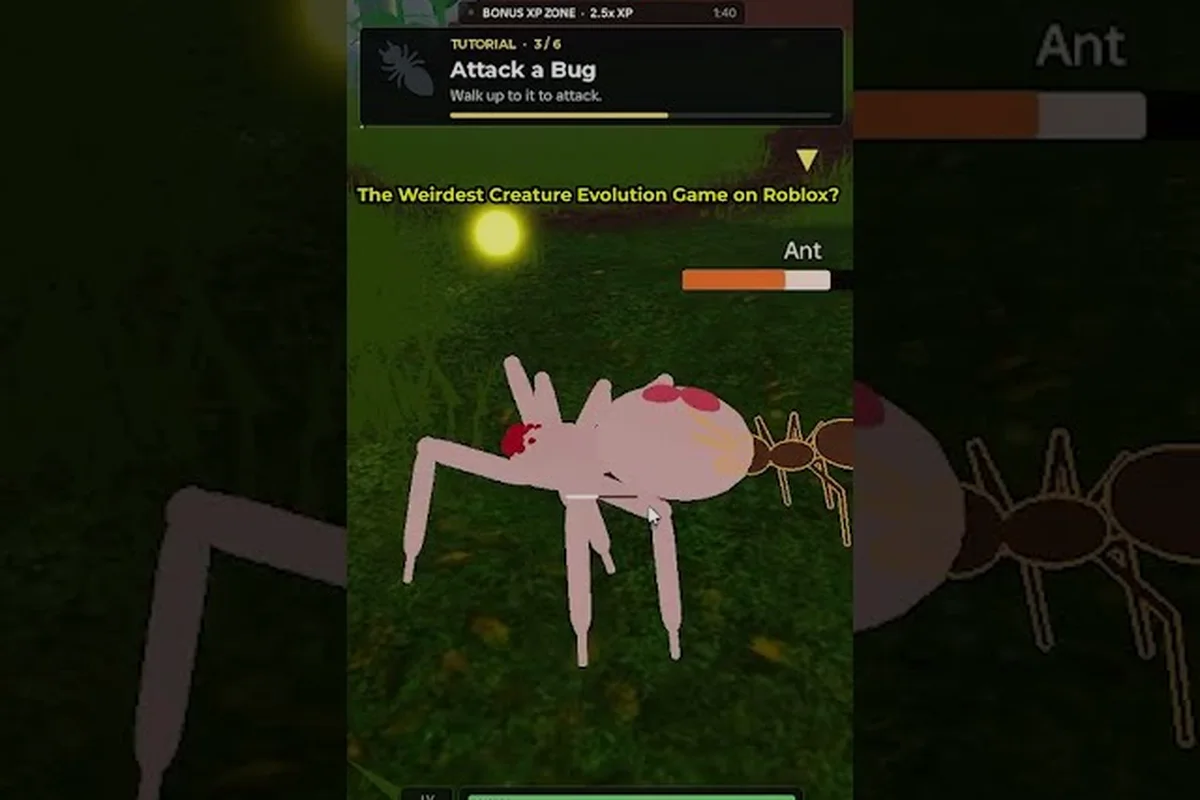
Confirmed forms include the Housefly, several fly variants, Spider, red-and-white Spider, Moth, Grasshopper, Tarantula, Black Widow, and Locust. The game advertises more than 30 forms, with deeper tiers represented in the Bug Tree. Exact roster numbers and complete statistics remain subject to updates, so treat the list as a practical snapshot rather than a permanent encyclopedia.
| Evolution point | Confirmed form | Build interpretation |
|---|---|---|
| Level 1 | Housefly | Baseline starter |
| Level 10 | Spider | Early spider route |
| Level 20 | Red-and-white Spider | Midgame spider route |
| Level 30 | White-fluffy spider | Deeper spider route shown in the interface |
| T3 branch | Black Widow or Locust | High-damage spider branch versus mobility branch |
| Deep spider path | Tarantula | Large spider candidate associated with later tree tiers |
| Prehistoric path | Locked forms | Potential late-game destination |
This information makes Bug Evolution first insect questions straightforward: new players begin as the Housefly and then follow the Bug Tree toward a Spider. It also shows why raw tier depth should not be treated as an automatic ranking. A later form can be weaker in a specific stat if that stat does not fit the build you wanted.
Strength Without a Fake Tier List
There are no official Common, Rare, or Legendary labels in Bug Evolution. Strength lists are inferred by players from the Bug Tree position, observable bars, and combat performance. As a result, the fairest evaluation combines Bug Evolution insect speed, offense, health, and the constraints of each evolution branch rather than inventing tier grades the game never provides.
The Housefly baseline is therefore useful for measuring progress. Once you obtain a Spider, compare its five bars against the starter you remember. Later, check whether Black Widow, Locust, or Tarantula actually improves the role you care about. A stronger insect should feel stronger across a practical situation, not merely occupy a more advanced tree row.
Bug Evolution Best Starter Insect: Housefly, Spider, or Grasshopper
The Housefly is the confirmed first form, but the best starter choice depends on how soon you want to leave the opening branch. Players usually begin with it because progression requires food, levels, and Bug Tree positions. The better strategic question is which creature to prepare for once the early movement is complete.
Spider is the clearest general recommendation because it appears at level 10 and preserves access to the largest branch in the confirmed progression. Black Widow and Tarantula sit deeper along that route. Choosing Spider therefore creates a coherent path toward stronger spider forms instead of committing to an isolated side branch.
Grasshopper is another plausible opening target because it appears on the way to Locust, the confirmed T3 alternative to Black Widow. That route emphasizes movement and hopper-style play. If you prefer gathering food across the open grassy map and repositioning quickly, the Grasshopper branch may produce a more satisfying early build than forcing a spider route.
| Candidate | Best reason to choose it | Main risk | Ideal player priority |
|---|---|---|---|
| Housefly | It is the confirmed starting form | Very early and mechanically limited | Learning food gathering and controls |
| Spider | Direct route to Black Widow and Tarantula | You may inherit a slower build | Balanced progression |
| Grasshopper | Leads toward Locust | Less access to deep spider forms | Mobility and rapid repositioning |
| Moth | Early flying form shown in gameplay | Exact stats are not publicly confirmed | Exploring the non-spider route |
For most players, Spider is the Bug Evolution best starter insect once the Housefly tutorial has served its purpose. It offers the clearest long-term structure and supports later high-damage options. Grasshopper becomes the stronger alternative when movement matters more than access to Tarantula.
A First-Hour Action Plan
A good first run should separate the need to progress from the desire to jump directly toward an advanced insect. Eat available food, reach the required level, and unlock the next Bug Tree node before evaluating whether the next form is actually stronger. The interface example places Spider at level 10, so spending that interval improving your position is productive rather than wasted.
First, collect nearby food and avoid unnecessary fights while your body is small. Second, compare the five-stat panel before and after each evolution. Third, choose the branch that improves your weakest important attribute. Fourth, save coins and upgrades for the build you actually want, because the food and growth mechanics reward consistent feeding rather than rushing into danger.
The broader growth loop is covered in the Bug Evolution food and growth system guide. It explains how eating and leveling contribute to progression, which is essential when comparing a starter with a form unlocked several tiers later.
Should You Avoid the Housefly?
No. The Housefly is necessary for beginning the run, and treating it as a bad choice creates the wrong goal. Its value is temporary: it teaches food collection, movement, attacks, and navigation while you gain the levels needed for the Bug Tree. The practical mistake is remaining attached to the opening form after its progression purpose has ended.
At the next meaningful unlock, inspect the bars rather than relying on appearance alone. Compare Bug Evolution insect health with your previous form, then compare speed and bite damage. If one option is dramatically faster but loses too much durability, balance it with upgrades instead of assuming it is automatically weaker.
Bug Evolution Insect Health, Speed, and Damage Compared
Without official values for every form, the strongest candidates should be compared by role. Black Widow is commonly treated as a high-damage option in community discussion, Locust represents a movement-oriented branch, and Tarantula is associated with a later spider position. These descriptions are useful clues, but the visible bars remain the final evidence.
| Candidate | Health profile | Speed profile | Damage profile | Community interpretation |
|---|---|---|---|---|
| Housefly | Low baseline | Low baseline | Low baseline | Weakest practical starter |
| Spider | Not officially published | Not officially published | Not officially published | Early general-purpose route |
| Black Widow | Expected to trade some durability for offense | Not confirmed | Commonly viewed as strong | High-damage branch candidate |
| Locust | Not confirmed | Movement-oriented branch | Not confirmed | Mobility-focused branch |
| Tarantula | Large form associated with a deep tree position | Exact movement unknown | Exact bite unknown | Strong late-spider candidate |
This table intentionally separates confirmed structure from community judgment. The tree positions and five HUD categories are verifiable, while claims about exact strength are not. If another player offers a precise ranking without naming a source or showing the bars, treat it as an opinion rather than a measured fact.
Bite Damage Versus Bite Speed
Bite damage determines how much punishment an attack lands, while bite speed influences how quickly attacks can occur. A fast attacker with weak damage may struggle against tougher creatures, but it can remain useful against low-health targets and food. A heavy attacker may need better positioning because recovery windows create opportunities for the target to escape.
For practical Bug Evolution insect bite damage choices, favor the candidate with a visibly stronger bar when your goal is faster progression through fights. Do not ignore bite speed, however, because a balanced combination can produce more damage across a full encounter. The best setup is the one that lands enough attacks before your stamina or target escapes.
The bite damage and upgrade guide provides a closer look at how combat values fit into upgrades and progression. Use that breakdown when deciding whether to buy a small stat increase or save for a larger improvement in your preferred build.
Health and Speed Create Different Builds
A health-heavy insect can absorb mistakes while learning later areas, which is valuable in a survival-and-evolution game. Speed-heavy insects can reach food and reposition before an encounter, but they still need enough damage to prevent a failed chase from becoming a damaging retreat. Bug Evolution insect speed is therefore a tool for controlling the match rather than a substitute for combat power.
Locust makes sense for players who value that control. Black Widow makes sense for players who can accept closer engagements and want offense to lead the build. Tarantula suits a late spider route in which reaching the form takes longer but aligns with the reward of staying in that branch.
| Stat priority | Practical benefit | Suitable candidate | Upgrade logic |
|---|---|---|---|
| Maximum health | Better survival margin | Durable spider form | Pair with enough speed to chase |
| Maximum speed | Better food access and escapes | Locust branch | Add damage so pursuits convert |
| Maximum bite damage | Faster combat progress | Black Widow branch | Improve stamina or speed for safety |
| Balanced stats | Flexible performance | Spider route | Fix the largest weak point only |
| High bite speed | More frequent attacks | Any form with strong damage bars | Upgrade bite damage afterward |
Reading the Bars During a Run
You do not need a perfect spreadsheet to make a sound decision. Record the five bars at each new form, then watch which numbers rise and which remain flat. If health increases while speed drops sharply, use food to cover the more dangerous terrain. If speed rises but damage stays low, favor weaker targets and use upgrades to make each hit worthwhile.
This process is especially useful when the game changes after its 2026 release. Community reports can age quickly, but your current session’s HUD remains directly relevant. A candidate that performs differently after a balance update may still be the Bug Evolution strongest insect for that particular version.
Bug Evolution Strongest Insect Candidates by Build
There is no single verified winner because the game evaluates several forms through five stats and different branch commitments. The Tarantula is often discussed as a strong spider candidate, Black Widow as an aggressive damage choice, and Locust as the faster alternative. These are plausible build leaders rather than confirmed official champions.
| Priority | Leading candidate | Why players favor it | Confidence level |
|---|---|---|---|
| Overall late-spider potential | Tarantula | Deep tree position and large-form reputation | Community-inferred |
| High offense | Black Widow | Frequently associated with stronger bite damage | Community-inferred |
| Mobility and gathering | Locust | Distinct hopper-style evolution path | Community-inferred |
| Balanced early route | Spider | Clear path into several later spider forms | Structure confirmed |
| Immediate beginner pick | Housefly | Confirmed opening form | Structure confirmed |
If you want a broader comparison, the community insect tier list organizes candidate builds around the game’s actual progression structure. Treat its rankings as a lens for testing the bars in your own server, especially because official rarity grades and complete numerical data are not currently available.
Tarantula Build: Power Through the Spider Route
Tarantula is the most credible answer when the question focuses on late spider potential. Its confirmed location below the prehistoric tier gives it depth, and players commonly associate larger spider forms with stronger overall performance. Still, the developers have not published its exact stats, so it cannot honestly be declared the universal winner based on data alone.
Build this form around sustained combat and the benefits of a familiar route. Eat enough to reach the level requirement, select Spider when the tree opens that path, and continue toward Black Widow or the deeper nodes. Compare every upgrade with your weakest bar, because an expensive health boost is less valuable if you cannot land attacks.
Black Widow Build: Aggressive Damage Focus
Black Widow is the likely candidate for players seeking a high-damage run. Community chatter treats the T3 branch as an offensive option, particularly once the insect is fully grown and supported by upgrades. Its exact bite value remains unconfirmed, so the visible bar should determine whether the build actually suits the account.
A Black Widow setup should preserve enough mobility to close the gap and enough health to survive an incorrect approach. Do not purchase every offense upgrade automatically; leave room for one defensive or movement improvement if your current bars show a severe imbalance. For more detail on the upgrade system, see the Bug Evolution upgrade strategy.
Locust Build: Speed and Food Control
Locust is the clearest branch alternative to Black Widow. Choosing it changes the remainder of the run and favors the hopper-style path. That makes Locust a strong candidate for players who gather food quickly, avoid prolonged fights, and prefer movement pressure over maximum bite damage.
Its strength comes from controlling distance and collecting resources efficiently. A Locust player should upgrade speed early when that is the limiting factor, then add bite damage so successful pursuits remain worthwhile. The build may not lead a community power ranking, but it can produce faster progression because food acquisition supports every later level.
Branch Choice Matters More Than One Number
Choosing Black Widow commits the run toward the spider branch, while choosing Locust moves toward flying and hopper-style insects. Because the tree determines later options, the decision cannot be reduced to one bar. Compare the full five-stat panel, the branch rewards, and the amount of upgrade currency you expect to accumulate.
A practical method is to write down three goals before evolving: the target food count, the preferred combat style, and the branch you want unlocked. When the next node arrives, select it only if it improves at least one goal without badly damaging the other two. That method is more reliable than chasing a community label that may shift with balance updates.
How to Make a Strong Bug Evolution Insect Run
Strong progression comes from efficient food collection, correct evolution timing, and balanced upgrades rather than an early fight with a dangerous creature. Use the confirmed level thresholds as milestones, then inspect your current insect’s five-stat panel before deciding which form comes next.
| Stage | Main action | Stat focus | Common mistake |
|---|---|---|---|
| Housefly opening | Gather food and learn controls | Survival while leveling | Treating the starter as a final build |
| Early progression | Reach Spider around level 10 | Balanced growth | Fighting before the insect is ready |
| Midgame branch | Choose spider or Grasshopper path | Build alignment | Selecting solely by appearance |
| T3 decision | Choose Black Widow or Locust | Offense versus mobility | Ignoring upgrade cost |
| Deep tree | Reach Tarantula or other later forms | Fix weak bars | Rushing without sufficient food |
Feed Before You Force an Upgrade
Food drives growth and helps you prepare for the next evolution. A player who spends every available coin on a minor upgrade may become stronger in one isolated stat while remaining underpowered overall. Save resources until you can address the stat that most limits your current form.
For beginners, the practical priority is food efficiency, survival, and reaching the next level. A controlled route can produce a stronger insect than a risky hunt because it protects both health and the time needed to gather enough resources. Learn the map’s food locations and avoid leaving your current growth area until the next requirement is nearly complete.
Test the Build Before Committing
Before taking an irreversible branch, compare the new form with the old one in a safe area. Note health, speed, bite damage, bite speed, and stamina. Then perform a simple test: move across the map, attack a low-risk target, and check whether your stamina supports the intended style.
The fastest evolution route guide can help with route planning, but speed is only valuable if the chosen insect remains functional. A faster route to a weak form may produce less progress than a steady route with balanced upgrades. The best build is the one that reaches later content while maintaining strong performance in the fights you actually encounter.
When to Change Your Mind
You can revise your interpretation when the next form reveals a severe imbalance, but changing branches may restrict access to earlier rewards. Avoid switching merely because a player calls another insect stronger. Compare the visible numbers, your resource reserves, and the branch rewards available after the next unlock.
If Black Widow’s damage is excellent but your speed is unusable, prioritize movement before continuing. If Locust moves quickly but cannot finish targets, add bite damage. If Tarantula’s stats look balanced but its path takes too long, improve food collection rather than abandoning the route. These targeted corrections usually produce a better result than a full restart.
A Ready-to-Use Decision Test
Use this four-part test before every major evolution: Can the form survive ordinary encounters? Can it collect food without exhausting stamina? Does it improve the stat you value most? Does its branch offer useful next nodes? A form that fails three or more checks is probably not ready to replace your current insect.
This decision test also avoids treating Bug Evolution best starter insect as a permanent ranking. The Housefly begins every run, Spider is the general midgame route, and the later contenders serve different priorities. Your best pick evolves as your account gains levels, coins, and familiarity with the Bug Tree.
First-Hour Priorities for Choosing the Right Insect
The first hour of Bug Evolution is about establishing a workable growth loop, not proving which insect is strongest. The confirmed level 1, 10, 20, and 30 examples on the interface establish a clear progression rhythm. Players should reach these gates consistently, gather food between fights, and make measured choices rather than rushing toward a distant species.
A housefly-to-spider start is the standard route because Spider appears early enough to provide useful growth without abandoning the largest branch. Grasshopper and other forms can offer different play styles, but they become more attractive when the player understands where their current form is weak. This approach also makes the beginner and endgame progression guide easier to apply to a fresh run.
First Ten Minutes
Use the Housefly period to learn food spawning, movement, attacks, and the visible stat panel. Gather enough food to reach the next threshold, but do not waste resources on a random encounter. Notice whether stamina limits movement, attacking, or both, because that observation informs later upgrade choices.
| Check | Good early sign | Warning sign |
|---|---|---|
| Food collection | You can fill a route before taking damage | You spend the whole period chasing |
| Health | A mistake does not end the run | Every nearby creature causes damage |
| Speed | You reach food before competitors | Food often escapes |
| Bite damage | Basic targets fall efficiently | Attacks take too long |
| Stamina | You can explore and still fight | Movement stops before combat ends |
These checks are qualitative because exact food values and respawn rules are not confirmed in the available material. They still reveal whether the starter build supports progression. If several warnings appear, prioritize food and survival rather than choosing a more aggressive form.
Middle of the Hour
By the time Spider is available around level 10, evaluate both the new bars and the branch ahead. Spider usually serves as the straightforward choice, but Grasshopper can be attractive if the Housefly experience showed that gathering efficiency is your main problem. Compare Bug Evolution insect health first, then speed and bite damage, because a severe weakness can override an attractive new appearance.
Spend the early upgrade budget on the largest bottleneck. If you are caught too often, add durability. If food disappears before you can reach it, improve movement. If targets survive too many hits, add bite damage. This one-bottleneck method prevents a premium build from becoming weaker than a balanced one.
End of the Hour
Choose a T3 direction only after considering the entire route. Black Widow suits a damage-focused spider player, while Locust suits a player who values mobility and food access. Tarantula is the deeper spider destination associated with later potential, not necessarily the form that becomes available first.
The final takeaway is straightforward: Bug Evolution strongest insect rankings are useful only when tied to a preferred role and checked against the live stat panel. Start with the confirmed Housefly, progress through Spider, balance upgrades, and treat Black Widow, Locust, and Tarantula as specialized candidates rather than unsupported absolute winners.
Frequently Asked Questions
What is the Bug Evolution strongest insect?
There is no official single winner because the game displays five stats and does not publish complete numerical values for every form. Tarantula, Black Widow, and Locust are leading late-game candidates for different builds, but the visible stat panel and your chosen branch determine the strongest option for each run.
Which insect is the best choice for a new player?
Spider is generally the best recommendation because it appears around level 10 and leads toward Black Widow, Tarantula, and other spider forms. The confirmed first insect is the Housefly, which remains useful for learning the food, growth, movement, and combat systems before your first major evolution.
Does health make an insect the strongest?
Not by itself. Strong health helps you survive mistakes, but speed determines how efficiently you find food, while damage and bite speed determine how well fights resolve. A balanced insect with no severe weakness often progresses better than one built around a single excellent bar, especially during the early levels.
Is Black Widow stronger than Locust?
Black Widow is commonly associated with stronger bite damage, whereas Locust follows the movement-oriented branch. The right choice depends on your priorities: choose Black Widow for close-range offense and Locust for gathering speed and repositioning. Because exact values are not officially published, compare their current bars before committing.
Should I buy upgrades before evolving into a new insect?
Keep enough coins and food to reach the next Bug Tree milestone, but spend early upgrades on your clearest bottleneck first. Add health if small mistakes are dangerous, speed if food remains unreachable, or bite damage if enemies take too many attacks. Avoid spreading coins across every bar before one important weakness is fixed.