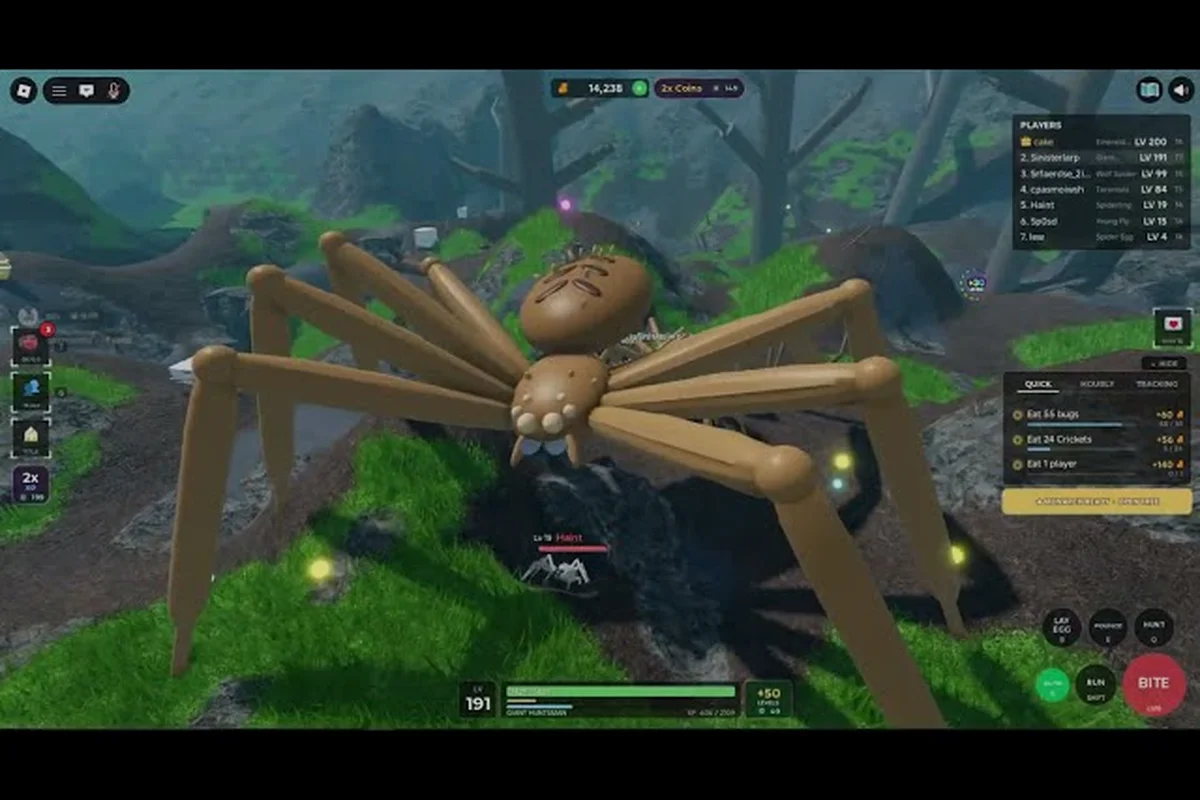
Bug Evolution includes more than 30 insect forms, but the Bug Tree presents the collection in smaller stages instead of revealing every entry at once. The full Roblox insect collection spans ground and flying types, with basic insects, rare insects, and the biggest insect forms unlocked through different progression milestones. Understanding the Bug Tree path matters because evolving your insect and spending Honey determine which branches become available, while some entries can be missed if their prerequisites are not completed.
Bug Evolution Insect Count and Collection Overview
Bug Evolution is a new Roblox survival and evolution game from the | Corgi Crew | group. Players begin as a tiny insect, gather scattered food, grow through levels, and use the Bug Tree to unlock additional forms. The store material advertises 30+ insects, although the developer has not published one exact final number.
That distinction matters when asking bug evolution how many insects there are. The safest confirmed answer is more than 30, not exactly 30, because locked tree nodes and premium sections may add forms as development continues. Community reports also describe the collection as extending from a Housefly and Moth to Locust, Tarantula, Black Widow, and larger prehistoric-looking creatures.
| Collection detail | Confirmed information |
|---|---|
| Advertised roster size | 30+ insect forms |
| Exact final count | Not yet officially published |
| Main unlock system | Bug Tree progression |
| Starting form shown | Housefly |
| Named examples | Moth, Grasshopper, Locust, Tarantula, Black Widow, Spider |
| Collection organization | Tree tiers and premium tabs |
| Official rarity grades | None currently displayed |
Confirmed Insects and Bug Tree Positions
The collection is not presented as a conventional shop with every creature visible from the beginning. Instead, the Bug Tree displays forms in tiers. A visible progression example includes Housefly at LV 1, Spider at LV 10, a red-and-white Spider at LV 20, and a white-fluffy Spider at LV 30. Deeper rows contain obscured nodes marked with question marks around tiers T4 through T6.
| Tree level or branch | Form shown or reported | What players can infer |
|---|---|---|
| LV 1 | Housefly | Starting insect and baseline form |
| LV 10 | Spider | Early unlock reached through progression |
| LV 20 | Red-and-white Spider | Midgame spider branch |
| LV 30 | White-fluffy Spider | Deeper spider option |
| T3 branch | Locust | A route away from spider forms |
| T3 branch | Black Widow | Alternative spider-focused branch |
| Lower tree | Tarantula | Large spider positioned near the prehistoric tier |
| T4–T6 | Obscured nodes | Additional forms exist but are not fully identified |
Because names and exact stat values remain hidden on some nodes, a complete catalog is not yet possible. The broader Bug Evolution insect size guide explains the confirmed roster, unlockable insects, and the Housefly-to-Spider progression in greater detail.
Insect Kinds and How Unlocks Progress
Every insect type belongs to a branching evolution route rather than one linear ladder. The key choice arrives around T3, when players can follow the Locust side or the Black Widow side. Choosing Locust leads toward flying and hopper-style insects, while Black Widow keeps the run centered on the spider branch.
| Branch | Early direction | Late-game direction | Practical identity |
|---|---|---|---|
| Spider route | Housefly to Spider | Black Widow and Tarantula | High-bite-damage specialization |
| Locust route | Housefly and early insect forms | Locust and flying forms | Mobility and swarm-style play |
| Premium spider section | Not fully displayed | Higher-tier spider options | Robux-funded alternate route |
The game does not display Common, Rare, Legendary, or Mythic labels. As a result, the bug evolution insect collection is organized by Bug Tree tier rather than an official rarity system. Any claim about the bug evolution rarest insect is currently community inference based on tree position, size, or combat performance.
How Bug Tree Unlocks Work
A new form generally requires a level milestone and an eligible position on the tree. Food, leveling, and coins contribute to growth, but simply eating enough does not guarantee that every branch becomes available. Players should watch for new nodes, level milestones, and the visible progression bar during a run.
In practice, evolution depends on securing the correct Bug Tree node, not merely filling the growth meter. Each branch has its own level requirement and position, so an eligible node may remain locked while food, coins, and XP accumulate. For example, a player can become ready for a flying form yet still need to reach the specific tree branch that grants flight; choosing a combat branch instead prioritizes attacks over movement. This makes the selected Bug Tree route a key part of the insect type for that run.
-
Start as the Housefly and learn where food appears on the grassy map.
-
Eat regularly to raise the insect’s level and growth.
-
Reach the required milestone for the next available tree position.
-
Inspect the Bug Tree to see which branch has opened.
-
Choose a route that matches the desired movement or combat style.
-
Continue upgrading the selected form with coins as resources allow.
This structure makes the bug evolution insect type attached to a run important. A player who wants a fast flying form may plan differently from someone focused on remaining a spider and maximizing bite damage. The complete Bug Evolution insect list is useful for tracking confirmed forms as more tree nodes become visible.
Bug Evolution Flying Insects and Movement Choices
Flying insects are not simply cosmetic variants. They alter how a player approaches food, avoids danger, and contests space with other players. The Locust branch is the clearest confirmed route toward bug evolution flying insects, and community descriptions place Locust at T3 on a side that leads away from spiders.
The collection’s movement identities can be compared without inventing unpublished stat values: compare visible traits, branch placement, and the role each insect serves in normal matches. Housefly represents the early basic form, Spider and Black Widow occupy the close-range specialization, and Locust marks the faster flying-or-hopper route. For bug evolution insect collection planning, this identifies reliable functional groups while leaving exact Speed, Health, Bite Damage, Bite Speed, and Stamina comparisons to the in-game bars.
| Movement identity | Confirmed examples | Best use | Main uncertainty |
|---|---|---|---|
| Early basic form | Housefly | Learning the map and gathering early food | Exact speed and stamina bars |
| Spider specialization | Spider, Black Widow, Tarantula | Close-range pressure and high bite focus | Exact damage values are unverified |
| Flying or hopper route | Locust | Fast repositioning and collecting distant food | Which later nodes are genuinely flying |
| Midgame hybrid | Red-and-white Spider, white-fluffy Spider | Testing a different appearance and branch | Full stat differences are not published |
Because the five displayed attributes—Speed, Health, Bite Damage, Bite Speed, and Stamina—can change through growth and upgrades, the in-game bars offer better evidence than an outside ranking. The bug evolution insect type you select should therefore be judged from measured performance during a session.
Why the Locust Branch Changes a Run
Locust represents the first meaningful route decision. Selecting that side alters later unlocks, so it is more than a cosmetic choice made at level three. Players who value quick movement and access to open terrain may prefer this route, while players who want to build around the spider branch can focus on Black Widow and the forms below it.
Community footage indicates that reaching a large form quickly can make escape easier, although movement speed and stamina depend on upgrades. Before committing, compare the visible bars after the same growth milestone. That approach avoids treating reputation as exact evidence when the developer has not published a numerical stat sheet.
Bug Evolution Rarest and Biggest Insect
Neither the rarest nor the biggest insect can be named with complete confidence from the current public information. The Bug Tree hides some nodes, the game has no official rarity grades, and exact insect dimensions are not published. This makes the questions “bug evolution rarest insect” and “bug evolution biggest insect” more nuanced than a conventional collectible-game list.
| Question | Best-supported answer | Why certainty is limited |
|---|---|---|
| What is the rarest insect? | A deeper or locked tree form | The game does not use rarity grades |
| What is the biggest insect? | Tarantula is a leading candidate | Exact dimensions and final roster are unknown |
| What is the strongest insect? | No verified single answer | Community rankings depend on stats and upgrades |
| Which insects are definitely available? | Housefly, Spider, Moth, Grasshopper, Locust, Tarantula, and Black Widow | Names come from visible or community-confirmed forms |
Tarantula sits deep in the spider branch near the prehistoric tier, and players commonly discuss it as one of the largest forms. However, visual scale is not the same as a verified size ranking. Later forms could exceed it, particularly if hidden nodes represent giant insects from the prehistoric tier.
The safest answer to bug evolution biggest insect is therefore Tarantula is a confirmed large candidate, but the final largest form remains unverified. Likewise, there is no official basis for assigning a single insect to the rarest slot. Community collections can still discuss “deepest tree form,” “premium form,” or “hardest to unlock” as more precise categories.
Measuring Rarity and Size Without Guesswork
Use several observable criteria when comparing creatures: tree depth, unlock conditions, visible body scale, movement pattern, and the stat bars after upgrades. These criteria are more reliable than assigning invented rarity labels. A hidden T5 or T6 form may be harder to reach, but it is not necessarily stronger than every lower-tier insect.
| Evaluation method | What it measures | Limitation |
|---|---|---|
| Bug Tree depth | Progression difficulty | Depth is not a formal rarity grade |
| Visible body scale | In-game appearance | Does not reveal exact dimensions |
| Stat bars | Current performance | Values change with growth and upgrades |
| Unlock requirement | Accessibility | Later does not always mean stronger |
| Community testing | Practical impressions | Results vary by match and play style |
The Bug Evolution insect stamina guide provides a closer look at the attributes that influence whether a large or distant insect can actually survive its encounters. Stamina is especially useful when comparing flying insects with aggressive ground opponents: it determines how long an insect can keep moving, attack, and avoid damage before its performance drops. This matters for both the insect collection and bug evolution, because an impressive body scale or a rare Bug Tree position does not guarantee practical strength if stamina cannot sustain the required distance. A careful comparison should therefore check the insect type, upgraded stat bars, and movement pattern together before deciding which specimen is better suited to a particular encounter.
Bug Evolution Strategy for Completing More Insects
Completing the collection requires more than finding one strong insect. Players need repeatable knowledge of leveling, resource management, and tree navigation. A practical objective is to identify one new form per session, record where its node sits, and decide whether the next run should follow that branch or test an alternative.
| Goal | Recommended approach | What to track |
|---|---|---|
| Reach LV 10 Spider | Prioritize consistent early food gathering | Food sources and level pace |
| Reach LV 20 red-and-white Spider | Maintain upgrades when available | Coins spent and health bars |
| Reach LV 30 white-fluffy Spider | Survive longer in contested areas | Stamina and escape routes |
| Explore the Locust branch | Check tier-three choices early | Movement type and branch position |
| Find hidden deep-tree insects | Repeat sessions and inspect T4–T6 nodes | Newly revealed node names |
A Practical Completion Plan
Start every session by evaluating your current level and available food density. Moving between food sources before a dangerous creature appears usually produces steadier growth than remaining in one exposed patch. Spend coins on the stat that currently limits your run, such as Stamina when escapes fail or Health when fights end abruptly.
At the Bug Tree, compare visible nodes before evolving. The red-and-white Spider and white-fluffy Spider demonstrate that one branch can contain several distinct appearances. Do not assume that choosing a familiar species immediately exposes every later form. Record the milestone, branch, and appearance of each unlock so the next run begins with useful information rather than repeated searching.
For competitive goals, the Bug Evolution tier list can help organize community opinions about strong builds, although it should not be mistaken for official rarity or balance data. Use it to compare practical performance rather than insect count alone: a build that combines early Bug Tree access, reliable food income, and enough Stamina or Health can outperform a rarer insect that requires an expensive or risky evolution path. Community rankings are especially useful when comparing flying insects, fastest-growing insects, and other specialized roles, but they do not establish a verified total of collectible bugs.
Bug Evolution Insect Collection Checklist and Summary
A practical bug evolution insect collection tracker should include every confirmed name, the level used to unlock it, its branch, and whether it can fly. The game currently has more than 30 advertised forms, but exact names for all locked nodes have not been published. Keeping provisional entries prevents a placeholder from being mistaken for an official release.
| Tracking status | Forms to include | Notes |
|---|---|---|
| Confirmed early forms | Housefly, Moth, Grasshopper | Visible or consistently reported |
| Confirmed spider forms | Spider, red-and-white Spider, white-fluffy Spider | Mark level milestones where known |
| Confirmed named branches | Locust, Black Widow | Different routes around T3 |
| Confirmed large candidate | Tarantula | Positioned near the prehistoric tier |
| Provisional entries | Hidden T4–T6 nodes | Do not assign names until confirmed |
| Premium entries | Robux Spiders tab | Exact forms and pricing are not fully public |
The final answer to bug evolution how many insects is 30+, pending an official exact count. The collection already contains a broad mix of basic insects, flying or hopper forms, several spider variants, and large prehistoric-looking creatures. For bug evolution flying insects, Locust is the clearest confirmed branch toward that category. For the bug evolution rarest insect, there is no official rarity label, so hidden depth is the best available description. For the bug evolution biggest insect, Tarantula is a strong confirmed candidate, although later hidden forms prevent a definitive ranking.
Frequently Asked Questions
How many insects are in Bug Evolution?
Bug Evolution advertises more than 30 insect forms, but the developer has not released an exact final count. Some Bug Tree nodes remain obscured, so “30+” is the most accurate confirmed answer. The collection includes Housefly, Moth, Grasshopper, Spider, Locust, Black Widow, Tarantula, and several other forms.
What are the Bug Evolution flying insects?
Locust is the clearest confirmed insect associated with the flying or hopper-style branch. Later nodes along that route have not all been publicly identified, so additional flying forms may exist. Players should inspect the tree, movement behavior, and Speed and Stamina bars after unlocking later insects.
What is the rarest insect in Bug Evolution?
There is no official Common, Rare, Legendary, or Mythic ranking in the game. Rarity is effectively determined by tree depth, unlock requirements, and availability. Forms in hidden T4–T6 nodes appear hardest to identify, while the Robux Spiders section is a separate premium category with unpublished details.
What is the biggest insect in Bug Evolution?
Tarantula is a confirmed large candidate and is positioned near the prehistoric tier of the Bug Tree. Exact dimensions are unavailable, and later hidden forms may be larger. Treat community size rankings as provisional until the developer publishes the complete roster or official measurements.
Can players collect every insect in one match?
Not reliably, because new forms are tied to level milestones and branch positions on the Bug Tree. A single run can expose several forms, including the Housefly, Spider, red-and-white Spider, and white-fluffy Spider progression, but a dedicated collection run across multiple sessions provides the best chance of finding the remaining locked insects.