Tracking bug evolution all insects is easier when you can separate confirmed forms from locked Bug Tree nodes. This roster reference lists every named species and the branch that unlocks it, so you can plan upgrades without guessing.
Bug Evolution All Insects: What the Roster Confirms
Bug Evolution’s insect roster spans more than 30 forms, beginning with the Housefly and expanding into late-game branches with substantially higher stat ceilings. Each species occupies a distinct Bug Tree path, where branching upgrades can alter its damage, speed, health, and special abilities; identifying Black Widow and White Spider variants therefore matters when comparing effective builds, since their roles differ from basic early insects rather than simply increasing the roster count.
This roster separates confirmed forms from mystery nodes, so you can plan upgrades without mistaking speculation for an official rarity list. The available data was last verified on October 30, 2026, and should be treated as a current snapshot of a new 2026 Roblox release.
Confirmed roster overview
The available information supports the following broad picture, but only as an evolving roster rather than a finished encyclopedia: published examples exceed 30 advertised forms, some variants appear only within specific branches, and the Robux Spiders tab may contain purchasable insects whose names, tiers, and prices have not been fully documented. For Bug Evolution all insects searches, the Bug Tree is therefore the more dependable organizing framework than outside rarity lists, while claims about the complete Bug Evolution insect list should identify the interface branch or source page supporting them.
-
30+ advertised forms rather than a developer-published exact total.
-
The Housefly is the starting insect.
-
The spider branch includes the Spider, red-and-white Spider, a white-fluffy spider, Tarantula, Black Widow, and deeper prehistoric forms.
-
Other confirmed branches include Moth, Grasshopper, fly variants, and Locust.
-
A premium Robux Spiders tab contains higher-tier spider options, but its full contents and prices remain unverified.
-
The game uses Bug Tree tiers, not official Common, Rare, or Legendary labels.
That distinction matters for the Bug Evolution insect database because its organization follows Bug Tree tiers, not formal rarity categories. A player might encounter community lists labeling individual insects as Common, Rare, or Legendary, but those labels cannot be verified against the game interface unless the corresponding Bug Tree branch, Robux Spiders entry, or another cited source explicitly supports them. For example, a Black Widow may be presented as especially powerful by a ranking, yet that assessment does not create an official Bug Evolution complete insect list classification; it describes practical strength rather than documented tier status.
Bug Evolution Insect List and Bug Tree Positions
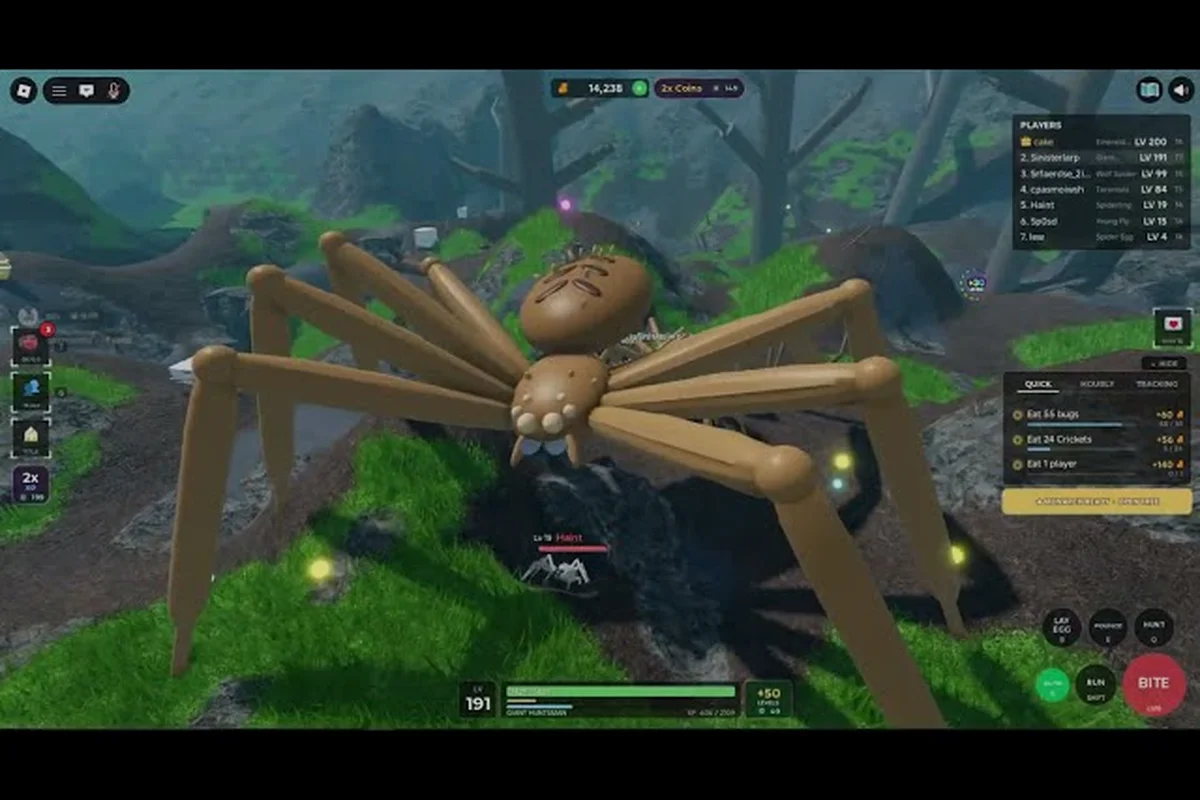
The Bug Evolution insect list is organized around level milestones and positions on the Bug Tree. A visible example places the Housefly at level 1, Spider at level 10, red-and-white Spider at level 20, and white-fluffy spider at level 30. Deeper rows contain locked nodes marked with question marks at tiers four through six.
| Confirmed or visible form | Tree position or level clue | Primary branch | Verification status |
|---|---|---|---|
| Housefly | Level 1 | Starting insect | Confirmed |
| Spider | Level 10 | Spider branch | Confirmed |
| Red-and-white Spider | Level 20 | Spider branch | Confirmed |
| White-fluffy Spider | Level 30 | Spider branch | Confirmed |
| Tarantula | Deep spider branch | Spider branch | Confirmed |
| Black Widow | T3 branch form | Spider branch | Confirmed |
| Locust | T3 branch form | Hopper and flying branch | Confirmed |
| Moth | Confirmed playable form | Winged branch | Confirmed |
| Grasshopper | Confirmed playable form | Hopper branch | Confirmed |
| Fly variants | Earlier progression | Flying branch | Confirmed |
| Prehistoric Beast | Deep tree area | Prehistoric branch | Confirmed |
| Unknown T4–T6 nodes | Locked rows | Multiple branches | Not publicly identified |
The opening forms
The Housefly baseline is useful for understanding progression because it is the weakest practical opening form and the creature a fresh player controls after hatching. It can still gather food and grow, but its role is transitional: eat, gain levels, and reach the first meaningful branch rather than remain on the insect path.
The Spider at level 10 is the first major visible milestone. It provides a clearer shift toward the spider branch without skipping the resource-gathering stage. Players who want more context on the starting creature and physical scale can consult the insect size and roster reference.
The branching decision at T3
The most consequential confirmed split occurs at T3. One path leads toward Black Widow and the spider branch, while the other leads toward Locust, fly-oriented insects, and hopper-style forms. Once selected, the remaining route changes, so this is not simply a cosmetic choice between two endgame insects.
| T3 route | Confirmed destination | Strategic identity | Evidence quality |
|---|---|---|---|
| Spider route | Black Widow | Higher bite-damage emphasis | Confirmed form; community strength assessment |
| Alternate route | Locust | Movement and hopping potential | Confirmed form; community strength assessment |
| Earlier branch | Spider or red-and-white Spider | Beginner spider progression | Visible tree examples |
| Deep branch | Tarantula and prehistoric forms | Late-game size and power focus | Confirmed names; exact stats unpublished |
Because Bug Evolution is still new, developers have not published complete numeric values for every insect form or added official rank badges. As a result, labels such as “strongest,” “best,” and “top tier” in community discussions are interpretations rather than confirmed rankings. A useful comparison is the T3 split shown in the table: Black Widow represents the spider route’s greater bite-damage emphasis, while Locust represents the alternate route’s movement and hopping potential. Until exact damage, health, and speed figures are released, comparisons among Black Widow, Locust, White Spider, Tarantula, and other forms remain provisional.
Bug Evolution Complete Insect List by Progression Stage
A useful Bug Evolution complete insect list groups species by where they appear in a run, not by an invented rarity tier. The confirmed names can be separated into the opening stage, spider progression, branching forms, and deeper endgame options. Several premium spider entries remain hidden behind the Robux Spiders interface, so they are discussed separately rather than inserted as confirmed free insects.
Early progression
Early insects help players learn food collection, growth, biting, and stamina management. The Housefly is the clearest confirmed starter, while other fly variants occupy nearby progression. Their practical value comes from fast access to scattered food rather than from impressive late-run combat.
Moth and Grasshopper also appear as confirmed playable forms. Their exact starting points can vary with the current interface or progression route, and the developer has not published a complete level-by-level chart. What can be verified is that these forms exist outside the initial Housefly stage and contribute distinct branches to the roster.
Spider progression
The named spider path is the best-documented sequence because the interface visibly shows several examples. It begins with Spider, passes through red-and-white Spider, reaches the white-fluffy Spider at level 30, and continues toward Tarantula, Black Widow, and deeper prehistoric forms.
The red-and-white Spider also receives dedicated attention in the red-and-white Spider and hidden-form reference. That guide is particularly relevant for distinguishing the named level-20 form from the white-fluffy spider shown at level 30, which many players may initially group together.
| Spider-era form | Confirmed milestone or location | What is known | What remains unknown |
|---|---|---|---|
| Spider | Level 10 example | Core spider branch | Exact five-stat values |
| Red-and-white Spider | Level 20 example | Mid-tier spider form | Exact unlock cost beyond level milestone |
| White-fluffy Spider | Level 30 example | Distinct white spider form | Exact rarity and tier grade |
| Tarantula | Deep branch | Large late-game spider candidate | Published stat totals |
| Black Widow | T3 choice | High-bite-damage community reputation | Official damage number |
| Prehistoric Beast | Deep progression | Giant or prehistoric endgame identity | Final unlock requirements |
Late progression and mystery nodes
The deepest tree rows expose the important limitation of any Bug Evolution every insect page: some forms remain concealed. Locked entries appear as question-mark nodes at tiers four through six. Their names, exact numbers, and requirements are not publicly verified, so naming them as confirmed insects would overstate the available evidence.
The premium Robux Spiders tab adds another layer of uncertainty. It clearly exists and advertises advanced spider options, but the public materials do not reveal every species or its price. Players should treat that tab as a paid collection with unconfirmed contents, not as proof that every hidden node is purchasable.
Bug Evolution Insect Database: Five Stats That Define a Form
Every insect in Bug Evolution is evaluated through the same five-stat panel: Speed, Health, Bite Damage, Bite Speed, and Stamina. Those values grow as a player eats, levels up, and spends coins on upgrades. Although exact base numbers are not publicly published for the complete roster, the stat framework makes comparisons possible once you record values in-game.
| Stat | What it controls | Why it matters during progression | Best way to evaluate it |
|---|---|---|---|
| Speed | Movement pace | Controls how quickly you find food or reposition | Compare time crossed on the same route |
| Health | Damage endured | Determines survival during contested encounters | Track health lost in similar fights |
| Bite Damage | Power per attack | Influences defeat speed and damage trade-offs | Compare health removed per bite |
| Bite Speed | Attack frequency | Affects damage output and action economy | Count attacks during a fixed window |
| Stamina | Repeated-action endurance | Influences sustained chasing and gathering | Test performance before stamina runs out |
Recording a reliable comparison
The Bug Evolution insect database becomes more useful when you standardize the test rather than relying on first impressions. Choose a flat route, collect the same food amount, and avoid buying upgrades until the baseline recording is complete. Afterward, repeat under similar conditions and record the five bars shown above the selected insect.
A practical sheet can use the following structure: run one baseline and one upgrade comparison for each insect, keeping the route, food amount, target health pool, and coin budget unchanged. For example, record how many bites a Black Widow needs with identical damage settings, then repeat after adding coins to bite rate; this reveals whether the improvement comes from the insect’s species mechanics or from the upgraded state. Apply the same controlled process across the complete insect list, including White Spider, so results remain comparable across the Bug Evolution insect database.
| Test | Control variable | Suggested record |
|---|---|---|
| Movement test | Same open route | Time to finish course |
| Bite test | Same target or health pool | Bites needed to defeat it |
| Stamina test | Same repeated-action pattern | Completion point before depletion |
| Farming test | Same food density | Food gathered per trip |
| Upgrade test | Same coin budget | Stat increase and rank change |
Because values can change with upgrades and patch balance, record both the species and its upgrade state. A level-only comparison may produce misleading conclusions if one form already has more coins invested in speed, health, damage, bite rate, or stamina.
What community reports can establish
According to community data, Black Widow is often treated as a high-bite-damage option after reaching its branch, while Tarantula is a common candidate for the strongest spider. Those labels describe practical impressions rather than official grades, and they remain useful only when the testing method is clear.
For a more focused comparison, the community insect tier list can be read alongside your own stat notes. Treat tier positions as hypotheses: an insect with strong bite damage may excel against tanky targets but perform poorly when stamina or movement is the deciding factor.
Bug Evolution Black Widow, White Spider, and Build Choices
Bug Evolution Black Widow builds center on the T3 spider branch, while the white spider forms occupy visible milestones earlier in the tree. The choice becomes more than a naming decision: it determines which later nodes can be reached and which resource-gathering play style you will use.
Choosing the Black Widow branch
Black Widow suits players who favor spider progression and want a form associated by players with strong bite damage. The confirmed fact is its location at T3. The inferred advantage is its build identity, which community discussion repeatedly links to aggressive fights and faster health removal.
That makes Black Widow a reasonable target when your session plan favors direct encounters and you understand the upgrade costs ahead. It is not officially labeled Legendary, so using that term in a guide would confuse power balance with rarity. The proper description is a confirmed T3 spider branch form with a strong community reputation for bite-focused performance.
For dedicated build testing, the Black Widow and Tarantula comparison can help frame early versus late spider goals. Keep separate notes for each form because a late Tarantula and a T3 Black Widow serve different portions of the run.
Choosing the white-spider route
The term white spider can refer to more than one visible form. The interface specifically shows a white-fluffy spider at level 30, while the red-and-white Spider appears at level 20. Keeping these separate prevents a mistaken claim that the two names describe the same unlock.
| Comparison point | Red-and-white Spider | White-fluffy Spider |
|---|---|---|
| Visible milestone | Level 20 | Level 30 |
| Position in progression | Mid-stage | Later-stage |
| Official rarity label | None published | None published |
| Exact stats | Not published | Not published |
| Best use in a reference | Track spider branching | Track white-form progression |
The Bug Evolution white spider entry is therefore best documented as the level-30 white-fluffy form. If another premium spider uses a similar name in the Robux tab, it must be treated separately because that tab’s contents are not fully public.
Choosing Locust instead
Taking the Locust branch changes the path away from the spider line. Grasshopper, fly variants, Moth, and other winged or hopper-style insects provide a different progression identity. This alternative can be attractive when you prefer movement and gathering efficiency over remaining entirely within the spider branch.
A complete route should consider four questions: which branch owns your preferred insects, whether its food economy can support the required unlock, whether your combat stats handle the intended enemies, and whether purchased upgrades reinforce that form. For example, choosing Grasshopper or a winged insect shifts progression away from the spider line, while Black Widow and White Spider remain tied to the spider branch; a Locust route therefore demands different food-gathering and combat priorities rather than simply substituting one insect name for another.
-
Which branch contains your preferred insects?
-
Can you consistently gather enough food to reach its unlock?
-
Do your combat stats match the intended enemies?
-
Are you spending coins on upgrades that reinforce the chosen form?
Because T3 is the first meaningful build decision, choosing early is reasonable only when the branch matches your planned play style. For example, a Locust-focused build should prioritize the food economy for Grasshopper or other hopper-style insects before spending coins on unrelated upgrades. If uncertain, record both routes and compare the next two unlocks: their food requirements, combat needs, and purchasable upgrades reveal which branch better fits the run.
How to Build a Complete Bug Evolution Roster Checklist
Use a Bug Evolution all insects checklist to track confirmed names, premium entries, and locked nodes without duplicating forms. Begin with the visible tree, note level milestones, then add each branch reached in the current session. This produces a clearer record than repeatedly scanning an expanding interface.
Tracking process
| Step | Action | Record | Why it helps |
|---|---|---|---|
| 1 | Start as Housefly | Starting form and level | Establishes the run baseline |
| 2 | Record visible tree nodes | Name, level, branch | Reveals the route structure |
| 3 | Reach T3 | Black Widow or Locust path | Documents the major split |
| 4 | Log five stats | Speed through Stamina | Supports objective comparisons |
| 5 | Inspect premium tab | Visible paid entries | Separates confirmed from unavailable details |
| 6 | Note mystery nodes | Tier and lock state | Prevents invented species names |
| 7 | Record upgrade spending | Coins and affected stats | Keeps results comparable |
Distinguishing confirmed, rumored, and premium forms
The Bug Evolution insect list separates entries by evidence level rather than treating every visible creature as equally verified. This matters because the game interface can reveal a bug icon, branch tier, or Robux Spiders option without confirming its final evolution, mutation path, or stat values. For example, the Black Widow is a confirmed visible form, while unnamed question-mark nodes in tiers four through six represent only slots whose identities remain unresolved. Recording those distinctions keeps a Bug Evolution complete insect list from overstating what the interface actually supports.
-
Confirmed and visible: Housefly, Spider, red-and-white Spider, white-fluffy spider, Moth, Grasshopper, Tarantula, Black Widow, Locust, and prehistoric forms.
-
Confirmed category with uncertain details: fly variants and the exact level order among several branch forms.
-
Visible but unnamed: question-mark nodes in tiers four through six.
-
Premium but not fully cataloged: spider options inside the Robux Spiders tab.
This classification prevents a common research error: presenting a premium entry or hidden node as a free, fully unlocked creature. The interface may show enough to establish that a slot exists without revealing enough to describe its stats or final form.
Comparing insects across separate sessions
For Bug Evolution every insect planning, record the server conditions that could distort a result. Food density, nearby players, upgrade spending, and the route to the next unlock can all influence an encounter. A controlled test in one session may be less meaningful than a repeated test spread across several sessions.
Community reports are especially helpful for identifying candidate builds, but they are not substitutes for direct testing. Use the available strength-focused spider analysis to generate hypotheses, then verify bite damage, bite speed, movement, and stamina in the game.
Frequently Asked Questions
Does Bug Evolution have every insect listed yet?
No complete species-by-species chart is publicly confirmed because the game advertises more than 30 forms and leaves several deep Bug Tree nodes hidden. Confirmed entries include the Housefly, Spider, red-and-white Spider, white-fluffy spider, Moth, Grasshopper, Tarantula, Black Widow, Locust, and prehistoric forms. The Robux Spiders tab and tiers four through six still contain details that have not been fully published.
What is the difference between the white Spider and red-and-white Spider?
The visible progression examples place the red-and-white Spider at level 20 and the white-fluffy spider at level 30. They are separate forms, not alternate names for the same insect. Their exact stat totals and official rarity grades have not been published, so players should compare their in-game bars rather than relying on community labels.
Is Black Widow the strongest insect in Bug Evolution?
Black Widow is a confirmed T3 branch form that players often favor for bite-focused performance, but the developers have not published a complete official tier ranking or final stat totals. Tarantula is another common late-game contender. The strongest choice depends on movement, stamina, target durability, and the other upgrades you have purchased.
How many insects are available in Bug Evolution?
The game advertises a roster of more than 30 insects, but an exact developer-confirmed total has not been published as of the October 30, 2026 verification. The visible tree includes confirmed early, mid-game, branch, and late forms, while mystery nodes and premium spider entries keep parts of the Bug Evolution complete insect list unresolved.
Where do insects unlock in Bug Evolution?
Insects unlock through the Bug Tree by meeting level milestones and following its branch structure. The interface example shows the Housefly at level 1, Spider at level 10, red-and-white Spider at level 20, and white-fluffy spider at level 30. T3 separates the Black Widow route from Locust, while deeper tiers contain additional locked and premium options.