
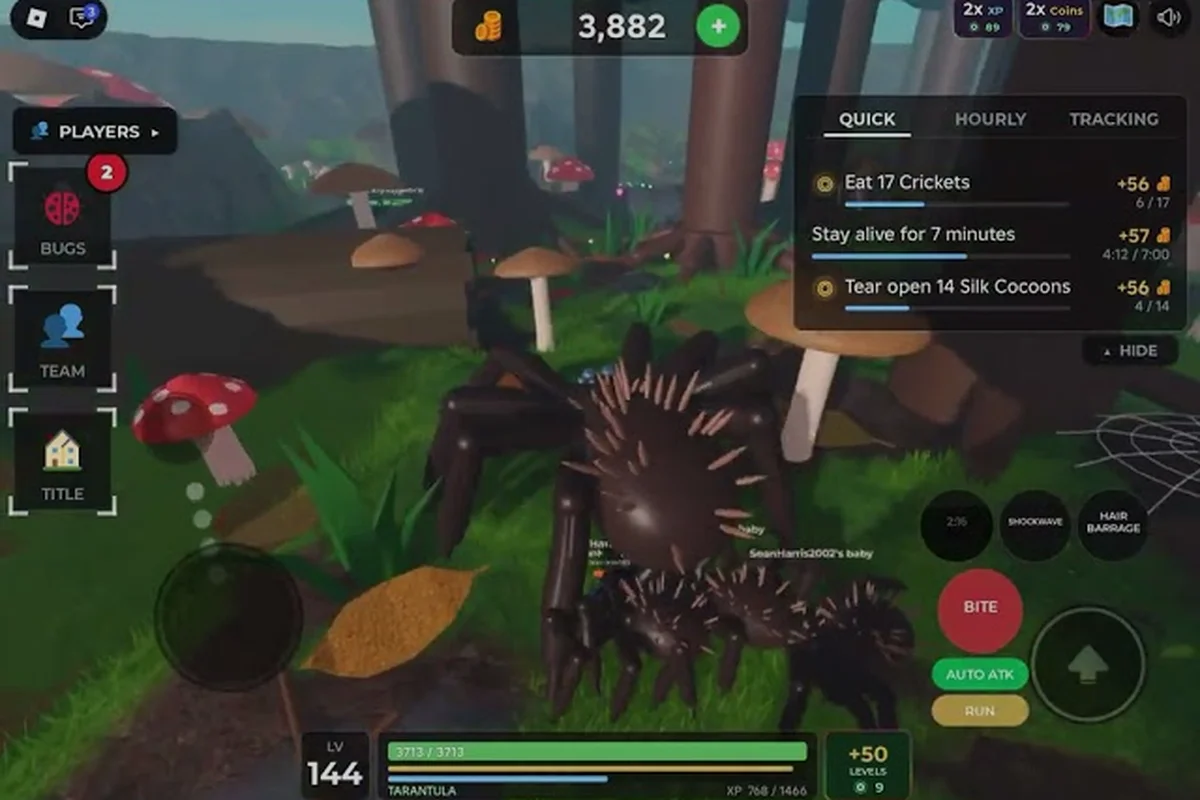
Understanding bug evolution insect stamina helps you predict how long each form can hunt before it needs to recover. Comparing stamina across insect species shows which evolution routes sustain longer runs and which choices stall mid-hunt.
Bug Evolution Insect Stamina: What It Changes
Bug Evolution insect stamina matters because it determines how long your current form can keep moving, attacking, and surviving while you gather food and pursue the next evolution. The game uses five visible attributes—Speed, Health, Bite Damage, Bite Speed, and Stamina—so understanding stamina prevents you from choosing a form that looks impressive but cannot sustain a long hunt. This guide explains how to read the stat panel, compare branches, and prepare for every named insect.
Reading Bug Evolution Stamina Stats
The stamina bar is one of five attributes shown above the selected insect in the HUD. As a player eats, levels up, and spends coins on upgrades, growth can add to the displayed stats. Because exact values are not published for every form, the safest comparison is the visible stat panel plus your own testing. Community reports confirm that Stamina matters during sustained movement and combat, while Bite Speed controls how quickly your attacks land.
What the five attributes reveal
A high stamina value does not automatically make an insect the strongest, because speed, health, bite damage, and bite speed all affect combat differently. Compare the complete profile rather than searching for a single perfect number. The following table gives each attribute a practical role.
| Attribute | What it controls | Why it matters |
|---|---|---|
| Speed | Movement speed | Helps you reach food or avoid danger |
| Health | Damage taken before defeat | Supports riskier encounters |
| Bite Damage | Damage per bite | Improves the strength of attacks |
| Bite Speed | Attack frequency | Shortens the gap between bites |
| Stamina | Endurance for movement and action | Helps during longer hunts and chases |
Full stat panel is the most reliable baseline because no official Common, Rare, or Legendary grades have been published. If two insects have similar bars, test their handling in a safe area before committing to a long growth run. The Roblox beginner guide is useful for learning the basic food, level, and evolution loop before advanced comparisons.
Reading a stamina bar accurately
Compare the filled portion of the stamina bar, not merely whether it exists. Every insect displays the same five-bar panel, which makes visual comparison straightforward even though the developers have not released a complete numerical chart. A longer bar generally suggests greater endurance, while a bar that drains rapidly may reflect lower stamina or heavier activity costs.
There is no confirmed formula connecting stamina directly to evolution tiers. Therefore, treat community-created rankings as estimates rather than official facts. A form placed deeper in the Bug Tree may look more powerful, but its stamina behavior still depends on the full stat loadout and the way you use it.
Stamina during a growth run
Stamina is most valuable when your route requires repeated bursts of activity rather than one short encounter. Eat enough to maintain your level, choose an upgrade that complements the form’s weak point, and avoid spending all your food reserves on a distant target. The level and coin progression guide explains how experience, coins, and upgrades fit into that preparation.
A useful routine is to eat, check the five bars, and take one short practice hunt before committing to a stronger insect. This reveals whether the form can handle travel, chasing, and repeated biting without losing momentum. It also prevents the common mistake of treating a dramatic appearance as proof that every stat improved.
Bug Evolution Insect Rarity and Progression Tiers
Bug Evolution insect rarity is not presented through official labels such as Common, Rare, or Legendary. Instead, the roster is arranged by Bug Tree tier, locked placeholders, and a premium tab for Robux spiders. As of the public interface captured on October 30, 2026, the game advertises 30+ insect forms, but an exact complete count has not been published.
Official structure versus community rarity
Players often describe later insects as rare because they take more effort to unlock. That is useful shorthand, although it is not an official rarity grade. For example, a late Bug Tree node requires more progression than an early one, while stamina determines how reliably an insect survives extended fights. The table below separates confirmed interface structure from community-inferred power judgments.
| Classification | Evidence | Best interpretation |
|---|---|---|
| Bug Tree tier | Confirmed game structure | Primary progression measure |
| Locked node | Confirmed interface state | Unavailable until requirements are met |
| Premium spider tab | Confirmed interface section | Separate Robux-based options |
| Common or Legendary label | No official label found | Community terminology only |
| Strongest insect | Opinion-dependent | Depends on play style and stats |
Bug Tree position is the safest rarity proxy. A form farther down the tree generally requires more progress, yet a community tier list can still differ because an insect with lower stamina may be less reliable in extended fights. Treat unofficial rankings as comparisons of use rather than fixed labels.
Known tiers and named branches
The interface example shows Housefly at LV 1, Spider at LV 10, a red-and-white Spider at LV 20, and a white-fluffy spider at LV 30. Deeper rows contain locked nodes at T4 through T6. Confirmed named forms also include Moth, Grasshopper, Tarantula, Black Widow, and Locust, giving players several distinct routes through the collection.
| Evolution point | Confirmed form or state | Practical meaning |
|---|---|---|
| LV 1 | Housefly | Opening and baseline form |
| LV 10 | Spider | Early branch progression |
| LV 20 | Red-and-white Spider | Mid-tree milestone |
| LV 30 | White-fluffy spider | Deeper milestone |
| T3 branch | Locust or Black Widow | Major route decision |
| T4–T6 | Locked nodes shown | Later content not fully documented |
| Premium section | Robux Spiders tab | Higher-tier spider options, details unverified |
T3 split is the first meaningful strategic choice because Locust leads toward flying and hopper-style insects, while Black Widow emphasizes the spider branch. Choosing one path can determine which later insects remain available during that run, so compare stamina and movement needs before committing.
Finding the final insect
The bug evolution last insect cannot be identified reliably from the current public information. The interface contains locked upper rows, but no official total or complete end-of-tree label has been published. Players searching for the bug evolution how to get every insect should focus on reaching every visible node rather than assuming the highest row is the only final form.
The collection overview is a practical companion for checking how many forms the game currently advertises and which categories players encounter. Until the developers publish the missing nodes, claims about a single definitive final insect should be treated as community speculation.
Bug Evolution Insect Names and Identification Guide
Knowing the bug evolution insect names helps you connect a visible form to its Bug Tree branch and avoid evolving past a form you wanted to collect. Confirmed names include Housefly, Spider, Moth, Grasshopper, Tarantula, Black Widow, and Locust, while the interface also shows a red-and-white Spider and a white-fluffy spider. Exact lettering may vary in community descriptions, so the silhouette and tree position remain useful checks.
Confirmed names and identifying traits
Several insects are visually distinct, while others are identified mainly by color or appearance in the interface. Use the reference table to recognize confirmed forms without inventing stamina, rarity, or damage statistics the developers have not released. For example, the White-fluffy spider is confirmed by its pale, fluffy appearance, whereas Black Widow and Locust are confirmed T3 branch forms whose power ratings remain community opinions rather than published data.
| Confirmed name | Identification cue | Confidence and limitation |
|---|---|---|
| Housefly | Small opening form shown in gameplay | Confirmed; baseline insect |
| Spider | Standard spider silhouette | Confirmed |
| Red-and-white Spider | Red-and-white body pattern | Confirmed from UI example |
| White-fluffy spider | Pale, fluffy appearance | Confirmed from UI example |
| Moth | Winged moth appearance | Confirmed |
| Grasshopper | Hopper-like body | Confirmed |
| Tarantula | Large spider in the deep branch | Confirmed; exact stats unpublished |
| Black Widow | Named T3 spider branch form | Confirmed; community power opinion |
| Locust | Named T3 branch form | Confirmed; community power opinion |
Tarantula is commonly discussed as a leading spider candidate, but its exact stats remain unavailable. The reference table identifies it only as a large spider in the deep branch and explicitly marks its stamina, rarity, and power values as unpublished. That distinction matters when evaluating insect stamina: community discussion tends to emphasize size, bite strength, and the assumed value of a deep-branch form, yet no confirmed endurance or damage figures support those comparisons.
Recognizing a new insect
The bug evolution new insect usually becomes apparent when a new Bug Tree node unlocks or the current form changes after meeting its level and tree requirements. Look for an unfamiliar silhouette, a changed body color, or a new entry in the selected-insect panel. Since the collection interface can contain locked placeholders, a new appearance may be a previously hidden branch rather than an update to an existing insect.
Community footage and player reports are currently more reliable than unsupported rarity websites because Bug Evolution is a new 2026 Roblox release. The earliest community videos date to October 20, 2026, and the public listing was updated on October 29. That short history means interface details can change quickly.
Building a complete collection
To determine bug evolution how to get every insect, record each confirmed form, the level that unlocked it, and its branch. Keep separate notes for the Locust and Black Widow routes because one choice may close off the other for the current run. The all-insects reference can then be used as a checklist rather than relying on memory.
A complete collection also depends on access to premium spiders. The Robux Spiders tab is confirmed, but its exact contents and prices are not publicly verified. Do not assume every premium insect is required for the standard Bug Tree, and treat community screenshots of that tab as provisional until the developer provides a complete roster.
Practical Bug Evolution Stamina Survival Tactics
Stamina survival depends on route planning, efficient food collection, and knowing when to stop attacking. Because the game’s exact stamina values and restoration rules are not fully published, observe consumption in controlled tests. A form that lasts five seconds while chasing a target may still be ideal for short food routes, while another may sustain movement but deal slower bites.
Optimize food routes
Short routes near several food sources reduce travel time, which preserves stamina for encounters. Mark a small farming zone, collect enough food to level up, and return before the bar becomes a constraint. If you need help with the basic loop, the common mistakes and hidden features overview offers additional context for new sessions.
| Route style | Stamina benefit | Risk |
|---|---|---|
| Tight loop with several food sources | Less travel and more recovery time | May expose you to crowded areas |
| Long route toward rare food | Fewer interruptions | Greater chance of exhaustion |
| Chase-focused hunting | Fast acquisition when successful | High stamina use and exposure |
| Conservative feeding | Predictable growth | Slower progress toward rare branches |
Feeding rhythm should match the insect’s capabilities. A high-endurance form can support longer exploration, while a low-stamina form benefits from frequent stops. Avoid changing routes repeatedly, because inconsistent testing makes it difficult to tell whether a weak result came from the insect or the player’s route.
Match upgrades to the weakest role
Coins can support upgrades after enough food has been earned, but the best upgrade depends on the current profile. If stamina drains quickly, prioritize whatever improves sustained activity or reduces the need to chase. If bites feel slow, improve the offensive stat that compensates without ignoring survivability.
Do not assume a fully upgraded low-level insect is automatically better than a fresh higher-tier form. Evolution can raise multiple bars, and tier position may unlock access to stronger upgrades later. Compare current performance, available progression, and the next branch choice instead of treating coins as the only measure of readiness.
Fight in short, controlled engagements
Practice attacks on targets that allow you to disengage safely. Observe whether the stamina bar falls during pursuit, biting, or both. This matters because a form with strong Bite Damage may still perform poorly if it spends most of its time traveling rather than attacking.
For the Locust branch, test movement-heavy routes because the form is associated with flying and hopper-style play. For Black Widow or other spider lines, compare bite frequency with movement endurance. These are community-informed play tests, not confirmed hidden bonuses.
Survive the branch decision
The T3 choice changes which insects you can reach later, so avoid selecting solely from appearance. Preview the visible next node, estimate which route fits your preferred combat style, and check the current stamina profile. If the game offers no free reset during a run, keeping that first route aligned with your routine is the safest option.
| Question before evolving | Reason to answer it |
|---|---|
| Can I survive the intended route? | Poor stamina may limit food access |
| Does my combat style fit the branch? | Movement and bite stats support different tactics |
| Is the next node clearly useful? | Locked placeholders reveal less than named forms |
| Am I saving coins for upgrades? | Evolution and spending may compete for resources |
| Can I still reach my target forms? | Some branches may not reconnect in one run |
Branch commitment is the point where stamina becomes more than a survival stat: it determines whether you can keep moving toward your target insect or must restart the run. Treat low stamina as a route constraint, because poor stamina may limit food access and leave an insect unable to reach later nodes. Compare the intended branch with your current movement, bite stats, and coin reserves before evolving; spending the final resources on an earlier insect can lock you out of the forms needed to complete bug evolution how to get every insect.
Tracking Bug Evolution New Bugs Without Missing Milestones
Tracking a bug evolution new insect requires more than watching for a final transformation. New nodes may be hidden behind level requirements, locked rows, or branch choices, and the public interface does not currently expose every requirement. Build a repeatable log after each evolution to preserve names, levels, and available destinations.
A reliable collection checklist
After every evolution, record five details: insect name, current level, Bug Tree location, visible next node, and stamina comparison with the previous form. This simple log makes it easier to identify a new form when the screen fills with food, insects, and combat effects. It also reveals whether a branch has quietly changed after an update.
| Log entry | Example | Why it helps |
|---|---|---|
| Current insect | Housefly | Confirms the form you control |
| Level reached | LV 1 | Establishes progression progress |
| Tree branch | Starter route | Shows available route group |
| Next visible node | Spider | Previews the next unlock |
| Stamina change | Baseline recorded | Reveals whether endurance improved |
Milestone pattern from the interface provides a starting framework: LV 1 Housefly, LV 10 Spider, LV 20 red-and-white Spider, and LV 30 white-fluffy spider. Deeper nodes remain concealed, so a checklist should leave those entries open until the interface reveals them.
Separate confirmed content from speculation
Community discussion often labels Tarantula as the strongest spider and Black Widow as a high-damage build. Those claims may be directionally useful, but the developers have not published exact values for either form. The same caution applies to any proposed order of the final insects. Write down what the interface proves and place community judgments in a separate notes column.
This separation prevents one problem: planning an entire run around an unverified rarity ranking. If a later form has exceptional bite damage but weak stamina, a safer route may still produce better results than rushing toward a supposedly elite insect.
Update your notes after patches
Because Bug Evolution is new and the store listing changed as recently as October 29, 2026, players should expect interface and balance adjustments. Revisit the Bug Tree after updates, compare your recorded stamina values, and replace assumptions with new observations. Community reports are useful for spotting trends, but only the live game can confirm the current state.
Building a Complete Bug Evolution Collection
The most effective approach combines branch planning, measured stamina tests, and a clear record of named forms. This process supports bug evolution insect stamina management while reducing the chance that the bug evolution last insect remains out of reach because of a poorly chosen route. The final objective is not simply to evolve once; it is to make deliberate progress through every confirmed node.
Before starting a new run
Review the current collection, identify locked branches, and choose a route that matches your preferred pace. Save coins only when the next upgrade or branch requirement makes that practical. Keep a separate note of premium spiders because their roster and pricing remain unverified in the public interface.
During each evolution stage
Test the insect for a few minutes before advancing. Record its stamina behavior, movement speed, bite frequency, and survivability. Food collection should remain efficient, but one or two controlled encounters can reveal whether the form suits the next route. If stamina runs out early, return to a tighter food route rather than forcing a long chase.
At the final available node
Treat the highest unlocked form as your current collection endpoint, not necessarily the game’s official final insect. The interface advertises 30+ forms and displays locked upper rows, but no complete official roster has been released. Update your checklist as new information appears and avoid marking speculative names as confirmed discoveries.
The core takeaway is straightforward: read all five bars, test stamina through short routes, and treat Bug Tree tiers—not invented rarity labels—as the reliable measure of progress. That approach keeps each evolution purposeful and makes the journey toward every known insect both safer and easier to plan.
Frequently Asked Questions
What does insect stamina do in Bug Evolution?
Stamina appears to represent endurance for movement and sustained activity. Because the game does not publish exact stamina values or consumption formulas for every insect, compare the bar visually and test short routes before making long hunts. It is most useful for judging whether a form can support repeated travel, chasing, and biting without stopping.
Which insect has the highest stamina in Bug Evolution?
No official insect has been confirmed as the highest-stamina form because the developers have not published a complete numerical stat chart. Later tiers may feel more durable, but community rankings are based on observation rather than official data. Compare the five-bar HUD panel and perform identical short-route tests before drawing a conclusion.
Is there an official rarity system in Bug Evolution?
No official Common, Rare, or Legendary grades are visible in the public interface. Progression is organized around Bug Tree tiers, locked nodes, and a premium Robux Spiders tab. Community members sometimes call certain insects rare based on unlock difficulty, but Bug Tree position is the better and more accurate classification to use.
How can I reach every insect in Bug Evolution?
Plan around the Bug Tree, record each named form, and avoid overlooking branches such as Locust and Black Widow. The LV 1 Housefly, LV 10 Spider, LV 20 red-and-white Spider, and LV 30 white-fluffy spider provide early milestones, while deeper rows remain locked. Also check the premium spider section, whose full roster and prices have not been publicly confirmed.
What is the last insect in Bug Evolution?
The final insect cannot be named with confidence because the public interface shows locked upper rows but does not reveal every form or an exact final label. The game advertises 30+ insects, so treating one visible endpoint as the permanent final insect could be misleading. Continue recording newly revealed names as players progress through the tree.