
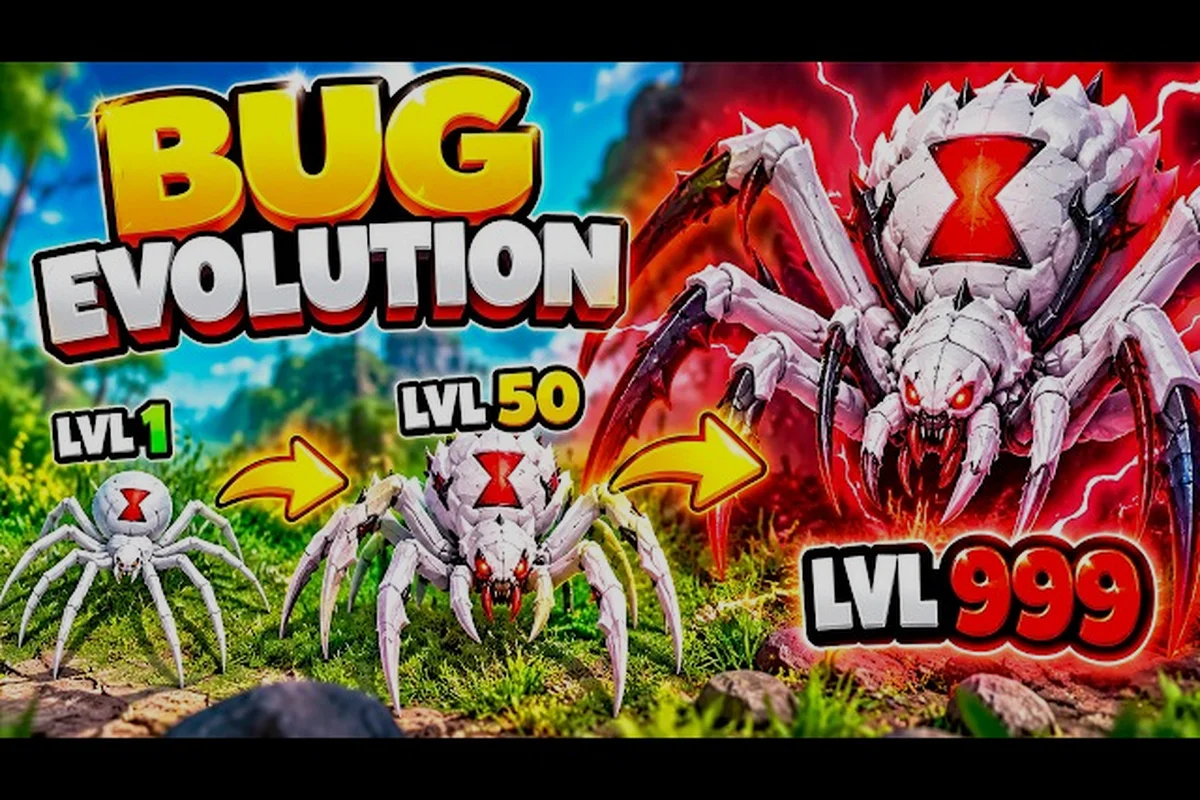
Bug Evolution's server system determines who shares your map, how many players compete, and whether you can play with friends. Learn how public and private instances differ, why the server size is capped at 15 players, and how to read the interface before joining a match.
Bug Evolution Server System and Instance Basics
The bug evolution server system centers on compact survival instances where every player shares one map, lobby, and competition. Each server supports as many as 15 players, which keeps food sources meaningful, opponents relatively close, and the King of the Server contest practical rather than chaotic. That limited population makes every early spawn and every large meal relevant because another player may be hunting for the same resources.
Public servers are the standard way most players enter a match. They are convenient for immediate solo play and may also support informal groups, but every participant competes within the same shared environment. A private instance offers a more controlled arrangement for friends who want a dedicated world, making the private server option particularly useful for organized hunts or practicing a build without unrelated spawns interfering.
| Server type | Best use | Population arrangement | Main advantage |
|---|---|---|---|
| Public server | Solo play or finding opponents | Players join a shared instance | Fast access to active competition |
| Private server | Playing with a known group | Friends occupy a dedicated instance | Greater control over the group session |
| Fresh public server | Establishing a new growth route | New or early-stage population | More room before the map fills |
| Crowded public server | Immediate PvP | Up to 15 active players | Opponents and resources are close |
Public server behavior
A public server places you in a shared survival session with a maximum population of 15. Everyone sees the same food distribution and can compete for prey, coins, and territory. Because the world is not divided into separate gameplay zones for each participant, scouting is essential. A cluster of food may be excellent for growth, but it can also reveal your location to larger insects.
The compact size also creates short feedback loops. A player who gathers aggressively may attract several opponents, while another player may hide near spawn and wait for larger creatures to arrive. This is why the server list alone does not tell you whether a match is easy. You still need to observe activity as soon as you enter.
What the server size changes
The 15-player cap affects resource pressure more than any other system. With fewer competitors, food can be easier to claim and early insects have more breathing room. As the server fills, stronger players begin targeting smaller ones, and the available food must support more growth cycles across the map.
This limit also makes the King of the Server objective more approachable. Instead of competing among a massive crowd, you are dealing with a manageable set of rivals. However, a small server can still become dangerous because evolved insects often remain in the same public area and can intercept players who are focused on feeding.
| Population state | Likely effect | Practical response |
|---|---|---|
| Empty or lightly occupied | More food available | Build size and spend coins on upgrades |
| Half full | Active hunting without constant pressure | Keep moving between food clusters |
| Near capacity | Strong competition for high-value food | Avoid open groups and guard your escape route |
| Dense around one region | Risk of being boxed in or attacked | Rotate feeding areas rather than camping |
The exact population changes quickly during active periods. Community data and player reports place Bug Evolution at roughly 20,000 concurrent players in late October 2026, while the game listing showed more than 3.9 million visits. Those totals describe overall activity, not the number of players in your individual server.
Bug Evolution Joining a Server and Private Options
Joining a server is a normal part of Bug Evolution's Roblox experience, but the best route depends on whether you want immediate competition or a coordinated session with friends. A public instance is usually the fastest option, while a private instance is built for a group that already knows what it wants to accomplish. In either case, understanding the difference between joining, hosting, and returning can prevent avoidable delays.
Starting a public match
Enter the game through its normal Roblox experience and allow the client to place you in an available server. You will begin near the starter area, where small food is concentrated in the grass fields. From there, the shared map supports the standard growth loop: eat, increase your size, level up, and gain access to larger prey.
Early movement is especially valuable in a populated server. Spend the first moments identifying clusters of food, nearby players, and common travel routes rather than attacking immediately. If you are unsure which insect choices fit your opening plan, the bugs tab mechanics guide explains how selecting and attacking with different forms changes your options.
Creating a private server
A bug evolution private server gives you and your invited group a dedicated 15-player world. This is more than a separate visual lobby: the group shares the same map and growth competition within that instance. It is useful when your group wants to hunt larger enemies together, test different insects, or avoid interference from unrelated players.
Private sessions still use the same core growth rules. Food must still be eaten to advance size, and level points still improve the five combat attributes: Speed, Health, Bite Damage, Bite Speed, and Stamina. The difference is that your group controls who else is present, which makes coordination easier and makes each resource contest more predictable.
| Decision factor | Public server | Private server |
|---|---|---|
| Start time | Join an available instance | Invite friends and begin together |
| Competition | Includes unfamiliar players | Limited to invited participants |
| Resource pressure | Depends on population | Depends mainly on the group's behavior |
| Best activity | Solo progression and rival encounters | Coordinated hunts and practice |
| King competition | Mixed skill levels | More predictable participants |
If everyone in the group immediately rushes the same food cluster, even a private server can become crowded. Split the route, use a rally point, and decide when the group should regroup. A dedicated server provides control over membership, not automatic control over every player’s choices.
Handling joins, departures, and full instances
Servers can become full before all of your invited friends arrive. When that happens, Roblox may prevent additional players from joining the existing private instance. The practical response is to wait for the population count to decrease or create another instance rather than repeatedly refreshing and assuming the game has frozen.
Public servers can also fill, but the client normally directs a new player to another available instance. If a connection attempt fails, check that you have selected the correct server type and that the instance still has space. Restarting the game can refresh the available-server list, although it should not be the first response to a normal queue or loading delay.
Bug Evolution Server Size, Population, and King Competition
Bug Evolution's server size is capped at 15 players, and that limit is central to the game's design. It creates a small, competitive ecosystem where even a single evolved player can influence the path of everyone else. Understanding how the cap interacts with food, respawns, and the King of the Server objective is more useful than simply memorizing the number.
Population pressure and resource control
Food is the primary engine of progression, so the player count determines how quickly a server's resources disappear. With fewer insects, a careful player can consume several small meals before a rival appears. At higher population, a large food cluster becomes a contested event, and smaller players may be forced to travel farther to find a safe feeding route.
Larger insects naturally create a wider area of control because their reach extends farther and they can threaten prey over greater distances. That makes server density relevant to survival. Hiding in a popular grass field may be convenient at first, but the same location becomes dangerous once stronger players need the remaining food.
King of the Server behavior
King competition is a direct struggle within the shared 15-player instance. The crown does not belong to an abstract global ranking; it depends on what is happening inside your current match. Every newcomer can become a threat, and every successful player attracts more attention.
This makes timing a major server skill. Joining an empty server may offer peaceful growth, but it also provides fewer opportunities to establish dominance. Joining a crowded server creates immediate danger and stronger rivals. The practical goal is not always to avoid competition; it is to enter at a time when your current insect can still compete and the map still offers a viable growth route.
The King of the Server combat guide provides deeper tactics for defending a position, handling enemy insects, and choosing when a confrontation is worth the risk.
| Server condition | Growth opportunity | King objective | Main risk |
|---|---|---|---|
| Few players | Broad access to food | Low immediate pressure | Few rivals to defeat |
| Medium population | Contested but productive feeding | Active competition begins | Being caught while focused on food |
| Near full capacity | Every major cluster is valuable | Strongest players dominate routes | Large insects controlling resources |
| Group-focused public server | Shared pressure against strangers | Competition against multiple teams | Friendly fire from allies |
Respawning and comeback chances
Death returns an insect to the starter area at its current evolved form, although the exact growth penalty is not documented. That means death should not be treated as a confirmed reset to an earlier species. Players can continue progressing, but they still lose time and must rebuild their position among nearby opponents.
A comeback strategy depends on your server size. In a sparse instance, return to grass fields and feed safely before re-entering contested areas. In a full instance, favor a smaller route with immediate escape options, and avoid announcing a return through repeated attacks. The best recovery plan changes with the population around you.
Bug Evolution Game Settings, Controls, and Server Visibility
Bug evolution game settings determine how comfortably you can read movement and react to threats, but not every setting changes the underlying server rules. The world population, food availability, insect form, and combat attributes remain the same regardless of whether you adjust graphics, controls, or interface preferences. Knowing which options affect performance and which options affect actual visibility can prevent wasted time.
Settings that improve server awareness
Settings should prioritize readable enemies, stable movement, and fast access to frequently used information. High visual fidelity is less useful during a crowded fight than a stable frame rate and clear silhouettes. The best configuration is the one that keeps your insect, nearby food, and opponent indicators legible while preserving quick turning in close-range combat.
The five combat attributes—Speed, Health, Bite Damage, Bite Speed, and Stamina—determine your strength regardless of display quality. Level points and coins upgrade those attributes, so settings should help you act on that information rather than replace it. The food and stats guide connects growth progress with the practical value of each attribute.
| Priority | Setting-related goal | Practical benefit in a server |
|---|---|---|
| First | Stable frame rate | Reduces missed attacks and awkward collisions |
| Second | Clear enemy visibility | Helps identify larger insects before they engage |
| Third | Responsive controls | Supports quick turns and retreats |
| Fourth | Readable HUD | Keeps stat bars visible during movement |
| Fifth | Visual detail | Secondary when the map becomes visually crowded |
Choosing a form that fits the match
The insect you select should reflect both your current size and the server's competitive density. Small forms are easier to maneuver around stronger enemies, but they depend on frequent small meals. Larger forms have greater reach and can control more of the map, although they require more food and attract attention from rivals of similar size.
A public match with 15 players can become hostile very quickly. A private group may let you cover more ground safely, yet the group's members can still draw large enemies. Do not choose a form solely because it looks impressive; compare its movement, durability, and bite performance with the food and opponents currently sharing your instance.
Server visibility and information limits
You can see nearby food, creatures, and players, but you cannot assume that another server's population or resources mirror yours. Each instance operates independently. Two players can eat from apparently equivalent grass fields while experiencing very different pressure because one entered a nearly empty server and the other joined a crowded one.
Server information also becomes less useful when the interface is cluttered. Stat bars should remain readable, but you still need to watch the world around your insect. A strong health bar does not reveal an attack from outside your field of view, and a long stamina bar does not guarantee that you can outrun a larger insect indefinitely.
Reading Stat Bars and Server Context
Bug Evolution stat bars provide the quickest summary of whether an insect can survive a server encounter. They matter because server size changes when you can find food, how long you can chase prey, and whether you can disengage from a stronger player. Reading the bars correctly prevents you from treating a low-risk meal as a worthwhile fight or entering a duel with an insufficient stat build.
What each stat bar reveals
Speed affects movement speed, while Stamina supports sustained travel and pursuit. Health determines how much punishment you can absorb, and Bite Damage measures the force of an attack. Bite Speed controls how quickly you can deliver bites. Because fighting involves both positioning and repeated attacks, a strong build normally needs more than one excellent attribute.
| Stat bar | Main purpose | Server situation where it matters most |
|---|---|---|
| Speed | Closing distance and escaping | Open terrain with many threats |
| Health | Surviving unfavorable exchanges | Crowded server and frequent ambushes |
| Bite Damage | Finishing an opponent quickly | Fighting prey or stronger insects |
| Bite Speed | Increasing attack frequency | Close-range contests |
| Stamina | Sustaining movement and pressure | Long chases across food routes |
Stamina deserves special attention for flying forms such as flies and moths. Community experience indicates that sustained movement can drain stamina faster for some insects, which makes a fast but fragile route risky in an active server. Ground-based spiders and early insects can use terrain and short routes to conserve energy while staying near food.
Reading a build before a fight
Before attacking, compare your bars with the target's visible size and behavior. A large insect with high bite damage may demand a different response than a quick smaller insect. You do not need perfect information, but you should avoid committing when your health, stamina, or damage is clearly unsuited to the exchange.
Coin-funded upgrades are most efficient when purchased before they become essential. Early ranks of Bite Damage and Stamina generally offer better value than saving for expensive late ranks. That matters in a shared server because delayed upgrades can leave you vulnerable during the exact period when other players are also accelerating.
Practical stat priorities
For solo players, Speed and Stamina often improve survival because they create more chances to eat without fighting. For coordinated groups, Bite Damage and Bite Speed can make hunts more efficient, especially when several insects surround a target. Health becomes a valuable middle investment when the server contains many predators.
| Player style | Early stat priority | Why it fits the server |
|---|---|---|
| Solo survivor | Speed and Stamina | More food routes and safer retreats |
| Group hunter | Bite Damage and Bite Speed | Faster team takedowns |
| Durable brawler | Health and Bite Damage | Better tolerance in crowded fights |
| Scout or feeder | Speed and Health | Escapes danger while collecting food |
No single setup wins every match. A stat build that dominates food gathering may struggle against a coordinated hunting group, while a damage-heavy build can become vulnerable when stamina runs low. Read the current server rather than treating a fixed build as the answer to every encounter.
Practical Server Plan for Public and Private Matches
A workable server plan combines timing, routing, upgrades, and withdrawal rules. The objective is not simply to eat as quickly as possible; it is to gain enough growth to survive later contests without exposing yourself to every large insect on the map. This becomes especially important in Bug Evolution because a 15-player instance can change quickly after a major player arrives.
Before joining
Check whether you want public competition or a private group session. For a public match, entering a moderate-population server often offers a better balance than selecting the emptiest instance, because there are rivals without constant crowding. For a private match, confirm every member can enter before the group begins hunting.
Do not spend your first moments in a server without a route. Identify the starter grass, one nearby food cluster, and a fallback area. Your first goal is to establish safe growth, not to prove that your current insect can win every encounter.
During the opening growth stage
Move between food clusters rather than consuming one area completely. The goal is to preserve future options. If you clear every nearby meal, you force yourself into a longer trip and increase the chance of meeting a larger insect. A simple rotation across two or three nearby areas can keep food available while you level.
Use the server's population as a signal. Quiet routes may still conceal an ambush, but repeated encounters with several players suggest that another feeding zone is more valuable. The beginner progression guide can help structure those opening minutes from basic food collection into deliberate upgrades.
Before taking a fight
Compare your build with the opponent's size, your current health, and your escape stamina. Attack when the exchange is favorable, especially against prey. Avoid chasing a large insect across the map because a long pursuit consumes stamina and lets other players enter the encounter.
In a private server, assign one player to create pressure while another controls the escape route. In a public server, assume the target may have allies nearby. Treat every chase as a three-way threat until you know the area is empty.
When the server fills up
As population approaches the 15-player limit, shorten your feeding route and preserve stamina. Do not remain at one rich cluster while stronger insects arrive. A mature server favors players who rotate, ambush selectively, and leave before their build becomes vulnerable.
Keep upgrades relevant to your current route. Cheap early damage and stamina ranks often produce immediate benefits, while saving every coin for an expensive final rank can leave you underpowered for several fights. The better purchase is the one that protects your next growth cycle.
| Server phase | Growth priority | Combat priority | Common mistake |
|---|---|---|---|
| Early | Consume nearby food | Avoid unnecessary fights | Staying at one food cluster |
| Middle | Expand to safer routes | Upgrade efficient stat ranks | Overinvesting in one stat |
| Late | Secure high-value meals | Defeat rivals selectively | Exhausting stamina in a chase |
| Crowded | Rotate constantly | Preserve escape options | Fighting every nearby insect |
The core takeaway is simple: the bug evolution server system is built around small, shared survival instances where 15 players can materially affect the map. Public servers offer immediate competition, private sessions give friends a dedicated world, and careful stat bars help you decide whether a confrontation is worth taking. Mastering the instance is as important as mastering combat because resource timing, population, and positioning shape every route.
Frequently Asked Questions
How many players can join a Bug Evolution server?
A Bug Evolution server supports up to 15 players at a time. This shared limit affects food pressure, rival encounters, and King of the Server competition. If a private instance is full, additional friends cannot enter it until a slot opens, so check the current population before organizing a group hunt.
What is the difference between a public and private server in Bug Evolution?
A public server includes players who joined through the normal matchmaking process, while a private server gives invited participants a dedicated world. Public servers are convenient for solo progression and immediate rival encounters. Private servers are better for coordinated groups because friends share one map without unrelated players occupying the same instance.
Can I join a Bug Evolution private server after it has started?
You can join while the private server has available space, but the server may fill before all invited friends arrive. Roblox can prevent entry once the 15-player limit is reached. If a friend cannot connect, wait for a player to leave or create another private instance for the group.
How do Bug Evolution stat bars affect fights in a crowded server?
Bug Evolution stat bars show your Speed, Health, Bite Damage, Bite Speed, and Stamina, which determine movement, survival, and attacking efficiency. In a crowded server, stamina and speed help you escape, while damage and bite speed help finish fights. Reading these values before committing prevents low-health chases and wasted upgrades.
Should I use the same build on public and private servers?
Not necessarily. Solo players benefit more from Speed and Stamina for gathering and escaping, while coordinated groups may favor Bite Damage and Bite Speed for faster takedowns. Public servers require more caution around unknown allies, whereas private sessions allow clearer roles. Adapt the build to the group's behavior and the available food.