Bug Evolution new enemy encounters turn a shared Roblox server into a tense survival arena, where each stronger insect changes how players judge distance, stamina, and safe ground. Read the enemy’s movement before committing to a chase, conserve Sprint for escapes rather than early attacks, and use terrain breaks to interrupt pursuit. If rival players begin hunting the same target, avoid a three-way clash: reposition, protect your weakest insect, and force opponents to fight the new enemy first. Understanding these triggers is essential for learning how to win fights against the strongest player while staying alive.
Understanding the Bug Evolution New Enemy Threat
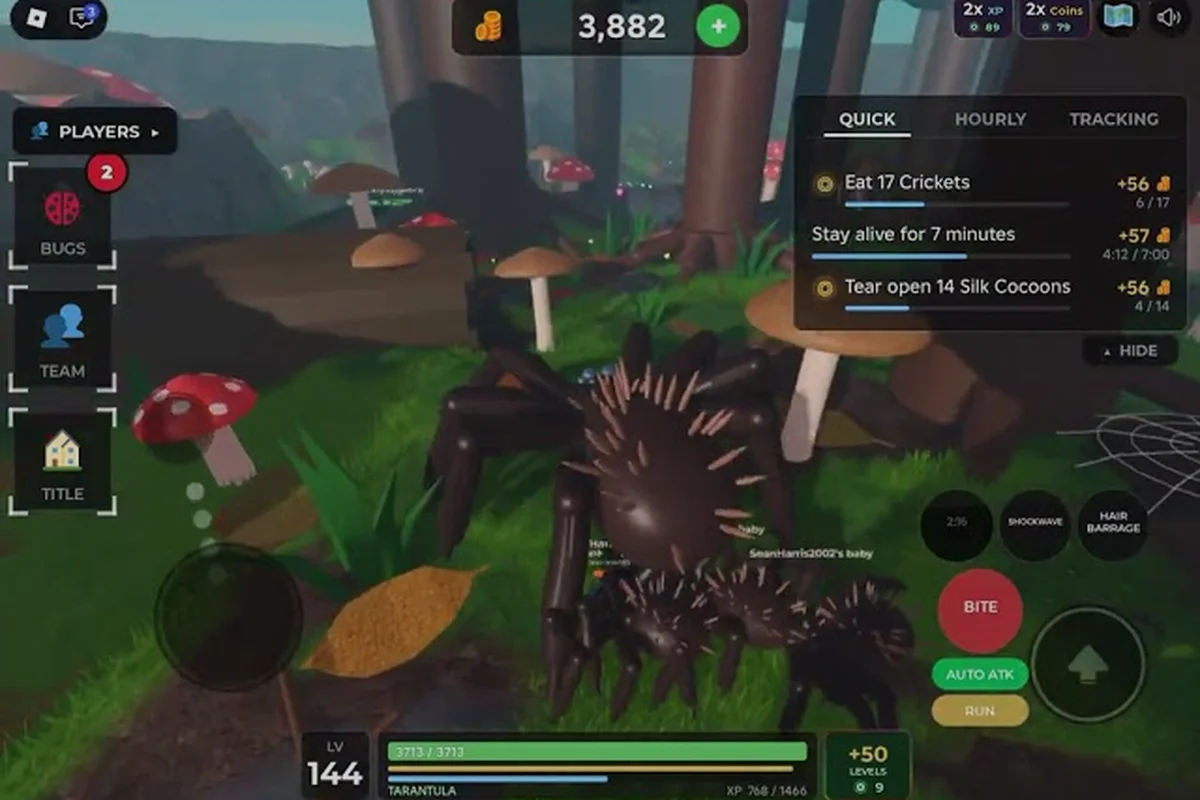
Bug Evolution is a new 2026 Roblox release from the | Corgi Crew | group, and its shared map makes every visible insect a potential rival. The game uses a 15-player server, so there is no separate PvP arena: players hunt one another while collecting food, growing through more than 30 insect forms, and competing for the King of the Server crown.
The most important fact about the bug evolution new enemy threat is that danger comes in two forms. Natural predators can interrupt a food route, while other players may deliberately pursue you for experience, coins, or status. A large insect that looks stationary is not automatically safe because it may be saving stamina, waiting for a target, or controlling the best nearby food.
Combat is based on Bite Damage and Bite Speed, which are visible on the stat panel. Health determines how many successful hits you can survive, while stamina governs how long you can chase or escape. No reliable stun, root, or launch effect has been verified in the current build, so positioning and timing matter more than effects.
| Threat level | Likely source | Main danger | Best response |
|---|---|---|---|
| Early | Nearby spiders or same-tier insects | Lost health during food gathering | Secure food, preserve stamina, disengage early |
| Mid | Larger insects or active hunters | Heavy bites and blocked escape routes | Circle obstacles, vary direction, use open terrain |
| High | Powerful players or predators | Fast collapse in a direct duel | Avoid isolated corridors and avoid trading bites |
| Event | Giant Mosquito or Desert Sand Worm | Boss-class pressure and area disruption | Prepare stats, coordinate, and preserve an exit |
The announced Giant Mosquito is listed for November 5, while the Desert Sand Worm is slated for November 9. These dates were announced for a new release in late October 2026, so event timing may still change through updates. Their importance is clear: normal player hunting is only one part of the broader combat ecosystem.
Distinguishing Players From Natural Predators
Players often arrive after a distant insect moves toward food, while predators may patrol a fixed territory. That difference is not absolute because players also camp resources, but it can influence your first decision. If a target follows you after you leave a food source, it may be a hunter. If it ignores nearby food and maintains a chase line, the behavior may reflect a predator’s aggression.
Do not begin attacking immediately after noticing danger. First compare the opponent’s size, movement speed, bite rate, and your available stamina. A slightly smaller insect with a fast bite speed can win a short exchange, while a larger insect with more health can absorb punishment. This is why there is no universal list of the bug evolution strongest player or insect form; strength depends on the matchup.
Server Pressure and King of the Server
The title of King of the Server depends on more than winning isolated duels. Strong play involves growing quickly, eliminating rivals when the advantage is clear, and defending that position against challengers. Team fights are especially effective because two insects can corner prey, protect one another while eating, and challenge a dominant solo player.
That makes bug evolution hunting players a strategic concern even when you are not actively hunting. A player who sees your upgrade path may block your next food source or force an early fight before you reach a stronger form. The Bug Evolution enemy difficulty overview explains how group pressure changes the risk of different insect sizes and encounters.
Reading Bite Speed, Health, and Stamina Before a Fight
Winning begins before the first bite. Every insect displays Bite Damage and Bite Speed, and these values determine whether a confrontation is favorable. Bite Damage measures the cost of each successful attack, while Bite Speed influences how quickly you can deliver it. Health is your total buffer, and Stamina is the resource that turns a retreat into a possibility.
A useful first comparison is not simply “am I bigger?” It is “how long can I remain active, and what happens when both insects land consecutive bites?” Fast attackers can pressure slower opponents before they finish a circle, but they may exhaust their Stamina and leave no margin for error. Tankier forms can absorb more damage but lose ground if they cannot reach food or create distance.
| Combat profile | Advantage | Main weakness | Preferred target |
|---|---|---|---|
| Fast biter | Repeated attacks and quick repositioning | Lower effective endurance | Slow or injured opponents |
| Heavy biter | High damage per hit | Recovery may expose it to counterattacks | Players stuck against terrain |
| Durable insect | More mistakes can be survived | Often slower to close distance | Weak hunters using stamina aggressively |
| Spider-type fighter | Useful reach and damage balance | Opponents may outpace its movement | Short trades near cover |
| Low-health challenger | Can win before stamina runs out | One mistake often ends the encounter | Higher-tier insects at a disadvantage |
This comparison shows why bug evolution how to win fights is not a single build recommendation. It is a sequence of decisions: identify the opponent’s profile, protect your health advantage, attack before stamina pressure becomes dangerous, and leave before a favorable trade turns into a loss.
Build a Practical Stat Check
Spend five seconds reading both stat panels before committing to a duel. Compare health, damage, and speed rather than relying on the insect’s appearance. Size offers clues, but an experienced player may have a stronger form, better damage upgrade, or more efficient stat allocation than the body size suggests.
The recommended early progression is to reach level 10 and the spider stage, then purchase Bite Damage level 1. Keep coins available for the next Bug Tree evolution, because evolving without enough coins delays power growth. A strong bite that leaves you unable to evolve is less valuable than a balanced setup that preserves both combat potential and progression speed.
Calculate the Hits You Need
Make a rough calculation by dividing the opponent’s health by your Bite Damage. This is not exact if damage bonuses or resistance mechanics change, but it provides a useful ceiling. If you need many hits while they need only one or two, avoid the fight. If you can win in two or three clean hits, you can enter the encounter with a controlled exit.
Use the same method for your own health. If a missed bite allows an immediate counterattack, your required-hit count may rise sharply. The safest exchanges are therefore short, deliberate attacks rather than constant forward pressure. This principle remains useful when reviewing broader Bug Evolution PvP tactics.
Bug Evolution Combat Tips for Open Ground and Cover
Open terrain is valuable because it gives you more paths to escape, while obstacles become dangerous when they trap your body between bites. A tree may block an enemy’s line of attack, but it can also prevent you from turning quickly. The best escape route is not always the nearest; it is the direction that keeps you able to change speed and keeps the opponent on one side of your body.
Stamina should be treated as a finite combat resource. Spend some early when breaking away rather than saving all of it for an emergency, because a late sprint may not remove a fast hunter if the gap never grows. Speed and Stamina are the main confirmed tools for disengagement because no dash mechanic has been verified.
Use a Three-Part Escape Plan
Before entering a risky area, choose a primary escape direction, a secondary route, and a fallback destination. The primary route should cross open ground. The secondary should use the Bug Tree, rocks, or another obstacle to break line of sight. The fallback should lead toward another player or a group so the hunter must reconsider whether the chase is worth it.
These bug evolution combat tips sound simple, but they prevent panicked movement. Players who run directly toward the map edge often lose Stamina with nowhere to turn. Players who circle a food cluster can use that same cluster as bait, drawing a hunter past the target they wanted.
| Situation | Preferred action | Avoid |
|---|---|---|
| Hunter is closing from behind | Use a broad arc and spend Stamina early | Running straight into a dead end |
| Opponent blocks open ground | Circle the nearest large obstacle | Trading bites in a narrow lane |
| Fight is near another player | Let the observer react and reposition | Committing where a group can gang up |
| Stamina is below one escape burst | End the fight and reach cover | Chasing a kill that can trap you |
| Opponent is low health | Attack only with a clear escape route | Chasing into their territory |
Turn Food Into Bait
Food creates natural decision points. When a stronger insect approaches a cluster, smaller players can sometimes avoid a direct collision by moving between nearby food sources rather than sprinting into the open. This does not guarantee safety because the hunter may still follow, but it changes the chase from a straight line into a contest over resources.
Community experience indicates that group encounters often outperform solo aggression in the current meta. Two allied insects can protect each other during feeding and pressure a larger target from two sides. Solo players should avoid challenging a group unless they have open space, a clear advantage, and enough Stamina to leave before the second opponent joins.
Surviving Bug Evolution Hunting Players Without Feeding Traps
The map is contested, so a successful escape is not always a defeat. A player who preserves health and reaches the next evolution can return later with a stronger form. Players focused only on kills may overlook insects that are eating efficiently and growing quietly, which makes careful positioning as valuable as raw damage.
Watch your surroundings before taking food. A quiet area may be safe, but a busy cluster may also indicate a powerful player has established control. If several insects repeatedly gather around the same location, treat that point as a controlled zone rather than a reliable food source.
Identify the Hunt Setup
A deliberate hunter often looks for one of three opportunities: a low-health player, a player separated from a group, or a player focused on food. The most effective counter is to remove one of those conditions before reaching the hunter’s preferred range. Stay near allies, keep enough Stamina for a departure, and avoid pausing beside a large food cluster when a stronger insect is nearby.
This approach helps against bug evolution player killing attempts because it changes where the encounter happens. A hunter expecting a stationary target may commit forward, while a moving player can redirect the fight toward open terrain. The key is not to challenge every threat but to recognize which ones are worth fighting.
Maintain Escape Stamina
Do not spend the entire Stamina bar on the first approach. An early partial burst can widen the distance, while the remaining reserve preserves a second option after a missed route. Watch the stamina meter rather than estimating from animation alone, since continuous attacking can also drain the resource.
If the hunter remains close after your first burst, change direction instead of continuing in a straight line. Sudden turns increase the chance that a fast opponent overshoots, especially near obstacles. If the hunter has more health and comparable speed, disengage entirely. Preserving your current form is often smarter than risking a run-ending exchange.
Defend Without Becoming Aggressive
A defensive player should keep moving between cover and open space while monitoring the opponent’s bite speed. The goal is not to hold one exact spot, because that gives the hunter a predictable angle. Instead, circle a resource area and force the hunter to approach from multiple directions. This also makes it easier to detect an allied player entering the encounter.
The Beginner’s Roblox progression guide is useful if upgrading from level 10 onward remains confusing. Keep your next evolution target in mind, but do not spend every coin on damage if the Bug Tree requires a larger coin reserve.
Winning Against the Bug Evolution Strongest Player Without a Bad Trade
There is no official ranking that identifies one insect as universally strongest. Community tier lists describe larger predators and late-evolution forms as powerful, yet combat still depends on health, Bite Damage, Bite Speed, positioning, and Stamina. The bug evolution strongest player in a server may be the largest insect, but that player may also be overconfident and vulnerable to a coordinated challenge.
Strong opponents reduce your available options, so the best plan often involves preparation rather than surprise. Conserve resources during their feeding routes, note which direction they favor when attacking, and compare your stats before accepting the first exchange. If the difference is small, teamwork can compensate; if it is large, waiting for an event distraction may be wiser.
Select One of Four Tactical Approaches
| Approach | Best situation | Main requirement | Typical result |
|---|---|---|---|
| Quick trade | You have slightly better damage and speed | Land two clean hits | Damage opponent before stamina pressure |
| Environmental trap | The opponent is near a narrow route | Predict their path | Forces an awkward approach |
| Group pressure | Two or more players can coordinate | Protect each other during bites | Opens a path to a larger target |
| Strategic withdrawal | Your form is still growing | Keep enough Stamina | Preserves health and reaches a stronger tier |
Choose one objective before the fight begins. Switching between harassment, damage racing, and escape leads to indecision. If the goal is a quick trade, leave after two successful hits. If the goal is a group pressure, stay close to your ally. If the objective is withdrawal, treat every missed bite as a signal to leave.
Know When a Kill Is Worth Taking
A kill is valuable only if the reward exceeds the risk. Chasing a wounded opponent through open terrain can work, but chasing one toward a group or their territory changes the equation. Make sure your health remains sufficient to survive one mistake, especially if your Stamina is already depleted.
Do not continue attacking because the opponent is nearly dead. A wounded insect can still land one strong bite, and that bite may defeat you. Finish only when the path is clear, or accept the damage reduction and turn toward the next evolution goal. The survival strategy guide offers a useful broader framework for deciding when ambition and preservation should take priority.
Prepare for Announced Enemy Events
The Giant Mosquito and Desert Sand Worm are event threats rather than ordinary insects. A boss fight may attract many players, creating more danger than the boss itself. Players who enter first may face multiple insects while also trying to learn the attack pattern. Waiting on the perimeter, checking movement, and preserving a retreat can be more effective than rushing into the center.
Because no current boss spawn is documented beyond these announcements, details about their health, damage, or attacks should be treated as unverified. Prepare through general principles: improve Bite Damage, maintain a balanced stat allocation, avoid overextending your Stamina, and coordinate with at least one other player. The dedicated announced boss preparation guide covers how to structure that preparation.
Frequently Asked Questions
What is the hardest new enemy in Bug Evolution?
The Giant Mosquito is an announced boss-class threat for November 5, while the Desert Sand Worm is announced for November 9. Their exact stats and attacks are not yet verified, so the safest preparation is balanced stats, preserved Stamina, and coordination with other players.
Can smaller insects defeat stronger players in Bug Evolution?
Yes. Better Bite Speed, a favorable Bite Damage exchange, terrain, or teamwork can overcome a larger opponent. For example, use large obstacles to interrupt pursuit, attack before Stamina becomes critical, and preserve an escape route even when your damage gives you an early advantage. Avoid extended trades against a bigger insect, because their larger health pool can outlast your Stamina and turn a temporary advantage into a defeat.
Who is the strongest player in Bug Evolution?
There is no official universal strongest-player ranking, so “strongest” must be judged encounter by encounter. A larger insect may have more health, but a smaller insect with better Bite Damage, faster Bite Speed, favorable terrain, or more remaining Stamina can win the exchange. For example, a fast player who lands early bites and preserves Stamina for escape may defeat a bulkier opponent that cannot sustain the chase.
How should I escape a player who keeps chasing me?
Run diagonally across open ground, use Stamina early, and change direction near large obstacles so the hunter cannot maintain a straight pursuit. If the gap fails to grow, stop fighting and seek a group rather than spending your final stamina on a hopeless chase.
Is Bug Evolution PvP a dedicated arena?
No. Player-versus-player action occurs throughout the shared 15-player server, and the map has no verified separate PvP arena. Food routes, evolution paths, resources, and safe-looking corners can all become contested combat locations. For example, a bug collecting food near a common route may need to prioritize early Bite Speed and Bite Damage over an extended fight, while a larger insect can use terrain and Stamina management to control nearby resources and prevent rivals from evolving.
The essential lesson about a bug evolution new enemy is that survival depends on reading the encounter before committing to it. Compare health, damage, bite speed, and Stamina; use open terrain and obstacles; preserve escape stamina; and cooperate when a powerful opponent is involved. The strongest result comes from winning fights on your terms or leaving them with enough resources to evolve again.