Bug evolution enemy difficulty rises as you grow, so survival depends on reading threats before they commit. In insect battles, spawn pressure and enemy positioning can turn a manageable group fight into a costly loss if you engage every bug at once. Prioritize isolating high-threat targets, use defensible ground when your health is low, and fall back toward your base to defend rather than forcing a risky counterattack. Choosing which opponents to challenge—and knowing when to regroup—can convert chaotic encounters into safer wins.
How Bug Evolution Enemy Difficulty Scales
Bug Evolution uses size, aggression, and the gap between your insect and another player’s form to shape danger. Early enemies are mostly spiders and insects around your current tier, while larger predators become serious threats as your health, bite damage, and reach improve. This progression makes tier comparison more useful than a fixed list of enemy names.
The server holds 15 players, and PvP occurs throughout the shared map rather than in a separate arena. A large insect can therefore become a threat while you are focused on food. One mistake may let a predator interrupt your growth, drain Stamina, and expose you to another opponent. Understanding the danger level of each encounter is essential for bug evolution combat.
| Threat level | Typical opponent | Main danger | Recommended response |
|---|---|---|---|
| Low | Insects near your current tier | Limited damage, but they can interrupt growth | Fight when the area is clear |
| Medium | Larger insects with stronger Health | Longer exchanges and higher Stamina cost | Use hit-and-run movement |
| High | Predators and stronger players | Quick defeat or a second attacker joining | Avoid unless prepared |
| Extreme | Announced boss-class threats | Extreme damage and limited escape opportunities | Gear up and coordinate first |
The first objective should be survival rather than an immediate kill. Food is scattered across a grassy open map, and growth creates a natural power curve. When you can eat safely, you gain stats and a stronger form. When you fight while low on Stamina or surrounded, that advantage disappears.
The five stats that change each encounter
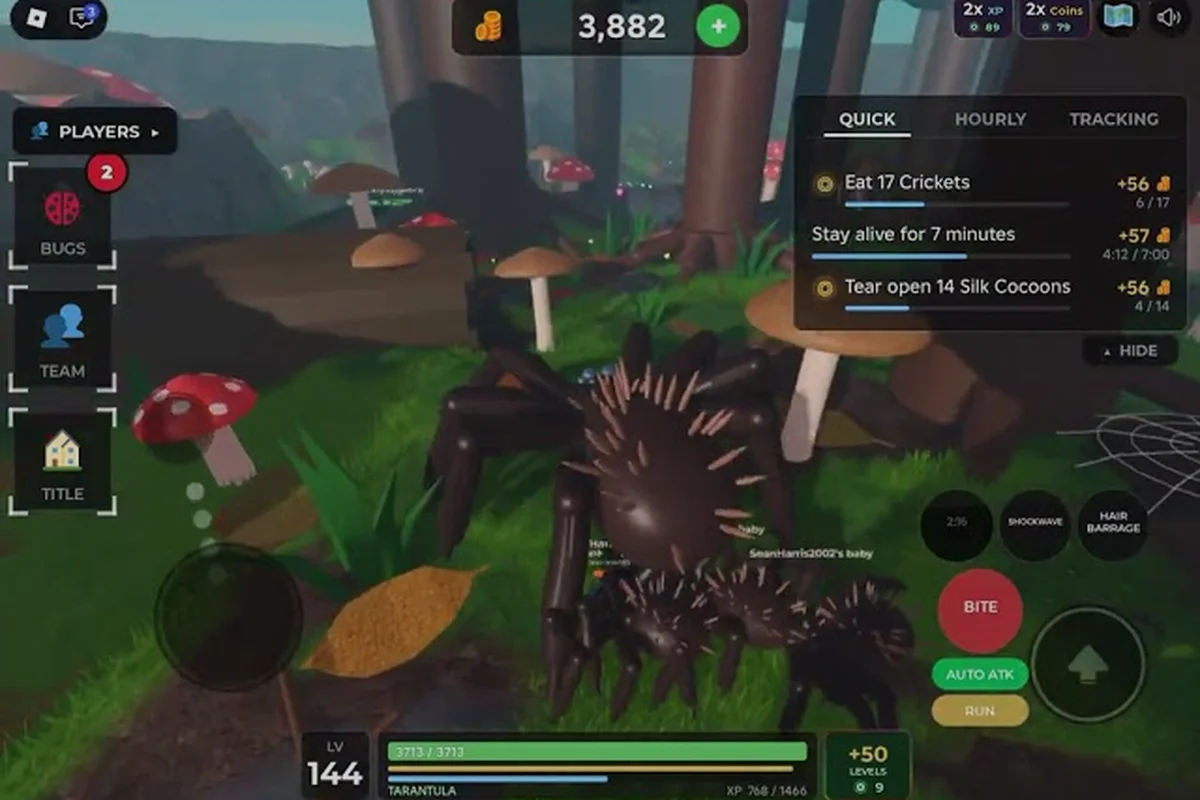
The HUD shows Speed, Health, Bite Damage, Bite Speed, and Stamina. Health determines how many bites you can survive, while Bite Damage determines how quickly you can remove an opponent’s health. Bite Speed controls the pace of the attack, and Speed affects your ability to enter, exit, and change the distance between you and danger.
Stamina is the hidden tension behind most failed runs. It lets you move and pursue targets, but spending it carelessly leaves you unable to escape a larger predator. A strong insect with poor positioning can still lose to a weaker one that keeps circling and attacking only when the opening appears.
When comparing enemy difficulty, check how Health, Bite Damage, and Bite Speed combine rather than judging a rival by one value alone: high Health with slow attacks can still be dangerous if it survives long enough to exhaust your Stamina. For the stat combinations that support steady growth and defense, see Bug Evolution insect stamina details, where the relationship between sustained movement and defensive durability can be assessed for solo encounters, group fights, and insect battles.
Threat Tiers for Bug Evolution Insect Battles
A threat tier describes the situation, not simply the insect’s size. Two opponents with similar Health can become very different problems depending on where they appear and whether teammates are nearby. The core variables are relative size, enemy aggression, available escape space, and the number of opponents.
Tier 1: Equal-size insect battles
These encounters are the baseline for bug evolution insect battles. Your insect has enough Health and damage to trade bites without instantly losing, provided the fight begins at a reasonable distance. The best results come from attacking, retreating, and repeating rather than standing in place while two insects exchange hits.
This is also the safest tier for practicing bite spacing. Notice how long your insect remains in range, how quickly the target can turn toward you, and when Stamina falls below a comfortable reserve. Because no dash or confirmed stun mechanic is documented, movement itself is the main tool for creating safe attack windows.
| Situation | Risk | What to check before engaging |
|---|---|---|
| One equal-size opponent | Low to medium | Nearby food, obstacles, and other players |
| Two equal-size opponents | Medium to high | Whether they are cooperating or focused on you |
| One equal-size predator | Medium | Its bite speed and your remaining Health |
| Equal-size opponent at low Health | Medium | Your ability to finish without overextending |
An equal-size fight is attractive because the winner often gains room to feed. However, community experience suggests that interrupting or eliminating a nearby rival can be more valuable than winning a long exchange. A quick knockout preserves your Stamina and prevents other players from closing in.
Tier 2: Larger insects and territorial pressure
A larger insect usually has more Health and may deal greater damage, but size does not guarantee an easy victory. A smaller form can win by using reach, speed, and repeated attacks if it avoids becoming trapped. The danger increases when the larger enemy controls a food-rich area and forces you to approach on its terms.
Before entering a larger insect’s area, identify your exit route. Open ground is valuable because it allows you to create distance without striking walls or other players. If the food sits beyond a predator’s patrol path, wait for it to move. Spending ten seconds observing is usually safer than beginning a fight with low Stamina.
The survival-focused combat strategy expands on movement economy, escape routes, and the value of choosing fights where your build has an advantage. Against a territorial insect, favor a larger Health pool, stronger damage, or a defensive passive over raw speed, because one hit can end the encounter before Stamina recovery becomes relevant. For example, if your build specializes in ranged attacks or rapid repositioning, attacking from the edge of its patrol range preserves health while forcing the insect to travel farther between engagements. In a group fight, avoid being caught between a large insect and another player: secure an escape corridor, use the area boundary to limit pursuit, and disengage when movement Stamina drops too low. This prevents a manageable insect battle from becoming a group PvP loss.
Tier 3: Predators and stronger-player ambushes
Predators appear as larger insects that can chase and end careless runs. Stronger players add another layer because they may deliberately hunt you, especially when your size makes you a worthwhile target. This tier combines combat risk with map risk, so a successful escape can be more valuable than a risky victory.
Never assume food is safe merely because nobody is attacking at first. A stronger insect may wait near a valuable cluster until you commit. Keep a mental check of nearby players and change direction when the same enemy tracks you for too long. That repeated alignment often indicates that you are being followed rather than simply sharing the same route.
| Predator indicator | Likely meaning | Best response |
|---|---|---|
| The enemy follows your turns | Active pursuit | Break line of sight and conserve Stamina |
| Food has nearby larger insects | Contested feeding zone | Circle the area and choose another source |
| Several players gather in one region | Group pressure | Leave rather than starting a multi-opponent fight |
| Opponent heals or eats between attacks | Recovery pattern | Delay the next bite and pressure the recovery |
Tier 4: Boss-class and announced threats
Boss encounters create a different kind of enemy difficulty because the preparation requirements are much higher. The Giant Mosquito and Desert Sand Worm were announced as special threats for November 5 and November 9, respectively, according to the available game information. Their exact movesets were not publicly documented in the supplied data, so precise attack patterns would be guesswork.
The safe strategy is to preserve resources, compare the group’s damage potential, and avoid a full commit until the fight is understood. A boss may still demand a different rule than ordinary bug evolution pvp because multiple players can draw attention from different directions. Communication through positioning is therefore more valuable than standing in a tight cluster.
Defending Against Bug Evolution Group Fights
Bug evolution group fights often defeat solo attackers because one player controls space while another strikes from behind. A crowded encounter can also make escape routes appear closed, even though each insect is acting independently. The defender must identify the immediate threat instead of trying to defeat everyone at once.
Establish a defensive order
Your first priority is to reduce the number of opponents who can reach you. Move toward open ground, avoid backing into another insect, and keep the strongest nearby threat on one side of your view. If two opponents approach from different angles, turn so that you are not forced to backpedal into both.
| Defensive phase | Primary objective | Avoid |
|---|---|---|
| Detection | Find the first attacker | Farming without checking the area |
| Separation | Keep one opponent engaged | Fighting inside a tight group |
| Rotation | Protect Stamina and Health | Spending every point of movement |
| Escape | Break the group apart | Continuing until surrounded |
| Reset | Eat safely and recover | Returning immediately to the same cluster |
The 15-player shared server means reinforcements can arrive quickly even if they are not part of the original attack. If a retreat becomes necessary, do not travel through the crowd. Travel around it, using the map’s open spaces to break pursuit. A fast escape preserves your chance to return after recovering.
Guard a teammate without overextending
Supporting an ally can turn bug evolution group fights into manageable encounters. Stand beside the teammate while they eat, intercept the first insect that closes in, and avoid chasing anyone beyond the defended area. The goal is not to collect every combat point; it is to prevent the group from stabilizing and becoming stronger.
When supporting a teammate, compare your roles: a durable insect can absorb pressure while an ally eats, a fast insect can intercept threats and scout the perimeter, and a strong biter can pressure enemies without pulling the group out of the defended area. Choose the role that preserves the most Stamina and prevents the enemy from stabilizing; for example, let a durable insect hold the front while a fast insect disrupts an attacker before it reaches your teammate.
-
A durable insect can absorb pressure and protect a teammate that is feeding.
-
A fast insect can scout threats and interrupt an attacker before it settles into position.
-
A strong biter can provide pressure, although stopping after each burst preserves more Stamina.
These roles are community-defined because the game does not publish an official strongest-insect ranking. For additional role-based combat ideas, the Bug Evolution combat tactics guide explains how to build around damage, reach, and positioning.
Defensive Tactics for Bug Evolution PvP
Bug evolution pvp starts with a simple rule: do not spend every resource to land one extra bite. A fight should end only if you can still move afterward. The defensive half of combat includes choosing targets, preserving Health, and creating uncertainty about your next action.
Measure the health gap before committing
A smaller insect can have a path to victory when the opponent has low Health and poor stamina management. The same insect can be defenseless against a full-health predator. Watch the target’s movement before attacking, because exhausted players often need several bites before they can respond.
Do not chase an opponent through unfamiliar territory simply to complete the fight. If they are moving toward a group, their allies can turn a losing duel into a dangerous encounter. This is where fight selection becomes as important as attack timing.
Preserve a stamina reserve
Set a personal reserve rather than moving until the Stamina bar empties. The exact number cannot be calculated because your current insect and build determine how quickly it drains. However, retaining enough movement to cross open ground and turn away from danger is more useful than landing one extra bite.
A practical sequence is to test whether the opponent’s turn speed gives you a safe opening before committing to close range. A fast, aggressive insect may interrupt the first approach, so use one short movement burst, attack only when their facing or turn animation is committed elsewhere, then leave before the counterattack. If every approach is met with an immediate turn, changing angle is safer than forcing a third exchange; repeated misses can drain Stamina faster than the damage gained.
-
Approach from open ground and watch the opponent’s turn speed.
-
Use a short burst of movement to reach bite range.
-
Attack when the target is committed to another direction.
-
Move away before their counterattack lands.
-
Re-enter only if your Health and Stamina remain favorable.
If the opponent turns toward you during every approach, do not repeat the same pattern. Circle to a different angle, wait for a distraction, or abandon the encounter. For more escape tactics, including how movement can protect a larger insect from weaker attackers, see how Bug Evolution survival strategies handle bigger fights.
Choosing Safer Bug Evolution Encounters
The safest fight is not always the weakest opponent. It is the encounter with the best ratio of reward to risk after accounting for health, distance, allies, and escape space. A slightly stronger insect defeated without injury may be safer than a weak one that leads you into a crowded zone.
Build a personal threat checklist
Before every engagement, quickly evaluate five points that determine whether a bug evolution fight is worth entering: compare the opponent’s relative size and health, scan the area for allied or hostile insects, check your remaining stamina, locate food without crossing the target’s path, and identify an escape route. For example, a slightly smaller opponent may still be dangerous if several insects are moving together, while a larger insect can be manageable when it is isolated, low on health, or trapped behind defenders. Treat group concentration, poor positioning, and depleted stamina as compounding threat signals; one warning may be survivable, but multiple signs can turn a simple food contest into a difficult bug evolution insect battle.
| Check | Safe reading | Warning sign |
|---|---|---|
| Relative size | Similar size or clear health advantage | Target is substantially larger |
| Nearby players | Area is empty or allies are nearby | Several insects are moving together |
| Stamina | Enough remains for entry and retreat | Bar is already low |
| Food location | Food is reachable without crossing the target | Food is trapped behind opponents |
| Escape route | Open space lies behind you | Enemies control every exit |
This checklist turns bug evolution enemy difficulty into a practical decision rather than a vague feeling. If two of the warning signs appear, disengage unless your insect has a clear burst-damage advantage or the group is already committed to a different target.
Time fights around the growth cycle
The best growth window often comes before you reach the map’s largest predators. Smaller forms can move more freely and may have more Stamina relative to their size. Rather than immediately seeking the strongest opponent, secure several safe meals and preserve a healthy ecosystem of retreat space.
Community data also suggests that teams can challenge stronger solo players more effectively. A pair can guard one another while eating, control a narrow route, and pressure a target from two directions. If your goal is the King of the Server title, coordinated growth may be more reliable than trying to overpower every rival alone.
For more on identifying and countering player hunters, use the new-enemy and hunting guide to distinguish ordinary competitors from opponents deliberately tracking your route. Watch for a rival repeatedly matching your turns, cutting across choke points, or arriving just after each food pickup: these are signs of an active hunter rather than normal PvP pressure. Changing your feeding route, breaking line of sight, and using narrow corridors with a teammate can reduce the chance that a stronger insect pins you during the growth cycle.
Practical Tier-by-Tier Survival Plan
A clear response plan prevents panic when an opponent appears. Use the following framework as a decision tree rather than a rigid rule. Insect stats, server activity, and player behavior can change as the session develops, so the same area may be safer at one moment and dangerous a minute later.
Pre-Fight Preparation Checks
-
Eat without tunnel vision: Pause after each meal and scan the surrounding open ground.
-
Save some mobility: Keep enough Stamina to create distance from a stronger insect.
-
Identify the food value: Do not take a high-risk route for a small gain.
-
Watch group behavior: Nearby players who coordinate are more dangerous than a single visible insect.
Range Control and Attack Timing
-
Control the range: Use a circle rather than a straight-line chase.
-
Attack after commitment: Enter when the target is turning or moving past you.
-
Protect your teammate: Stand near an ally who is feeding instead of wandering into a chase.
-
Avoid excessive damage: Do not trade bites with three opponents simultaneously.
Post-Fight Recovery and Rerouting
-
Recover before roaming: Eat when the immediate area is clear.
-
Check your Stamina: Low mobility can turn a safe path into a dangerous one.
-
Readjust the route: Move away from the area where the previous opponent came from.
-
Preserve growth momentum: A short reset is better than ending the run in a preventable corner.
Frequently Asked Questions
What is the hardest enemy difficulty in Bug Evolution?
The hardest confirmed threats are the Giant Mosquito and Desert Sand Worm, announced for November 5 and November 9, 2026. Their exact attacks were not publicly documented, so the safest preparation is to preserve Health, avoid unnecessary group pressure, and learn the encounter before committing. Ordinary predators and stronger-player ambushes remain more common day-to-day threats.
Can smaller insects win against larger opponents?
Yes, when movement, reach, and attack timing compensate for lower Health. A smaller insect should attack in short bursts, leave bite range before the opponent turns, and preserve Stamina for escape. Staying still or chasing across the map usually removes those advantages and makes the larger opponent much harder to defeat safely.
How do you survive group attacks as a solo player?
Avoid starting a fight where two opponents can reach you, then move toward open ground before engaging. The goal is to separate attackers rather than defeat them all. If one enemy remains committed while another circles, retreat beyond the group and use the extra distance to reduce the pressure before considering another attack.
Is defending a teammate better than chasing a knockout?
It often is, especially when your teammate is eating and nearby enemies are gathering. Defending can prevent the opposing group from gaining control, while a long chase may waste Stamina and draw more players into the area. The better choice depends on whether your target is isolated and whether you can complete the pursuit without abandoning the defended position.
Does Bug Evolution have dash or stun abilities?
No dash or confirmed stun mechanic is documented in the available build. Speed and Stamina are therefore the primary tools for repositioning, breaking pursuit, and creating safer bite windows. This makes movement management essential in bug evolution insect battles, especially against predators or players who coordinate their attacks.